Today, 25 November, the Church remembers Saint Catherine of Alexandria, virgin and martyr, with an optional memorial. For centuries she was one of the best-loved saints of Christendom: patroness of philosophers and students, one of the “voices” of Saint Joan of Arc, honoured in East and West alike. In 1969 she left the universal calendar, because almost nothing of her story can be proved; in 2002 she returned to it. Both facts say something true about her.
What tradition tells
According to the Passion of Saint Catherine, she was of noble birth, at Alexandria in Egypt, and deeply learned in the sciences. At eighteen she presented herself before the emperor who was persecuting the Christians — the versions name Maximinus or Maxentius —, rebuked his cruelty and tried to show him the falsehood of the idols. Unable to answer her, the emperor summoned fifty learned men to make her renounce her faith; she won the debate, and several of them were converted and put to death.
Imprisoned and scourged, Catherine converted the empress as well, and Porphyry, the captain of the guard, who also died as martyrs. Condemned to die on a wheel set with iron spikes, the wheel shattered when she touched it. She was then beheaded, and angels carried her body to Mount Sinai. So the story ends, and the Middle Ages read it, preached it, sang it and painted it without tiring.
What history can — and cannot — say
Here honesty is part of devotion. No text about Catherine is known from before the ninth century; the oldest account to have come down to us is in a Byzantine menologion compiled around the year 976 for the Emperor Basil II. As early as 1908 the Catholic Encyclopedia acknowledged that the texts of the legend have reached us “transformed and distorted”: without denying the saint’s existence, it concluded that most of the details and the long speeches put into her mouth must be rejected as inventions. The early pilgrims who visited Sinai, it noted, say nothing of a body carried there by angels.
There may be a historical kernel. Around 320 the historian Eusebius of Caesarea relates that the Emperor Maximinus wanted to make a young Christian woman of Alexandria his mistress and, when she refused, sent her into exile and seized her property; Eusebius does not give her name. Some scholars think the memory of Catherine preserves the remembrance of such women persecuted for their faith; others doubt that she existed as a historical person.
That is why, in the reform of the calendar of 1969 under Paul VI, her feast was removed from the General Roman Calendar, like those of other ancient saints of whom almost nothing is known; the Roman Martyrology went on remembering her on 25 November. In 2002, in the third edition of the Roman Missal, published under Saint John Paul II, she returned as an optional memorial. The Church does not ask us to believe the details of the Passion; she goes on praying with the martyr who, as tradition says, overcame “the learned by her learning, and the iron by her patience”.
At the foot of Mount Sinai, in Egypt, the Emperor Justinian had a fortified monastery built between 548 and 565 around the chapel of the Burning Bush. According to tradition, around the year 800 the monks found Catherine’s body there; in time the monastery came to bear her name, and her relics are kept there to this day. It is one of the longest continuously inhabited Christian monasteries, and since 2002 it has been a UNESCO World Heritage Site.
Saint John Paul II went there on 26 February 2000, as a pilgrim of the Jubilee, and recalled that there “the body of the martyr Catherine found a final resting-place”.
Patroness of those who think
Because she had overcome the philosophers, Catherine was invoked by theologians, philosophers, preachers and students before they studied, wrote or preached. She was one of the most popular saints of the Middle Ages, counted among the Fourteen Holy Helpers. In 1431, at the trial that condemned her, Joan of Arc declared that the voices guiding her were those of Saint Catherine and Saint Margaret; her sword had been found in the church of Sainte-Catherine-de-Fierbois, and Joan told her judges that she loved it for that reason. In Brazil, the name of the island of Santa Catarina, which gave its name to the state, is attributed to Sebastian Cabot in 1526 — though its origin is debated: the saint, or the navigator’s wife, Catalina Medrano.
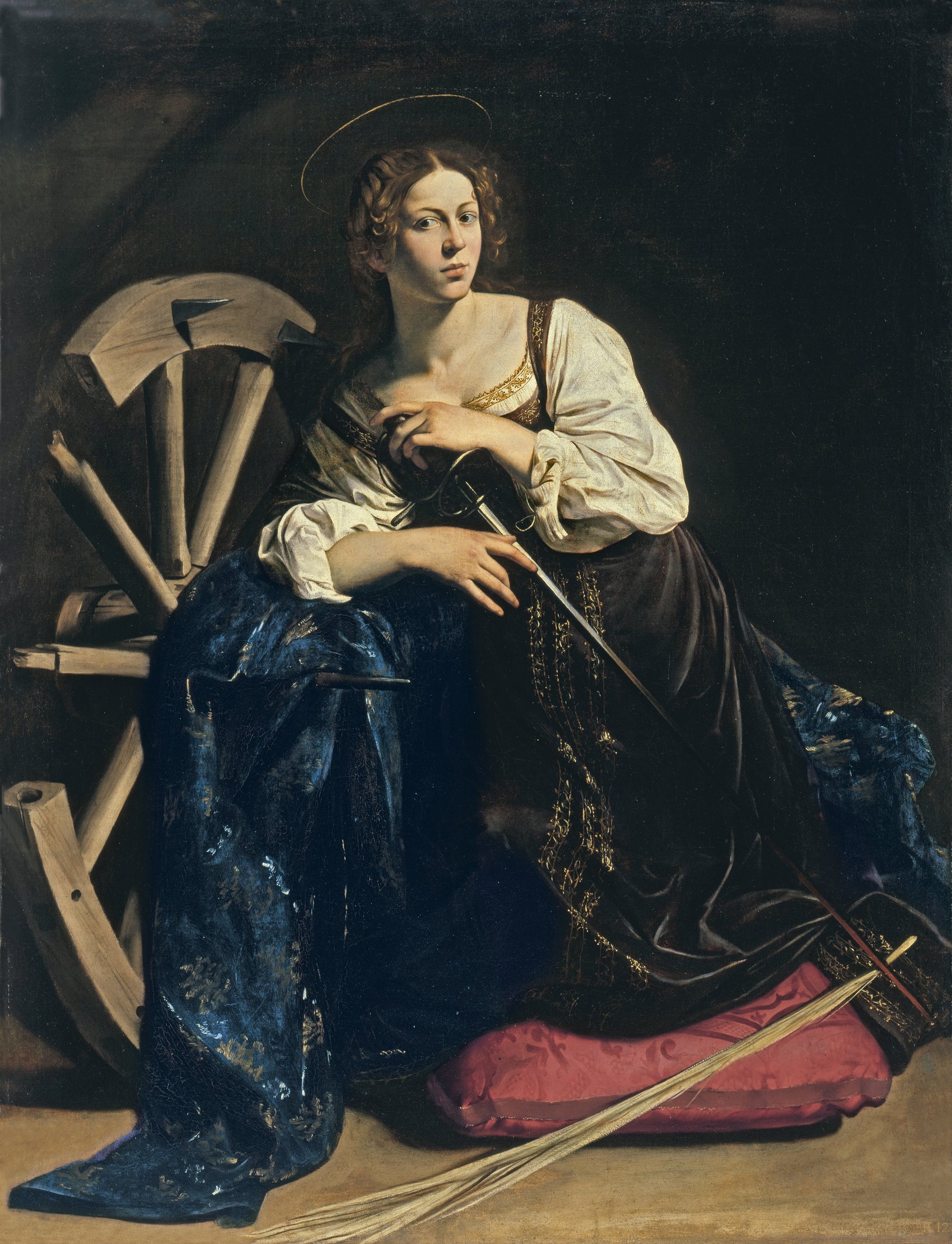
The painting on this page is by Caravaggio, made in Rome around 1598 for his first great patron, Cardinal Francesco Maria del Monte. Dressed as a princess, kneeling on a cushion, Catherine looks out at the viewer, surrounded by the signs of her martyrdom:
- The wheel. Broken and spiked: the torment that, tradition says, fell apart at her touch.
- The sword. The instrument of her beheading.
- The palm. The sign of the martyrs, who conquered by dying.
- The robes of a princess. The nobility the legend gives her, which she is said to have exchanged for the faith.
“I pray that in the new millennium the Monastery of Saint Catherine will be a radiant beacon calling the Churches to know one another better and to rediscover the importance in the eyes of God of the things that unite us in Christ.”— Saint John Paul II, homily at Saint Catherine’s Monastery, Sinai, 26 February 2000
“I have told you many times that they are Saint Catherine and Saint Margaret; believe me if you will.”— Saint Joan of Arc to her judges, trial of condemnation, Rouen, 1431
“…when blessed Catherine overcame the learned by her learning, and the iron by her patience.”— sequence Vox sonora nostri chori, attributed to Adam of Saint Victor (twelfth century)
The prayers
The Collect of 2002 asks, through Catherine’s intercession, for steadfastness in faith and commitment to the unity of the Church — the same request John Paul II made at Sinai, in an Orthodox monastery that keeps her relics. Then some verses of a medieval sequence sung on Saint Catherine’s feast, attributed to the poet Adam of Saint Victor; the legend it sings is that of tradition.
Omnipotens sempiterne Deus, qui populo tuo beatam Catharinam virginem et invictam martyrem praestitisti, concede, ut, eius intercessione, fide et constantia roboremur, et pro Ecclesiae unitate operam tribuamus impense. Per Dominum.
Almighty ever-living God, who gave to your people blessed Catherine, virgin and unconquered martyr, grant that through her intercession we may be strengthened in faith and constancy, and may spend ourselves generously for the unity of the Church. Through our Lord.
Amen.
Vox sonora nostri chori
nostro sonet Conditori,
qui disponit omnia;
per quem dimicat imbellis,
per quem datur et puellis
de viris victoria.
Per quem plebs Alexandrina
feminae non feminina
stupuit ingenia,
cum beata Catharina
doctos vinceret doctrina,
ferrum patientia.
…
Oleum ex ipsa manat,
quod infirmos multos sanat
evidenti gratia.
Bonum nobis dat unguentum,
si per suum interventum
nostra sanat vitia.
Gaudens ipsa videat
de se praesens gaudia,
et futura praebeat,
quae dedit praesentia;
et hic nobis gaudeat,
illi nos in gloria. Amen.
Let the ringing voice of our choir
sound forth to our Creator,
who orders all things;
through whom the unwarlike fight,
through whom even to maidens
is given victory over men.
Through whom the people of Alexandria
stood amazed at a woman’s mind,
in nothing weak,
when blessed Catherine
overcame the learned by her learning,
and the iron by her patience.
…
From her an oil flows forth
that heals many who are sick
by evident grace.
A good ointment she gives us
if, through her intercession,
it heals our vices.
May she, rejoicing, see
the joy we have in her here,
and grant us the joys to come
as she has granted those of now;
may she be our joy here,
and we hers in glory. Amen.
— stanzas 1–2 and 11–13; Latin text of L. Gautier’s edition
Sancta Catharina, ora pro nobis. Saint Catherine of Alexandria, pray for us — and for all who seek the truth.
- Saint Catherine Labouré — another Catherine, of the Miraculous Medal, on the 28th.
- All Saints — the great multitude of the martyrs; and the Litany of the Saints.
- Saint Albert the Great — another patron of those who study, on the 15th.
- Words of the saints — a growing collection, in English and Portuguese.

Comments