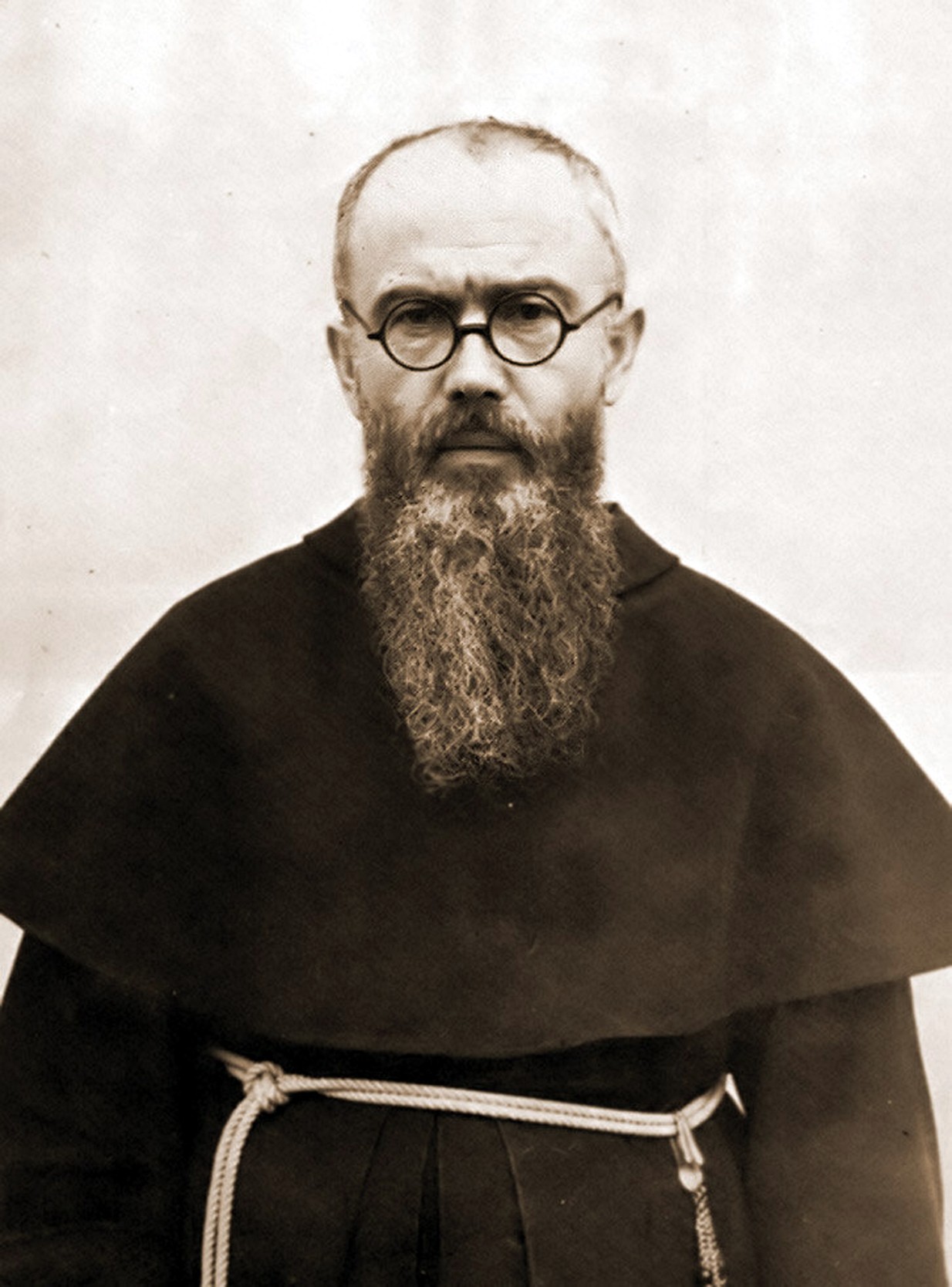
At the end of July 1941 a prisoner escaped from block 14 at Auschwitz. The reprisal was known: ten men from the same block would be starved to death. The sergeant went down the line pointing. When he pointed at Franciszek Gajowniczek, the man cried out about his wife and his children. It was then that prisoner 16670 stepped out of the line and asked to go in his place.
It took about ten seconds. And that is all the world remembers of a man who had spent his life doing everything on an industrial scale.
The two crowns
Rajmund Kolbe was born in Poland in 1894, the son of poor weavers. He was, by his mother’s account, an impossibly mischievous boy, and one day she asked him in exasperation what was going to become of him.
He went to pray. He said afterwards that Our Lady appeared to him holding two crowns: a white one, which was purity, and a red one, which was martyrdom. She asked which he wanted. The boy answered that he wanted both.
Hold on to that, because it explains the strange absence of drama in the rest of the story. At twelve he had already settled how it would end.
A militia founded in 1917
He entered the Conventual Franciscans, was sent to study in Rome, and did two improbable things there for a friar in his early twenties: he took a doctorate in philosophy and then one in theology, and he had an idea about organisation.
On 16 October 1917 — the year of Fatima and the Russian revolution, and a few months after watching freemasons parade in front of Saint Peter’s with banners against the pope — he founded, with six companions, the Militia Immaculatae. It was not one more devotional confraternity. It was a structure, with the declared aim of reaching the entire world and converting even the Church’s enemies, and with a single instrument: total consecration to Our Lady.
What followed was him taking that idea seriously to its last industrial consequence.
The friar who became a publisher
Back in Poland, tubercular, with one lung all but useless, Kolbe began printing a magazine called The Knight of the Immaculata. He started with five thousand copies and no money.
In 1927 he founded Niepokalanów — “the city of the Immaculate” — on donated land near Warsaw. Thirteen years later, this is what it was:
- The largest friary in the world. Around eight hundred friars lived there. No Catholic religious house anywhere held so many.
- A publishing operation of industrial size. The Knight reached something close to a million copies a month, on rotary presses run by friars.
- A daily newspaper, the Mały Dziennik, at over a hundred thousand copies a day — one of the largest in Poland.
- Its own radio station, SP3RN, licensed in 1938 and operated from inside the friary.
- And bigger plans: a film studio and an airfield, to get the magazine out faster. He began taking flying lessons.
It needs saying plainly, because hagiography tends to hide it: Kolbe was a media entrepreneur. A friar in sandals with half a lung, running the largest Catholic publishing operation on the planet and planning to buy aeroplanes.
Nagasaki, on the wrong side of the hill
In 1930 he sailed for Japan with no Japanese, no money, and no permission from a local bishop he had not yet met. A month after landing he was printing the Knight in Japanese.
He founded a friary at Nagasaki — the Mugenzai no Sono, the Garden of the Immaculate. And in choosing the site he did something everyone thought absurd: he built on the slope of the hill that turns its back on the city. He was told the view was worse, the access harder and the land less valuable. He built there anyway.
On 9 August 1945 the atomic bomb fell on Nagasaki. The hill absorbed the blast and the friary was left standing, all but undamaged, and served as an improvised hospital. It is still there.
Kolbe had been dead four years and never knew. When asked why he had chosen that side, he only said that it seemed better.
1939
Poland was invaded in September. Niepokalanów was occupied, the presses stopped, and Kolbe arrested for the first time — released three months later, on the feast of the Immaculate Conception.
He went back and turned the empty friary into something else. Niepokalanów became a hospital and a refugee shelter, and took in around two thousand Jewish people, fed and hidden there on what was left. He went on publishing what he could, without a licence, including material the German occupation would not have approved.
He was arrested again in February 1941 and reached Auschwitz on 28 May. He became number 16670.
The starvation bunker
After the step forward, the ten men were taken to the basement of block 11 and locked in without food or water.
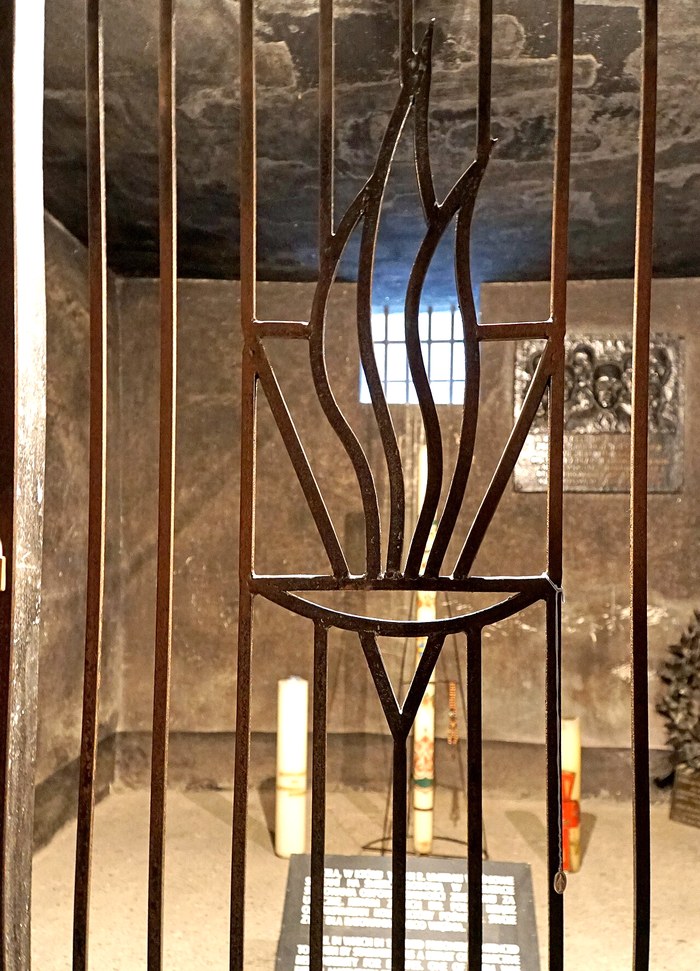
What happened inside is known because one of the Polish orderlies, Bruno Borgowiec, whose job was to remove the bodies, survived and testified. He said that basement had always been a place of screaming and blasphemy — and that this time it was not. This time they sang. Kolbe led the prayers and the hymns to Our Lady, and the guards ordered silence without effect. Borgowiec said the cell sounded like a church.
Two weeks later four were still alive, and the cell was needed. On 14 August 1941, the vigil of the Assumption, an executioner came in with a syringe of carbolic acid. Kolbe, who could no longer stand, held out his own arm.
The body was cremated the next day — 15 August, the feast of the Assumption of Our Lady. He was forty-seven.
The man who stayed alive
Franciszek Gajowniczek survived Auschwitz. He survived the war. He found his wife again — but the two sons he had cried out for in that line were killed in a Soviet bombardment in 1945.
He lived another fifty-three years. And he spent a great deal of them doing one thing: travelling to tell people what had happened. He spoke in schools, parishes and halls across half the world, always the same story, always about the man who stepped out of the line for him.
On 10 October 1982, in Saint Peter’s Square, he was present at the canonisation. He died in 1995, aged ninety-three. No other saint has had, at his own canonisation, the witness for whom the thing was done.
A martyr of what, exactly
There is an argument here worth knowing, because it is not a technicality.
A martyr, in the Church’s strict vocabulary, is someone killed in hatred of the faith. Kolbe was killed for taking another man’s place in a reprisal — which is why Paul VI beatified him in 1971 as a confessor, not as a martyr. That was the technically correct reading.
In 1982 Saint John Paul II — a Pole, who had lived the occupation — decided otherwise and canonised him a martyr, coining for the purpose a phrase that stuck: martyr of charity. The argument is that a system built to reduce a man to a number was, in that instant, contradicted by a man offering himself in another’s place — and that to hate this is to hate precisely what the faith asserts about the worth of a person.
“Hatred is not a creative force; only love is.”
Saint Maximilian Mary KolbeAnd here the story closes on itself. The man of the million copies, the rotary presses, the radio station and the planned airfield — the man who wanted to reach the whole world and had the means to try — ended up preaching the most effective thing he ever preached without printing a line, in front of a few dozen exhausted prisoners, on a roll-call yard, in about ten seconds.
All that scale was practice. The sermon was the step forward.
“Hatred is not a creative force; only love is.”— Saint Maximilian Mary Kolbe
“Let yourselves be led by the Immaculata. She will take care of everything, even what seems impossible to you.”— Saint Maximilian Mary Kolbe
“No one will ever love the Virgin Mary in the fullness with which Jesus loved her.”— Saint Maximilian Mary Kolbe
Sancte Maximiliane Maria, ora pro nobis. Saint Maximilian Mary, pray for us — and win us the grace to recognise, when it comes, the moment to step forward.
- The Assumption of Our Lady — the feast on whose vigil he died, and on whose day he was cremated.
- Saint Lawrence — another martyr who answered power with a sentence.
- Consecration to Our Lady — the total self-gift he put at the centre of the Militia.
- Words of the saints — a growing collection, in English and Portuguese.

Comments