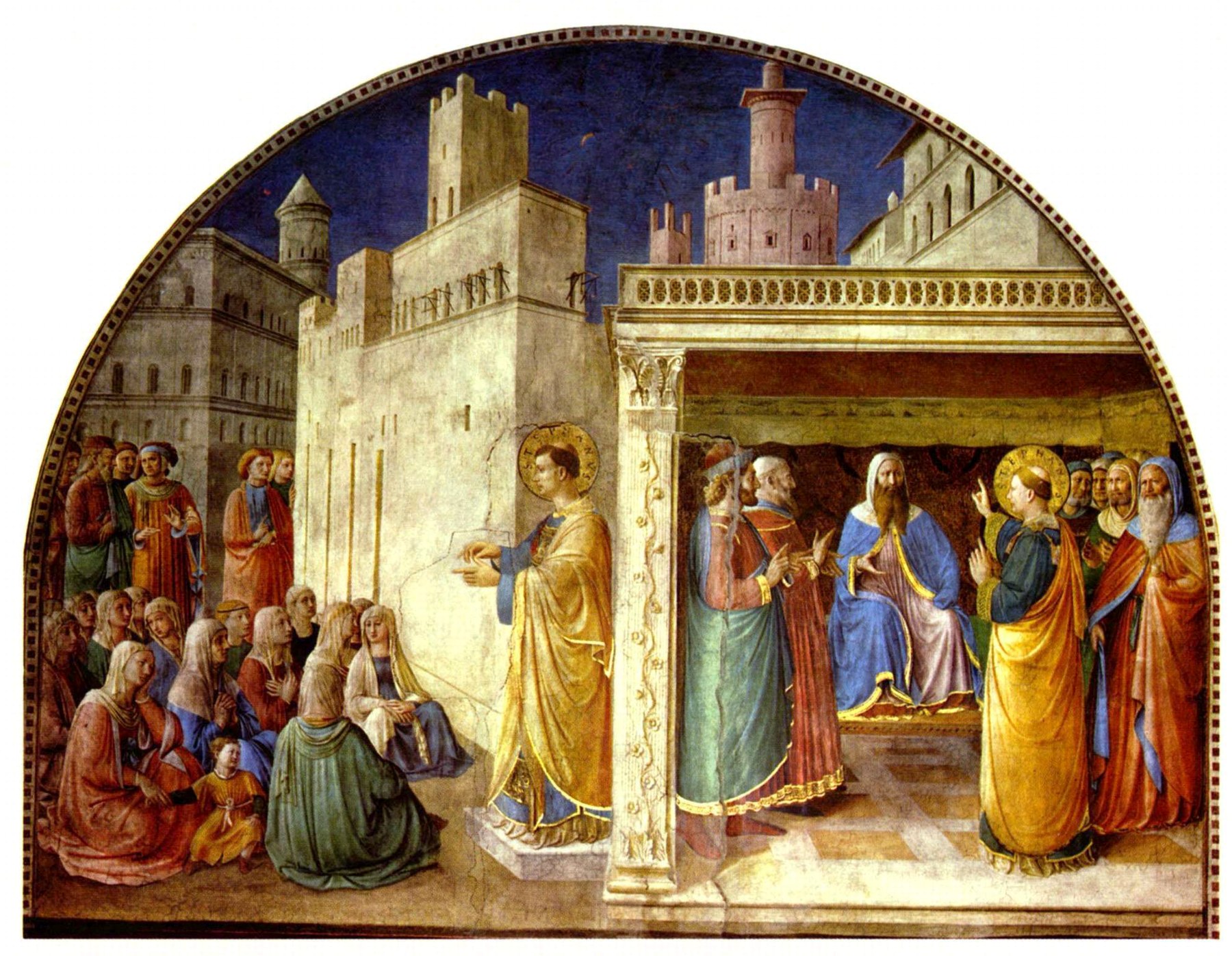
The prefect of Rome asked Lawrence for something perfectly bureaucratic: the inventory. Bring the list of the Church’s assets and hand them to the imperial treasury. He asked for three days, spent all three emptying the till, and on the third came back bringing beggars, the blind, widows and abandoned children. That was the inventory he presented. They killed him for it on 10 August 258 — and seventeen centuries later the Church still repeats his answer whenever she has to explain whose money she is holding.
A bloody August
The emperor Valerian issued two edicts against Christians, in 257 and 258. The second was surgical: bishops, priests and deacons were to be executed without trial; Christian senators and knights lost property and rank. This was not a mob persecution — it was an administrative beheading. The target was the structure, and above all the money the Church handled.
On 6 August 258, Pope Sixtus II was caught celebrating in the catacomb of Callixtus and killed on the spot with four of his deacons. Saint Ambrose records that Lawrence ran after him through the street, weeping at being left behind: “Where are you going without your son, father? Where are you hurrying, priest, without your deacon?” And that Sixtus answered that he was not abandoning him — that greater struggles were waiting for him, and that in three days he would follow.
It was four. Lawrence outlived the pope by exactly long enough to do one thing.
The man who kept the books
The office is worth understanding, because the whole story depends on it. Lawrence was the archdeacon of Rome: first of the city’s seven deacons. A deacon in the early Church was not a cleric in training — he was the administration. The archdeacon guarded the sacred vessels, controlled the offerings, kept the register of widows and orphans the community supported, and signed off every coin that left.
In today’s language: he was the finance director of the Church of Rome. When the prefect sent for him he was not sending for a preacher or a mystic. He was sending for the accountant, and asking exactly what one asks an accountant. That is why the answer works: this was not a saint producing a fine line, it was the man responsible for the books making a technical statement about the nature of the asset.
“These are the treasures of the Church”
He asked three days to gather the riches. He used all three to give them away: sold what could be sold and handed it to the poor, keeping no reserve, not even for the following day.
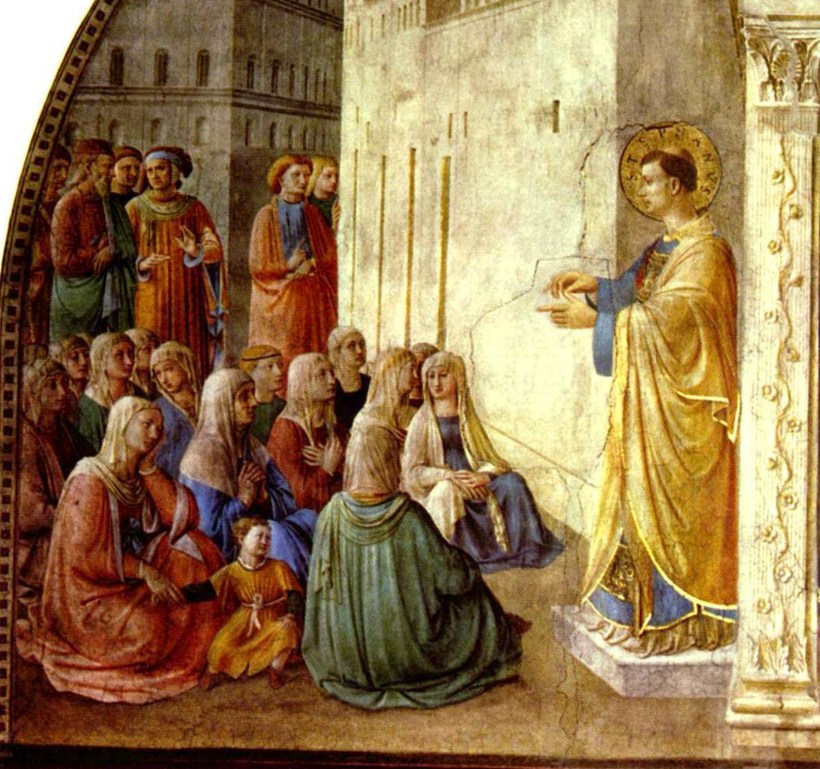
On the third day he presented himself before the prefect bringing with him the beggars, the crippled, the blind, the widows and the orphans the Church was keeping alive, and said the sentence that crossed seventeen centuries:
“These are the treasures of the Church.”
Hi sunt thesauri Ecclesiae.
Saint Lawrence to the prefect of Rome — August 258It is easy to read that as a piece of nerve, and it was. But before that it is doctrine, and doctrine the Church has never revoked. The Fathers — Ambrose and Jerome among them — called ecclesiastical goods the patrimony of the poor: the Church is not the owner, she is the administrator, and the poor hold the title. Lawrence was not improvising in front of Roman power. He was reading aloud, to an official of the empire, the only set of accounts that counted.
And here is the uncomfortable part, which is why the line refuses to age: it is still a question put to every parish, every diocese and every Christian with anything in the bank. When they come for the inventory, who turns up?
The gridiron — and what is still argued about it
Tradition says the prefect, humiliated in front of his own people, had him killed slowly: an iron bed over coals.
It is fair to say what historians point out. Valerian’s second edict ordered the clergy beheaded, and that is how Sixtus and the other deacons had died four days earlier; some scholars further suggest the gridiron may have begun in a copyist’s slip — passus est, “he suffered”, becoming assus est, “he was roasted”. None of this is conclusive, and there is the other side: Saint Ambrose, still in the fourth century, and Prudentius shortly after, already speak of the fire — testimony far too early to wave away.
What nobody disputes is the rest: the office, the date, the burial on the Via Tiburtina, the Depositio Martyrum of 354 already carrying 10 August, and Pope Damasus cutting an inscription on the tomb within the same century.
And there is one fact about the gridiron that holds however he died: the Church chose to keep it. She could have chosen the palm, the book, the alms-purse. She kept the instrument of torture and put it in his hand in every church in the world — because the gridiron says something about Lawrence that no other symbol would say.
The only recorded joke by a man being executed
Tradition holds that after some time over the coals he spoke to his executioner:
“This side is done. Turn me over, and eat.”
Assum est, versa et manduca.
Saint Lawrence to his executioner — after Prudentius and Saint AmbroseThe Church kept that line deliberately, and not from a taste for the macabre. It states something true about martyrdom: a man who has already handed over his life has nothing left for an executioner to take, and can therefore afford a joke. Lawrence’s humour is the most disarming way possible of announcing that the fear is gone — and a man without fear was precisely what that empire did not know how to execute.
Why a feast, and not a memorial
In the calendar, 10 August is a feast — a liturgical rank reserved, among the saints, almost entirely to apostles and evangelists. Lawrence is the exception Rome would never give up.
- He is named in the Roman Canon. In the list of martyrs in the Communicantes, between Cyprian and Chrysogonus, stands Laurentio. At every Mass that uses the First Eucharistic Prayer his name is said aloud.
- He belonged to the Church of Rome. A deacon of the Pope’s own city, killed in the persecution that meant to behead the Roman Church, and buried days after his bishop.
- The cult is immediate and enormous. Constantine raised a basilica over the tomb; Saint Lawrence outside the Walls is one of the seven pilgrimage churches of Rome.
- He had a vigil and an octave — an honour granted to almost no saint, and a plain signal of how Rome regarded him.
- He defines the diaconate. To serve at table, to care for the poor, to hold goods without clinging to them: everything the Church asks of a deacon is in him in finished form.
On 10 August 1557, Saint Lawrence’s day, the army of Philip II won the battle of St Quentin. The king credited the saint of the day and promised him a monument.
He delivered. El Escorial — monastery, palace, basilica and royal pantheon, the costliest building in sixteenth-century Europe — was dedicated to Saint Lawrence and laid out, tradition holds, on the plan of a gridiron: the rectangle of walls, the courtyards forming the bars, a tower at each corner for the feet turned upward.
A king who had his own tomb built in the shape of the instrument used to torture a Roman deacon. There is no stranger tribute in the history of architecture, and none more exact.
Every August the Earth passes through the dust of comet Swift–Tuttle and the sky fills with shooting stars: the Perseids, peaking between 10 and 12 August.
In Italy they have been called for centuries Lacrime di San Lorenzo — the tears of Saint Lawrence, the sparks off his gridiron falling out of the sky on the night of his feast. It is astronomy with a name out of the martyrology, and perhaps there is no better image: the whole world, once a year, covered in sparks.
19 July 1943
There is a last chapter, and it belongs to the last century. On the afternoon of 19 July 1943, Allied bombers struck the San Lorenzo railway yards in Rome. Some of the ordnance missed. The basilica of Saint Lawrence outside the Walls — Constantine’s church over the deacon’s tomb — was hit, and the working-class district around it was reduced to rubble, with thousands dead and injured.
Pius XII left the Vatican that same afternoon, with no escort and no announcement, and walked to San Lorenzo. He handed out the money he had brought. He prayed with his arms open in the middle of the wrecked street, surrounded by people. He returned to the Vatican with his white cassock stained by the blood of the wounded he had held.
One thousand six hundred and eighty-five years later, at Lawrence’s exact address, somebody turned up again with money in his hand and the poor around him. It is the same scene. That is all today’s feast is asking us to understand.
“These are the treasures of the Church.”— Saint Lawrence, to the prefect of Rome
“This side is done. Turn me over, and eat.”— Saint Lawrence, to his executioner
“Where are you going without your son, father? Where are you hurrying, priest, without your deacon?”— Saint Lawrence to Pope Sixtus II, according to Saint Ambrose
Sancte Laurenti, ora pro nobis. Saint Lawrence, pray for us — and teach us to look at the poor and recognise, with no irony at all, that what we hold dearest is kept there.
- Saint Dominic de Guzmán — another who sold what he had to feed the hungry.
- Saint Clare of Assisi — the woman who prised out of three popes the right to own nothing.
- Saint John Mary Vianney — the Curé of Ars, patron of parish priests.
- Words of the saints — a growing collection, in English and Portuguese.

Comments