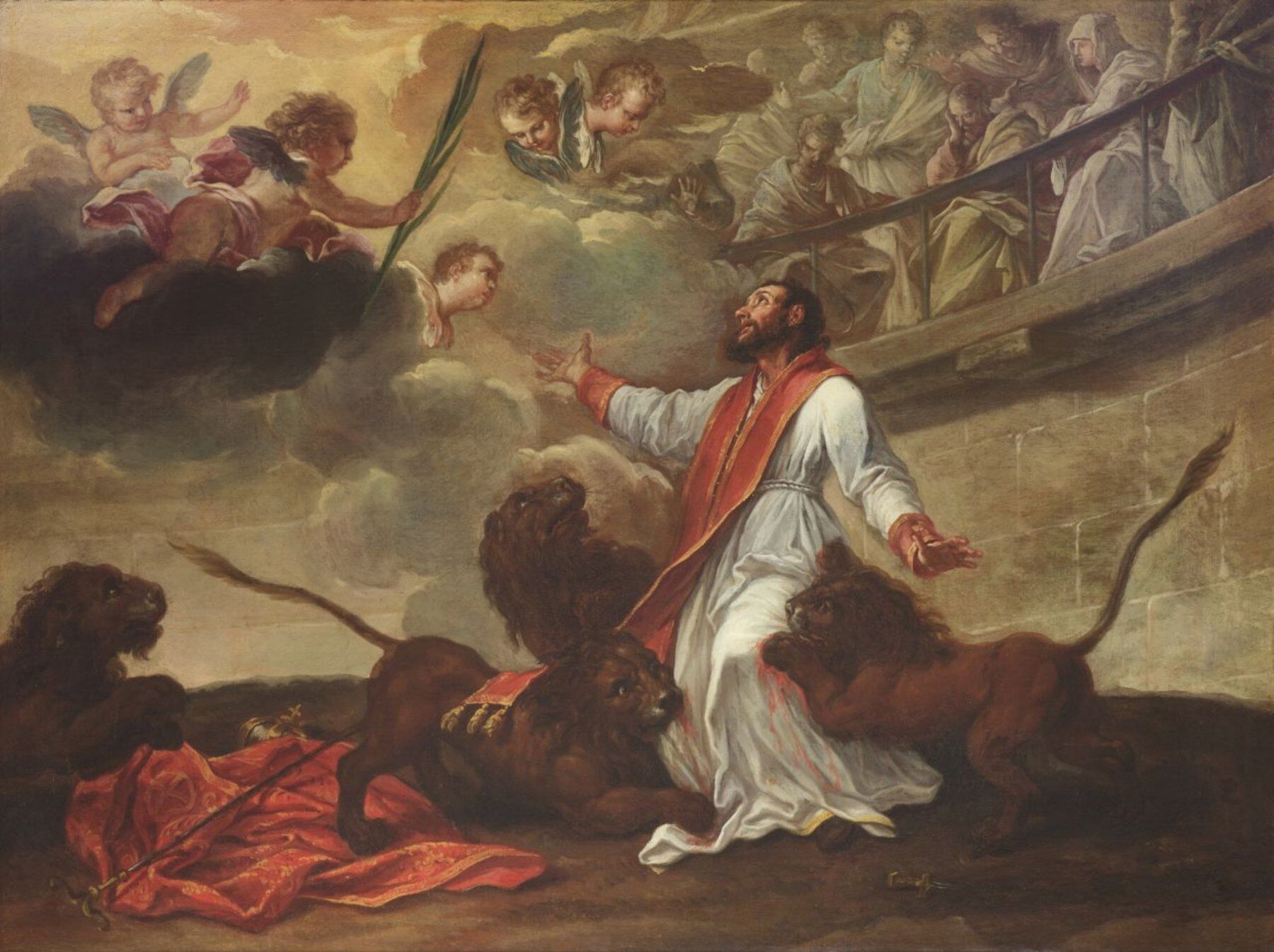
Today, 17 October, the Church keeps Saint Ignatius of Antioch, bishop and martyr. He was taken in chains from Syria to Rome to be thrown to the beasts, and on the road, guarded by soldiers he called “ten leopards”, he wrote letters that are still read today. In one of them he begs the Christians of Rome to do nothing to save him: “I am God’s wheat, and I am ground by the teeth of wild beasts.”
The bishop we know only through his letters
Little of his life is known beyond what he wrote himself and what tradition added later. Eusebius of Caesarea, in the fourth century, presents him as bishop of Antioch, second in succession to Peter (Ecclesiastical History III, 36). Antioch was the great city of Syria, where the disciples were first called Christians (Acts 11:26).
In his letters he signs himself in an odd way: “Ignatius, who is also called Theophorus”, that is, “God-bearer”. A late tradition says he was one of the children Jesus took in his arms; there is no proof of that, and it should be said so.
The journey to Rome
Condemned to death, he was sent to Rome under military guard. Tradition, from Eusebius on, places this in the reign of Trajan (98–117), around AD 107–110; some scholars propose much later dates, and the exact year remains open.
The route ran through Asia Minor: Smyrna, where Bishop Polycarp received him, then Troas, and from there by sea to Macedonia. From Smyrna he wrote to the churches of Ephesus, Magnesia and Tralles, and to the church of Rome; from Troas, to those of Philadelphia and Smyrna and to Polycarp himself. That makes seven letters, which Eusebius lists one by one and which are generally taken to be authentic.
“From Syria to Rome I fight with wild beasts, by land and sea, by night and by day, bound to ten leopards, that is, a detachment of soldiers who grow worse the better they are treated. Yet through their wrongdoing I become more and more a disciple.” (Letter to the Romans 5:1)
The picture above is the oil sketch that Pier Leone Ghezzi (1674–1755), painter to the household of Pope Clement XI, made in 1714–1715 for the fresco in the central nave of San Clemente in Rome. Ghezzi painted the bishop in a white tunic and red pallium, with angels bringing the palm of martyrdom, and reduced the Colosseum to blocks of travertine and a slender balustrade.
A historian’s caution: in Ignatius’s letters there are neither lions nor Colosseum. He speaks only of “wild beasts”. According to scholars, Saint Jerome is the first to mention lions, and Saint John Chrysostom the first to place the martyrdom in the Colosseum; it is not known whether they had any source beyond the letters themselves. The painting shows the tradition.
What the letters teach
- The Church is “catholic”. “Wherever Jesus Christ is, there is the Catholic Church” (Smyrnaeans 8:2) is the first known use of the word for the Church. For Ignatius it means universal, whole: the Church of Christ, not merely the local community.
- Unity around the bishop. “Follow the bishop, all of you, as Jesus Christ followed the Father, and the presbytery as the apostles; and respect the deacons” (Smyrnaeans 8:1). Bishop, presbyters and deacons appear side by side in the letters to the churches of Asia.
- The Eucharist is the flesh of the Saviour. He calls the shared bread “the medicine of immortality and the antidote against dying, but for living for ever in Jesus Christ” (Ephesians 20:2). And he charges those who deny that the Eucharist is “the flesh of our Saviour Jesus Christ, which suffered for our sins” with having no care for the widow, the orphan, the afflicted, the prisoner, the hungry (Smyrnaeans 6:2).
- Christ is truly man. “If these things were done by our Lord only in appearance, then I too am a prisoner only in appearance” (Smyrnaeans 4:2). It is the argument of a man in real chains.
- To be a martyr is to begin to be a disciple. “Now I am beginning to be a disciple” (Romans 5:3), he says, after all those years as a bishop.
Wheat of God
The Letter to the Romans is unlike the others: it is about neither bishops nor doctrine but about what he fears most, being rescued. He fears the love of the Romans, who might obtain a pardon: “I beg you not to show me an untimely kindness.” And he writes: “Let me be food for the beasts, through whom it is given me to reach God. I am God’s wheat and I am ground by the teeth of wild beasts, that I may be found pure bread” (Romans 4).
The saying was so well known that Saint Irenaeus of Lyons, around AD 180, quotes it without naming the author: “as one of ours said, when he was condemned to the wild beasts because of his testimony with respect to God” (Against Heresies V, 28, 4). A point of textual criticism: the text wavers. The Greek of the letters has “wheat of God” and “pure bread of God”; Irenaeus, quoting, writes “wheat of Christ” and “pure bread of God”; and Lightfoot’s edition puts “of Christ” in square brackets at the end of the sentence. Hence the translations differ.
Today’s Mass takes up the image, in the form Irenaeus quoted. The prayer over the offerings says that God received “beatum Ignatium, frumentum Christi, per martyrii passionem panem mundum”: “blessed Ignatius, the wheat of Christ, as pure bread, through the passion of martyrdom”.
“I am God’s wheat and I am ground by the teeth of wild beasts, that I may be found pure bread.”— Saint Ignatius of Antioch, Letter to the Romans 4
“Wherever Jesus Christ is, there is the Catholic Church.”— Saint Ignatius of Antioch, Letter to the Smyrnaeans 8:2
“The bread we break is the medicine of immortality and the antidote against dying, that we may live for ever in Jesus Christ.”— Saint Ignatius of Antioch, Letter to the Ephesians 20:2
The prayers
There is no “prayer of Saint Ignatius” in the sense of a formula he left behind. What we have is this passage from the Letter to the Romans, taken here as a prayer, and the Collect of today’s Mass.
ἄφετέ με θηρίων εἶναι βρῶμα, δι’ ὧν ἔστιν θεοῦ ἐπιτυχεῖν. σῖτός εἰμι τοῦ θεοῦ καὶ δι’ ὀδόντων θηρίων ἀλήθομαι, ἵνα καθαρὸς ἄρτος θεοῦ εὑρεθῶ. λιτανεύσατε τὸν κύριον ὑπὲρ ἐμοῦ, ἵνα διὰ τῶν ὀργάνων τούτων θεῷ θυσία εὑρεθῶ.
Let me be food for the beasts, through whom it is possible to reach God. I am wheat of God, and I am ground by the teeth of beasts, so that I may be found pure bread of God. Entreat the Lord for me, that through these instruments I may be found a sacrifice to God.
— Saint Ignatius of Antioch, on the road to Rome
Omnipotens sempiterne Deus, qui sanctorum martyrum confessionibus Ecclesiæ tuæ sacrum corpus exornas, concede, quæsumus, ut hodierna gloria passionis, sicut beato Ignatio magnificentiam tribuit sempiternam, ita nobis perpetuum munimen operetur. Per Dominum.
Almighty and everlasting God, you adorn the sacred body of your Church with the witness of the holy martyrs: grant, we ask, that the glory of the passion we recall today, which gave blessed Ignatius a splendour without end, may become for us a lasting defence. Through our Lord Jesus Christ.
Amen.
Sancte Ignati, ora pro nobis. Saint Ignatius, pray for us.
- Saint Margaret Mary Alacoque — yesterday, the 16th.
- The Eucharistic hymns of Saint Thomas Aquinas — the Eucharist Ignatius called the medicine of immortality.
- Words of the saints — a growing collection, in English and Portuguese.

Comments