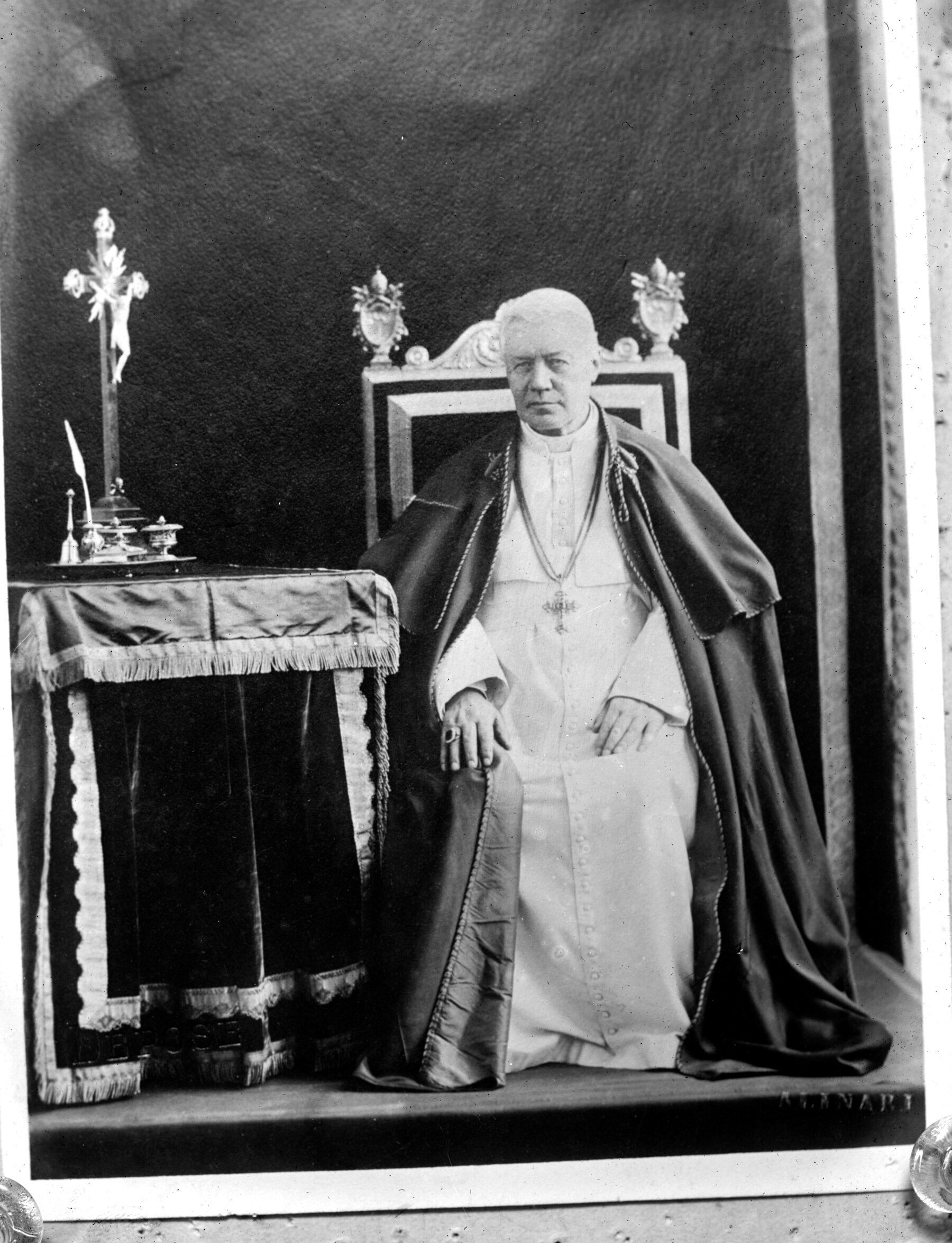
If you made your first communion at seven or eight, you owe that to one particular man. Until 1910 the norm was to wait until twelve, or fourteen, sometimes longer — and to receive rarely, because common practice treated the Eucharist as a prize for those who measured up. It was a pope, the son of a village postman, who took that down, and took it down fast. His whole pontificate fits in one sentence: removing gates.
The boy who carried his shoes
Giuseppe Sarto was born in 1835 at Riese in the Veneto, second of ten children. His father was the village postman and sacristan; his mother a seamstress.
They say he walked the miles to school at Castelfranco barefoot, shoes slung over his shoulder, to wear them less and put them on only on arrival. It is the kind of detail that usually sounds like pious legend and that, in his case, explains a great deal: nothing he did later came from an office.
He was a village curate, a parish priest, a canon, bishop of Mantua, patriarch of Venice. In every post he was known for the same thing: he gave everything away. In Venice the creditors complained that the patriarch kept pawning his own pectoral cross to pay poor people’s debts.
The last veto by an emperor
At the conclave of 1903 the favourite was Cardinal Rampolla, Leo XIII’s secretary of state. On the third ballot something happened that had not happened for a long time and would never happen again: the cardinal of Kraków read aloud, in the name of Emperor Franz Joseph of Austria, a formal veto against Rampolla.
This was the jus exclusivae, the prerogative Catholic sovereigns claimed to block a candidate. The cardinals protested, but the damage was done: the votes moved, and the man elected was the patriarch of Venice. He wept and asked them to choose someone else.
A few months later the new pope did the thing that defines a character: he abolished the veto for good, under pain of automatic excommunication for anyone attempting to transmit one. He owed his own throne to an imperial privilege, and the first thing he did was destroy it — so that nobody would ever again be elected as he had been.
Communion: the two decisions that changed the Mass
Here is why the Church calls him the pope of the Eucharist. Inherited from Jansenist rigorism there was a climate nobody had decreed and everybody obeyed: communion is for the very well prepared, therefore rarely.
- 1905 — he declares that frequent and even daily communion is desired by Christ and must be open to every one of the faithful in a state of grace and with a right intention. And he knocks out the underlying argument: the Eucharist is not a prize for the holy, it is medicine for the weak.
- 1910 — with the decree Quam singulari he sets the age of first communion at the age of discretion, that is, around seven: when a child can tell the Eucharistic Bread from ordinary bread. That was enough.
It is hard now to measure the size of that change, because we inherited the result. Millions of children who would have waited until adolescence began receiving Christ at seven. Asked whether one so small could understand, he is said to have answered that theologians would argue about it forever and children already knew.
“Holy communion is the shortest and safest way to Heaven.”
Saint Pius XAnd the singing: giving the people their voice back
In his first year, 1903, he published a document on sacred music that remains the yardstick. The diagnosis was simple: the Mass had turned into a concert. Orchestras, operatic arias, soloists — and the people silent, watching.
He restored Gregorian chant as the Roman Church’s own song and ordered that it be given back to the people, so that the faithful might sing the Mass again rather than listen to it being sung. He coined there the phrase the liturgy would repeat all century: sacred music exists for the sanctification and edification of the faithful, not for display.
Notice the pattern. Communion earlier, communion oftener, the singing handed back to those who had only been watching — the same decision three times.
A catechism a child can read
By the same logic he had a short catechism made, in questions and answers, in plain Italian — the Catechism of Saint Pius X, which whole generations learned by heart and which still circulates. And he required catechesis in every parish, adults included.
The same pontificate began the codification of canon law, a thousand years of scattered legislation that he ordered organised into a single code — finished in 1917, three years after his death, and the largest legal reform in the Church’s history.
That is the line from his will, and it was not rhetoric. He refused to ennoble his own family, as was customary: his sisters, who lived with him in Rome, stayed poor, and he forbade them titles or pensions.
Offered decorations for his relatives, he answered that his sisters were the pope’s sisters, which was honour enough for people who had done nothing to earn it.
August 1914
In July 1914 Europe was walking into war. He was asked to bless the arms of the Austrian empire — the same empire whose veto had made him pope. His reply is on record: I bless peace, not war.
He tried everything to stop what was coming, and failed. He fell ill in August and died on 20 August 1914, three weeks into the First World War. Those with him said he died of grief.
He left instructions against embalming and against grand obsequies. He was canonised in 1954 — the first pope canonised in more than two centuries.
And there is the fairest summary of the life. A man who reached the highest place by an emperor’s privilege, abolished that privilege, and spent the rest of his time removing steps from every place where there were steps between an ordinary person and God.
“I was born poor, I have lived poor, and I wish to die poor.”— Saint Pius X, his will
“Holy communion is the shortest and safest way to Heaven.”— Saint Pius X
“I bless peace, not war.”— Saint Pius X, July 1914
Sancte Pie decime, ora pro nobis. Saint Pius X, pray for us — and teach us not to put steps where God put none.
- The mystery of the Holy Mass — the thing he wanted within everyone’s reach.
- Saint John Mary Vianney — the parish priest he himself beatified in 1905.
- Eucharistic dependence — on living from the Eucharist, not only receiving it.
- Words of the saints — a growing collection, in English and Portuguese.

Comments