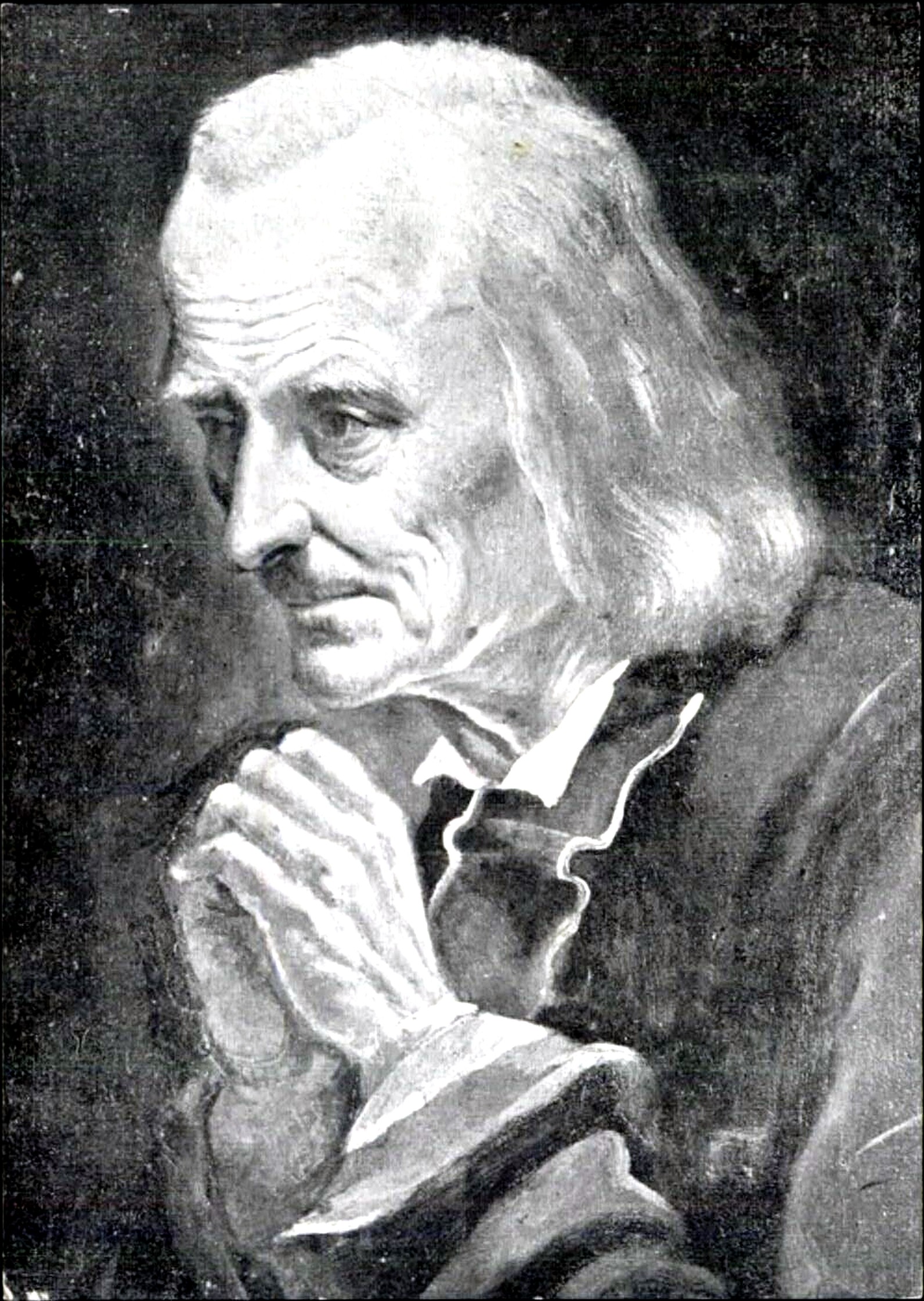
The seminary let him go. Not for indiscipline, not for doubt: for incapacity. Latin simply would not go in, he came last in the examinations, and his professors concluded that the young man had not the head for priesthood. He was ordained almost as a favour, and for his first years was not licensed to hear confessions — they judged him unfit to weigh consciences. One hundred and fourteen years later the Church declared him patron of every parish priest in the world. This is how one gets from there to here.
A child of the Revolution
Jean-Marie Vianney was born at Dardilly, near Lyon, in 1786. He was three when the French Revolution began, and his entire childhood was spent in a France where being a priest was a crime.
The Masses of his boyhood were said in barns, at night, with lookouts on the road. He made his first communion at thirteen, in secret, in a farmhouse, the windows blocked with hay carts so that nobody would see the light. The priests he knew as a child were hunted men who arrived in disguise and could be guillotined for what they carried in their bags.
That explains a great deal of what he became. Before he had learned a line of Latin he had already understood that a priest was a thing worth dying for. The conviction came first. It was the study that would not come.
The vocation nobody believed in
He began his studies at twenty, late and with no grounding, sitting in a room with adolescents who knew more than he did. Latin was a wall. At the major seminary of Lyon, where the lectures were all in Latin, he could not follow and was sent away.
There was also the military episode, which nearly ended everything. Called up in 1809 for Napoleon’s armies, he fell ill, missed the column as it left, and spent more than a year hidden in a lost hamlet called Les Noës, living under a false name and teaching the local children. Only an amnesty in 1810 restored him to civil life. As far as the State was concerned, he was a deserter.
What saved the vocation was one man: Fr Charles Balley, the parish priest of Écully, who took him back, taught him in French, and went to the bishop to argue that this candidate was ignorant but not stupid, and that the diocese needed saints more than it needed scholars. The bishop asked whether the young man was devout. He was told that he was. Then call him, said the bishop — the grace of God will do the rest.
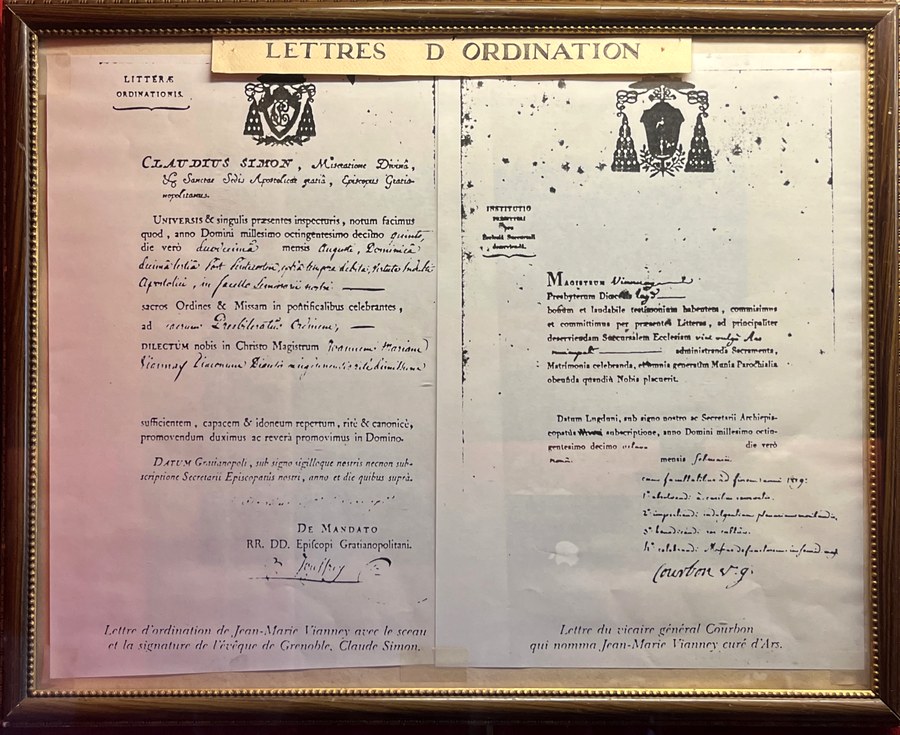
He was ordained on 13 August 1815. And, as said, the early years carried a humiliating restriction: he was not to hear confessions unsupervised. The man the Church now holds up to the world as the confessor began forbidden to confess.
Ars: two hundred and thirty souls
In 1818 he was sent to Ars, a hamlet of some two hundred and thirty people out on the plain, with nothing in it — the sort of place you send a man when you do not know where to put him. The bishop is said to have remarked that there was not much love of God there, and that he might put some in.
Vianney got lost on the way. He asked a boy minding sheep where Ars was, and the boy pointed. His reply became the opening line of his ministry:
“You have shown me the way to Ars; I will show you the way to heaven.”
Saint John Mary Vianney, arriving at his parish — 1818He found a village that worked on Sundays, drank heavily, danced at the fairs and rarely went to church. He began with the obvious and the unpopular: he preached against the taverns and against the dances, and he did not do it tactfully. But he did something else in parallel, and that is the thing that worked: he fasted almost completely, slept a few hours in an unheated room, gave away whatever clothing he had, and spent the small hours kneeling in the empty church praying for his parishioners by name, one at a time.
The village changed over about ten years. And then the phenomenon began.
The confessional
Word went round France: there was a priest at Ars who read souls. Who told people the sin they had come to hide. Who consoled without sentimentality and absolved without haggling.
Through the 1840s and 1850s that hamlet of two hundred and thirty people was receiving some twenty thousand pilgrims a year. The Lyon station went as far as selling a dedicated ticket to Ars, return, valid eight days — because eight days was the average wait in the confessional queue.
And he heard them. Sixteen to eighteen hours a day, winter and summer, for thirty years. He went in before dawn and came out at night. He ate boiled potatoes standing up. He lost his teeth, his voice and most of his health in there.
It is worth putting in cold figures: a man who failed his moral theology examinations spent the equivalent of more than a whole decade, counted in hours, sitting in the dark listening to other people’s consciences — and the Church has never had anything to correct in what he said there.
The four escapes
Here is the detail that stops the story becoming a holy card: he tried to run away from Ars four times.
Not out of laziness. He believed himself unworthy of the post, suffered under the fame, and wanted to end his life weeping over his own sins in a monastery. He packed and left in the dark. Four times they caught up with him, and four times he came back and sat down again in the confessional. The last attempt was at seventy-two, a year before he died.
A saint who spends his whole life wanting to leave the place where he is being a saint is a far more useful thing to contemplate than a serene one. His faithfulness was not the absence of the urge to quit. It was the urge to quit, beaten every single day, for forty-one years.
For years, at night, things happened in the presbytery: banging, voices, furniture dragged about, and on one occasion the bed caught fire. Vianney treated the matter with an almost domestic contempt and nicknamed the culprit le grappin — roughly, “the grappling hook”.
And he reached a practical conclusion, which he told with a laugh: when the grappin made more noise than usual it meant that the next day would bring “a big fish” — some hard case coming to confession. He came to regard the racket as a useful forecast.
“I look at him, and he looks at me”
Of all the spiritual doctrine of the Curé of Ars, the piece that has worn best is not his: it belongs to a farmhand in his parish.
Vianney noticed that a simple man came into the church every day, sat at the back, opened no book, moved no lips, stayed a long time and left. One day he asked him what he was doing there all that while. The man answered, in the dialect of the region:
“I look at him, and he looks at me.”
Je l’avise, et Il m’avise.
A farmhand of Ars to his parish priest — recorded by Saint John Mary VianneyThe priest repeated that sentence for the rest of his life as the best definition of prayer he had ever heard, and it probably is. It asks for no education, no vocabulary, none of the Latin that never went into him. It asks for presence, time, and a willingness to be looked at. The man who failed his examinations found, in the mouth of a labourer, the only thing he needed to teach.
The death, and what the Church did with him
He died on 4 August 1859, aged seventy-three, worn out. It was hot; he had been in the confessional until a few days before. A thousand people came to the funeral.
After that the Church did what she does when she has understood something late and wants to correct it out loud:
- 1905 — beatified by Saint Pius X, who at once proposes him as the model of the clergy.
- 1925 — canonised by Pius XI, the same year as Saint Thérèse.
- 1929 — declared patron of all parish priests in the world. Not of catechists, not of confessors only: of every parish priest, in every parish, permanently.
- 2009 — Benedict XVI opens the Year for Priests on the 150th anniversary of his death, holding him up again, and for the same reason, to a Church in a crisis of credibility.
There is a last irony worth keeping. In 1855 the French government decorated him with the Legion of Honour. He never wore the cross on his cassock, and asked what it was worth — he wanted to know whether it could be turned into money for the poor.
“If we knew what the Holy Mass is, we would die of love.”— Saint John Mary Vianney
“Every consecrated host is made to be consumed with love in a human heart.”— Saint John Mary Vianney
“When we are going to sin, the devil takes away all our shame. And when we go to confess that sin, he gives it all back.”— Saint John Mary Vianney
“Contradictions set us at the foot of the cross, and the cross at the gate of heaven.”— Saint John Mary Vianney
“If you wish to possess Christ, never seek him without the cross.”— Saint John Mary Vianney
Sancte Ioannes Maria Vianney, ora pro nobis. Saint John Mary Vianney, pray for us — and win for our priests your stubbornness in staying seated where God has put them.
- The priesthood was born at the Last Supper — where the thing he exercised for thirty years comes from.
- Saint Lawrence — the deacon who produced the poor as the treasure of the Church.
- The sacrament of Confession — the work of his whole life.
- Words of the saints — a growing collection, in English and Portuguese.

Comments