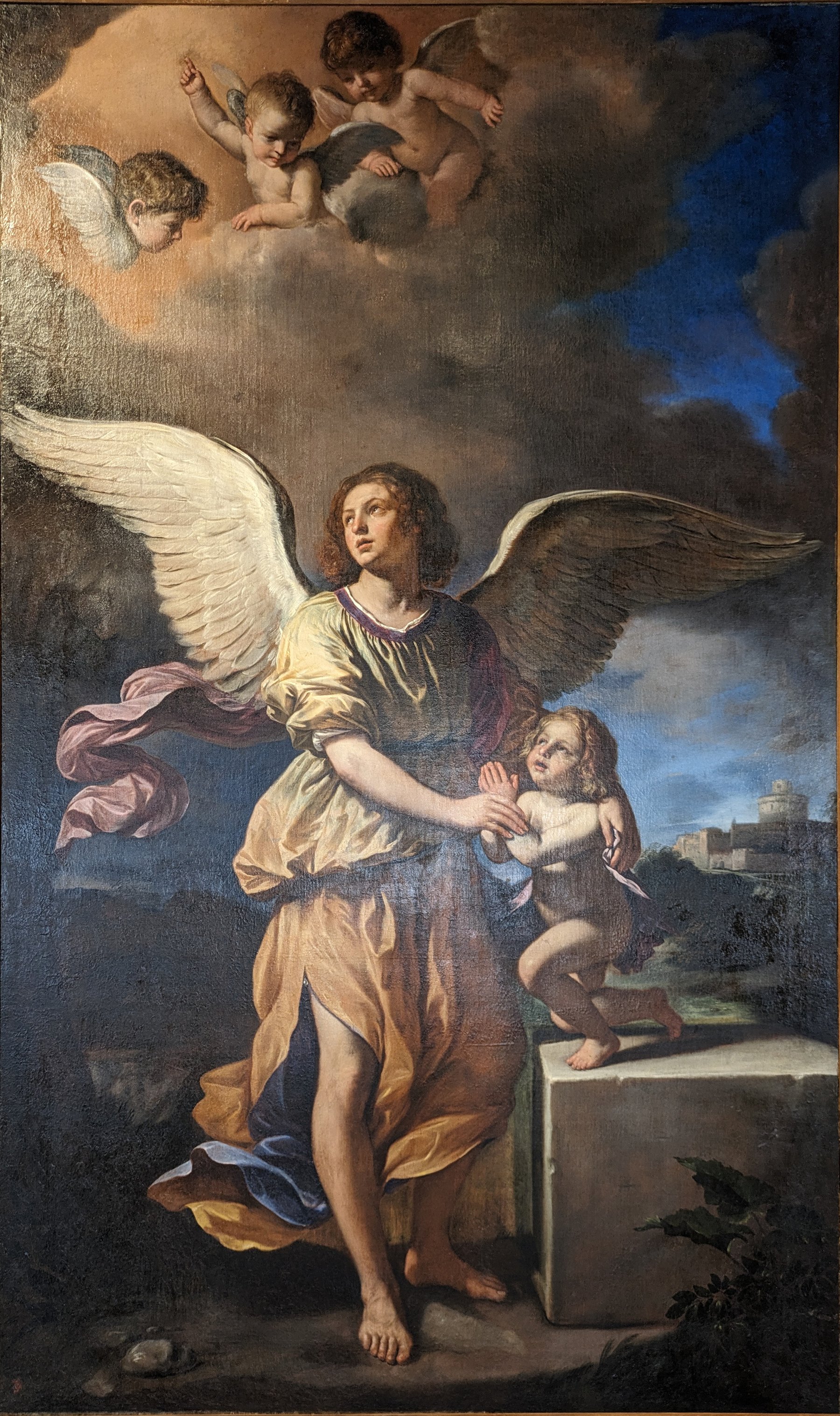
Today, 2 October, the Church keeps the Holy Guardian Angels. In Fano, in Italy, there is a picture of 1641 in which an enormous angel, eyes fixed on heaven, holds by the hands a child who is praying. Nothing more is needed to grasp today’s feast: it says in words what the painting says in colour — that no one walks alone.
What Scripture says
The Bible has no treatise on the guardian angel, but the idea runs through its pages. God promises his people: “Behold I will send my angel, who shall go before thee, and keep thee in thy journey” (Ex 23:20). The psalmist sings: “For he hath given his angels charge over thee; to keep thee in all thy ways” (Ps 90:11). And Jesus, speaking of the little ones: “their angels in heaven always see the face of my Father who is in heaven” (Mt 18:10).
In the book of Tobit the archangel Raphael makes a long journey beside young Tobias without Tobias knowing who his companion is. And when Peter, freed from prison by an angel, knocks at the door of the house where the brethren were praying, nobody believes the maid who announces him. They say: “It is his angel” (Acts 12:15). Many see in this a sign that among the first Christians it was natural to think that each person has one.
Scripture quotations are from the Douay-Rheims Bible.
What the Church teaches
The Catechism sums it up: “From its beginning until death human life is surrounded by their watchful care and intercession. ‘Beside each believer stands an angel as protector and shepherd leading him to life.’” (no. 336). The sentence in single quotation marks is from Saint Basil the Great (Against Eunomius, III, 1).
Saint Jerome, for his part, commented on the passage of Matthew with a sentence that Saint Thomas Aquinas cites in the Summa Theologiae (I, q. 113, a. 2) to conclude that each man has a guardian angel: “Great is the dignity of souls, for each one to have an angel deputed to guard it from its birth.”
- Each person has one. This is the conclusion of Jerome and of Thomas, and it is what the Church’s piety has always prayed.
- From infancy to death. The Catechism sets no term: the angels’ watchfulness accompanies the whole of life.
- Always before God. According to Jesus, the angels of the little ones continually see the face of the Father. Guarding and beholding do not exclude each other.
- Protector and shepherd. Basil joins the two images: the angel defends and leads. The Collect of the memorial asks for both, to be defended and to reach the eternal company.
How the feast entered the calendar
This is a more recent feast than people usually imagine. It was not in the breviary of Saint Pius V (1568); it began in local churches, such as Valencia, which obtained approval in 1582 for an office of the Guardian Angels. In the early seventeenth century Paul V placed it in the general calendar, still optional (the sources give 1607 or 1608). In 1670 Clement X made it obligatory for the whole Church, on 2 October: the first free day after the feast of Saint Michael, of which it is believed to have been conceived as a supplement.
Leo XIII raised its rank in 1883. Today it is an obligatory memorial in the General Roman Calendar. On 2 October 1795, as it happens, Pius VI granted an indulgence to those who devoutly said the Angele Dei, which follows below.
Guercino’s Guardian Angel was commissioned by Vincenzo Nolfi, a magistrate and playwright of Fano, for an altar of the church of Sant’Agostino. The painter’s account book records the payment on 12 October 1641. The canvas, nearly three metres high, stayed on the altar until 1944, when it was removed to escape the bombing that struck the town.
The child rests his foot on a cube of stone, which critics read as an image of firmness in faith, in contrast with the dark landscape on the left. The picture made the English poet Robert Browning, after seeing it in 1848, write a poem that begins: “Dear and great Angel, wouldst thou only leave / That child, when thou hast done with him, for me!” (“The Guardian-Angel: A Picture at Fano”, 1855).
“Great is the dignity of souls, for each one to have an angel deputed to guard it from its birth.”— Saint Jerome, on Matthew 18:10, quoted by Saint Thomas Aquinas, Summa Theologiae I, q. 113, a. 2
“Beside each believer stands an angel as protector and shepherd leading him to life.”— Saint Basil the Great, Against Eunomius III, 1, quoted in the Catechism of the Catholic Church, no. 336
“For he hath given his angels charge over thee; to keep thee in all thy ways.”— Psalm 90:11
The prayers
The prayer that cannot be missing is the Angele Dei, short and much used with children. It is traditional and of uncertain authorship. After it, the Collect of today’s memorial, in Latin and English.
Angele Dei, qui custos es mei, me tibi commíssum pietáte supérna, illúmina, custódi, rege et gúberna.
Angel of God, who are my guardian, to whom the goodness of God has entrusted me: enlighten me, guard me, rule me and govern me.
Amen.
Deus, qui ineffábili providéntia sanctos Angelos tuos ad nostram custódiam míttere dignáris: largíre supplícibus tuis; et eórum semper protectióne deféndi, et ætérna societáte gaudére.
O God, who in your ineffable providence deign to send your holy Angels to guard us: grant to those who pray to you that we may always be defended by their protection and rejoice in their eternal company.
Through our Lord Jesus Christ. Amen.
Sancti Angeli Custodes, orate pro nobis. Holy Guardian Angels, pray for us — and never let us let go of your hand.
- Michael, Gabriel and Raphael — the three names, on the feast of 29 September.
- Saint Thérèse — the little way, yesterday, the 1st.
- Padre Pio — the September post also carries the Angele Dei.
- Words of the saints — a growing collection, in English and Portuguese.

Comments