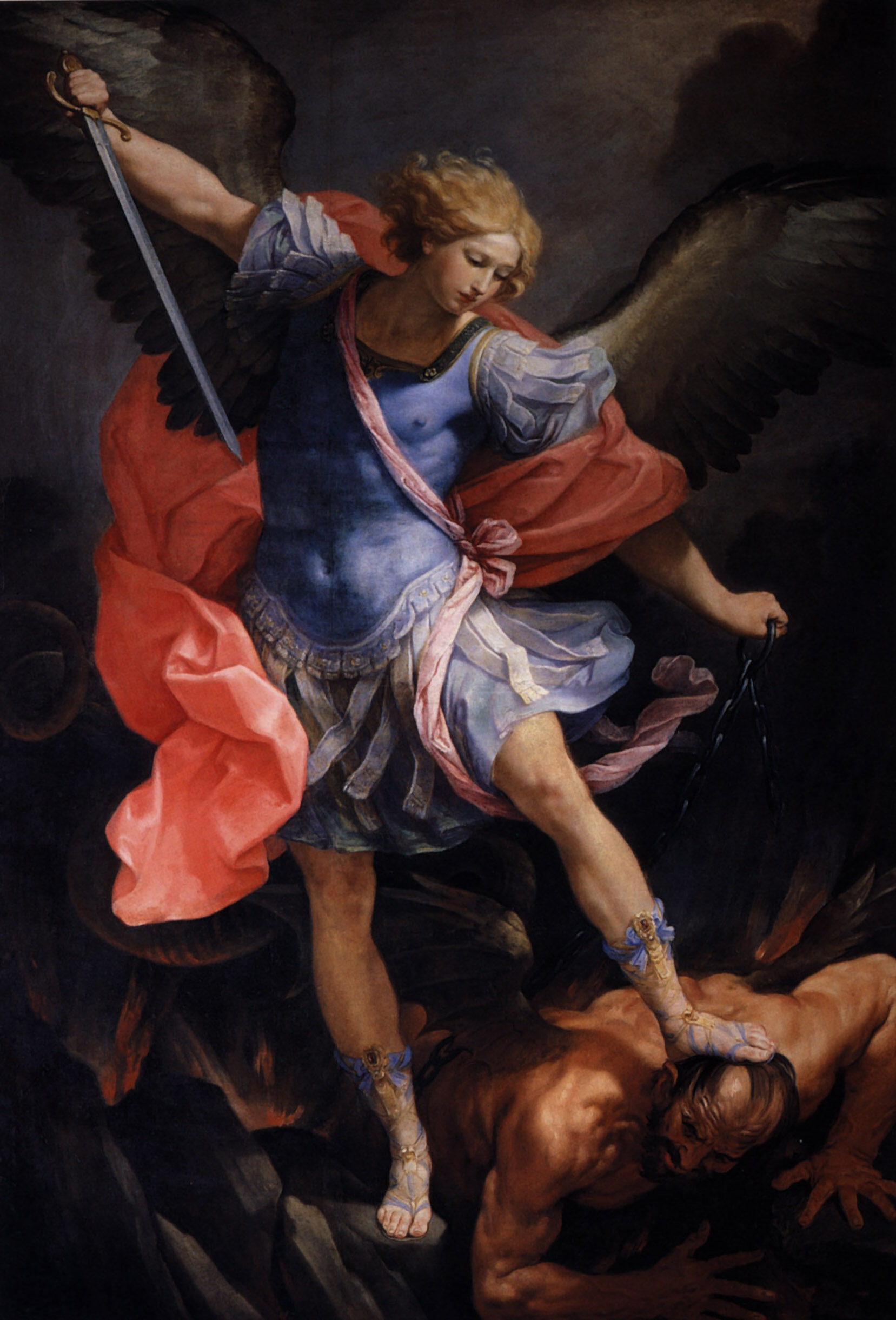
Today, 29 September, the Church keeps the Holy Archangels Michael, Gabriel and Raphael. They are the only three angels Scripture calls by name — and not one of those names is ornament. Each is a whole sentence in Hebrew, and says what that angel does.
In the Church’s calendar today is not a simple memorial: it is a feast, one rank higher. The Mass has the Gloria, its own readings and its own prayers, and those who pray the Liturgy of the Hours read in the Office of Readings a homily by Saint Gregory the Great written precisely to explain who these three are.
Three names, three sentences
- Michael — Mi-ka-El, “Who is like God?” Notice that it is a question, not a title. It is the cry that undoes all pride, and it is the whole weapon of the story: the archangel does not win by being stronger, he wins by asking who God is and knowing the answer. He appears in Daniel, in the Letter of Jude and in Revelation 12:7.
- Gabriel — Gabri-El, “strength of God”. He is the messenger. He explains the vision to Daniel, announces to Zechariah the birth of John, and carries to Nazareth the question on which everything depends (Lk 1:26-38).
- Raphael — Rafa-El, “God heals”. He is the road companion of the book of Tobit: he walks with the boy, arranges his marriage, cures the father’s blindness, and only at the end says who he is.
What the Church teaches about angels
The existence of angels is not an optional devotion or a poetic image. The Catechism of the Catholic Church calls it a truth of faith (no. 328): the witness of Scripture is as clear as the unanimity of Tradition. As early as 1215 the Fourth Lateran Council professed that God created out of nothing, from the beginning of time, both orders of creatures, “the spiritual and the corporeal, that is, the angelic and the earthly”.
- Pure spirits. “As purely spiritual creatures angels have intelligence and will: they are personal and immortal creatures, surpassing in perfection all visible creatures” (CCC 330).
- The name of an office. The Catechism (no. 329) quotes Saint Augustine: “‘Angel’ is the name of their office, not of their nature. If you seek the name of their nature, it is ‘spirit’; if you seek the name of their office, it is ‘angel’.”
- Christ’s own. “Christ is the centre of the angelic world” (CCC 331). The angels were created through him and for him (Col 1:16), and they are present throughout his life: at the Annunciation, in the song over Bethlehem, in the desert, in the agony of the Garden, at the empty tomb and at the Ascension.
- With us. “From its beginning until death, human life is surrounded by their watchful care and intercession. ‘Beside each believer stands an angel as protector and shepherd leading him to life’” (CCC 336, quoting Saint Basil).
That is why the Church is sparing with angels’ names. The Directory on Popular Piety and the Liturgy, published by the Holy See in 2001, says that the practice of assigning names to the holy angels should be discouraged, except in the cases of Gabriel, Raphael and Michael, whose names are contained in Holy Scripture (no. 217).
Uriel, Jophiel, Selaphiel and the others that circulate in apocryphal books, in “seven archangels” calendars and in internet chain messages are left out: Revelation has not given us those names, and the Church does not use them in prayer.
Angel and archangel: today’s homily
The word archangel appears only twice in the Bible: in the Letter of Jude (“the archangel Michael”, v. 9) and in 1 Thessalonians 4:16, in “the archangel’s call” that will announce the Lord’s return. The one who explains the difference is Saint Gregory the Great, pope from 590 to 604, in the homily the Church reads today in the Office of Readings. He starts from Saint Augustine’s distinction — angel is the name of a mission — and goes on:
Those who deliver messages of lesser importance are called angels; and those who proclaim messages of supreme importance are called archangels. And so it was that not merely an angel but the archangel Gabriel was sent to the Virgin Mary. It was only fitting that the highest angel should come to announce the greatest of all messages.
Names, Gregory says, are given to some “to denote their ministry when they came among us”. Whenever some act of wondrous power must be performed, Michael is sent, so that his action and his name may make it clear that no one can do what God does. Gabriel, God’s strength, announced the One who came to quell the powers of evil. And Raphael is God’s remedy, because when he touched Tobit’s eyes he banished the darkness of his blindness.
It is a key to the whole feast: each of the three appears in Scripture on a mission — to fight, to announce, to heal. And the three missions go on.
One feast that was three
Until 1969 the dates were separate. 29 September belonged to Saint Michael — and not because of the victory over the dragon, but because of the dedication of a basilica in his honour on the Via Salaria near Rome in the fifth century. Gabriel was kept on 24 March, the eve of the Annunciation, and Raphael on 24 October.
The reform of the calendar gathered all three onto the 29th and left 2 October to the Holy Guardian Angels, who keep their own memorial. The Church first keeps the three who have names and, three days later, the nameless angel each of us has at our side.
Today’s Mass readings are chosen with care. The first is Daniel 7, with “thousands upon thousands” serving before the Ancient of Days, or Revelation 12, with Michael against the dragon. The psalm is Psalm 138(137), which sings to God “in the presence of the angels”. And the Gospel is the call of Nathanael (Jn 1:47-51), where Jesus promises: “You will see heaven opened and the angels of God ascending and descending upon the Son of Man.” It is the ladder Jacob saw in his dream (Gen 28:12) — and now the ladder is Christ.
In English the day keeps its old name, Michaelmas, which for centuries marked the end of harvest, the paying of rents and the start of the academic year at Oxford and Cambridge — still called Michaelmas term today.
Tradition holds that Saint Michael appeared in a cave on Monte Gargano in Apulia and asked that the place not be consecrated by human hands, because he had consecrated it himself. The shrine has stood there ever since — the oldest in the West dedicated to the archangel, and never consecrated by any bishop.
From it grew a line of shrines across Europe that popular piety joins in a straight line: Gargano, the Sacra di San Michele in Piedmont, Mont-Saint-Michel in Normandy, St Michael’s Mount in Cornwall, Skellig Michael in Ireland. Curiously, nearly all on heights and islands — always in places you can see a long way from.
The prayer of today’s Mass
The collect of this feast is very old: it is already in the Roman sacramentaries of the first millennium, when the 29th still belonged to Saint Michael alone. In one sentence it says everything the Church asks today — that those who serve God in heaven may guard our life on earth.
Deus, qui miro órdine Angelórum ministéria hominúmque dispénsas, concéde propítius, ut, a quibus tibi ministrántibus in cælo semper assístitur, ab his in terra vita nostra muniátur. Per Dóminum nostrum Iesum Christum Fílium tuum, qui tecum vivit et regnat in unitáte Spíritus Sancti, Deus, per ómnia sæcula sæculórum.
O God, who dispose in marvellous order ministries both angelic and human, graciously grant that our life on earth may be defended by those who watch over us as they minister perpetually to you in heaven. Through our Lord Jesus Christ, your Son, who lives and reigns with you in the unity of the Holy Spirit, God, for ever and ever.
Amen.
Saint Michael: the prayer of Leo XIII
In 1886 Pope Leo XIII ordered this prayer said at the end of every low Mass, together with the Hail Marys and the Salve Regina. It ceased to be obligatory with the liturgical reform, but it never left the Church’s lips. In 1994 Saint John Paul II asked that no one forget it. And on 29 September 2018 — on this same feast — Pope Francis asked all the faithful to end the Rosary every day during October with the Sub tuum praesidium and with this prayer. Since the feast falls on the threshold of October, the month of the Rosary, the invitation still stands.
Sancte Míchael Archángele, defénde nos in prælio; contra nequítiam et insídias diáboli esto præsídium. Ímperet illi Deus, súpplices deprecámur: tuque, Princeps milítiæ cæléstis, Sátanam aliósque spíritus malignos, qui ad perditiónem animárum pervagántur in mundo, divína virtúte in inférnum detrúde.
Saint Michael the Archangel, defend us in battle; be our protection against the wickedness and snares of the devil. May God rebuke him, we humbly pray; and do you, O Prince of the heavenly host, by the divine power thrust into hell Satan and the other evil spirits who prowl about the world for the ruin of souls.
Amen.
For centuries the Church has also entrusted to him the hour of death. In the Requiem Mass, the offertory asks that “the standard-bearer Saint Michael” lead the souls “into the holy light” — signifer sanctus Michael repraesentet eas in lucem sanctam. And this is the name entire, which is the shortest prayer there is:
Quis ut Deus?
Who is like God?
Amen.
A prayer to Saint Gabriel
Until 1969 Saint Gabriel had his own Mass on 24 March, the eve of the Annunciation. The collect of that Mass is a small, perfect prayer for today: it asks the protection of the one who carried to Nazareth the news on which our whole salvation hung. In 1951 Pope Pius XII declared him patron of telecommunications — of those who work with radio, telephone, television and, today, with everything that carries news from one place to another. He is also the one to turn to before a hard conversation, or a word that needs to be said.
Deus, qui inter céteros Angelos, ad annuntiándum Incarnatiónis tuæ mystérium, Gabriélem Archángelum elegísti: concéde propítius; ut, qui festum eius celebrámus in terris, ipsíus patrocínium sentiámus in cælis: Qui vivis et regnas cum Deo Patre in unitáte Spíritus Sancti, Deus, per ómnia sæcula sæculórum.
O God, who among all the angels chose the Archangel Gabriel to announce the mystery of your Incarnation, mercifully grant that we who keep his feast on earth may feel his protection in heaven. Who live and reign with God the Father in the unity of the Holy Spirit, God, for ever and ever.
Amen.
A prayer to Saint Raphael
Saint Raphael’s feast was on 24 October. He is the archangel of those on the road: patron of travellers, of the sick and of those who care for them, and, through the story of Tobias and Sarah, of those who ask God for the right husband or wife. He sums up his own mission at the end of the book: “When you and Sarah prayed, I brought a reminder of your prayer before the glory of the Lord” (Tob 12:12). The collect of his old Mass asks exactly this: that Tobias’s companion be ours too.
Deus, qui beátum Raphaélem Archángelum Tobíæ fámulo tuo cómitem dedísti in via: concéde nobis fámulis tuis; ut eiusdem semper protegámur custódia et muniámur auxílio. Per Dóminum nostrum Iesum Christum Fílium tuum, qui tecum vivit et regnat in unitáte Spíritus Sancti, Deus, per ómnia sæcula sæculórum.
O God, who gave the blessed Archangel Raphael to your servant Tobias as a companion on his journey, grant to us your servants that we may always be guarded by his protection and strengthened by his help. Through our Lord Jesus Christ, your Son, who lives and reigns with you in the unity of the Holy Spirit, God, for ever and ever.
Amen.
“Now war arose in heaven: Michael and his angels fighting against the dragon.”— Revelation 12:7
“I am Gabriel, who stand in the presence of God; and I was sent to speak to you, and to bring you this good news.”— Luke 1:19
“I am Raphael, one of the seven angels who stand before the Lord.”— Tobit 12:15
“Whenever some act of wondrous power must be performed, Michael is sent, so that his action and his name may make it clear that no one can do what God does.”— Saint Gregory the Great, Homily on the Gospels
“Where there is an angel, there is always heaven.”— ascribed to Saint John XXIII
Sancti Angeli custodes nostri, defendite nos in prælio. Holy Angels, our guardians, defend us in battle.
- Our Lady of the Rosary novena — from 28 September to 6 October; a good place to end the Rosary with Saint Michael, as Pope Francis asked.
- Padre Pio — who sent his guardian angel to those who wrote to him, on the 23rd.
- Words of the saints — a growing collection, in English and Portuguese.

Comments