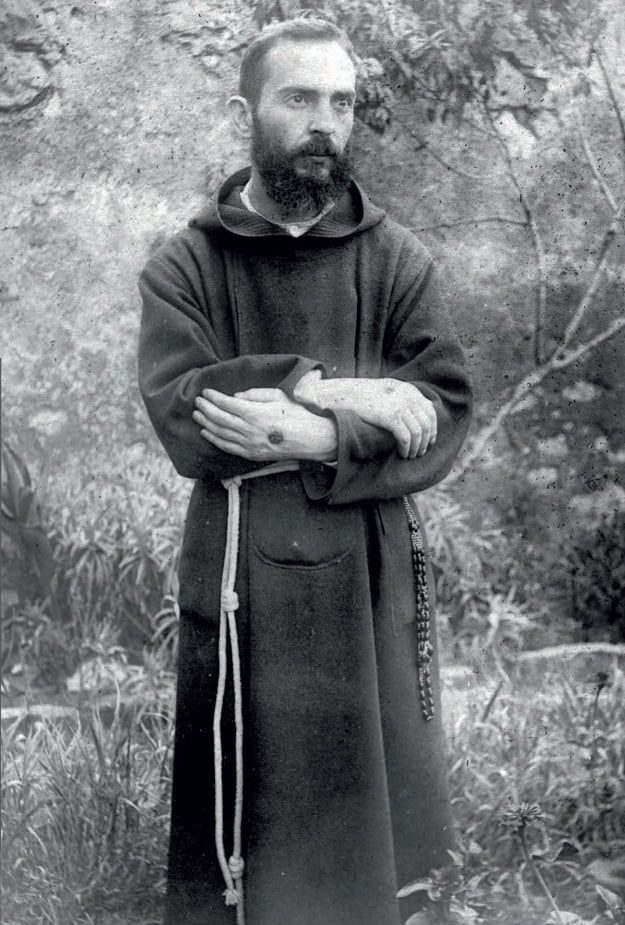
Today, 23 September, the Church keeps Saint Pius of Pietrelcina — Padre Pio. He died on this day in 1968, at half past two in the morning, with two words in his mouth: “Gesù, Maria.” He was eighty-one, and fifty of those years had been lived with open wounds in his hands, his feet and his side.
Francesco, of Pietrelcina
He was born Francesco Forgione on 25 May 1887 at Pietrelcina in southern Italy, into a peasant household. His father, Grazio, emigrated twice to America and worked years away from his family to pay for the schooling of a son who wanted to be a friar.
He entered the Capuchins at fifteen and took the name Pio. He was ordained on 10 August 1910. His health was wretched — fevers nobody could explain, whole months sent home again. In 1916 he was assigned to the friary of San Giovanni Rotondo on the Gargano, and there he stayed until he died.
20 September 1918
That morning he was alone in the choir of the old church, praying before the crucifix after Mass. He wrote afterwards to his spiritual director that he saw a mysterious figure, and that when it withdrew, “I became aware that my hands, feet and side were pierced and dripping with blood”.
He was thirty-one. He was the first priest in the history of the Church known to bear the visible stigmata.
- Fifty years. The wounds stayed open from 1918 until days before his death in 1968 — and then closed without leaving a scar.
- Examined by doctors. The Holy Office sent specialists: Luigi Romanelli, Giorgio Festa, Amico Bignami. They disagreed with one another about the cause, but agreed on the facts — the wounds did not become infected, did not heal, and bled every day.
- He hated speaking of it. He wore brown fingerless mittens to hide his hands and asked people not to ask. He called the wounds “my humiliation”.
Between 1931 and 1933 the Holy Office forbade him to celebrate Mass in public or to hear confessions. The accusations came from outside the friary and from inside it; some were pure invention.
He obeyed. He wrote no letters in his own defence, mobilised no devotees, made no complaint. Asked how he bore it, he answered that he was “a son of obedience”. He was restored in 1933 by order of Pius XI, who said he had been badly informed.
If there is one sign worth more than the stigmata, it is this one. Anybody can invent a wonder; obeying in silence for two years, when you are in the right, is the work of a saint.
The confessional and the hospital
The work of his life was not the marvels: it was the confessional. He spent ten, twelve, up to sixteen hours a day in it. People waited days for a turn; there were lists. Many stories are told of penitents to whom he named the sin they were hiding — but what the testimonies repeat most is something else: they came out light.
And there was the other side, very concrete. On 5 May 1956 he opened, on top of that poor mountain, a hospital built with donations from around the world. He refused to call it a hospital. He called it Casa Sollievo della Sofferenza — the Home for the Relief of Suffering. Today it is one of the largest hospitals in southern Italy.
He also founded the prayer groups, which he called “nurseries of faith, hearths of love”. They still exist, in their thousands.
The end
He said his last Mass on 22 September 1968, seated, without the strength to stand. He died before dawn on the 23rd. When the body was prepared, the wounds had gone: the skin was smooth, as though nothing had ever been there.
He was canonised by John Paul II on 16 June 2002 — the same man who, as a young Polish priest, had made his confession to him in 1947.
“Pray, hope, and don’t worry.”— Saint Pius of Pietrelcina
“The Rosary is the weapon for these times.”— Saint Pius of Pietrelcina
“I am a son of obedience.”— Saint Pius of Pietrelcina, on being forbidden to celebrate in public
The prayers
The Collect of his Mass asks for one exact thing: not the marvels, but union with the sufferings of Christ.
Omnípotens sempitérne Deus, qui sanctum Pium presbýterum Fílii tui crucis singulári grátia partícipem esse tribuísti, et per eius ministérium misericórdiæ tuæ mirabília renovásti: concéde nobis, ut, eius intercessióne, passiónibus Christi iúgiter uníti, ad resurrectiónis glóriam felíciter perducámur.
Almighty ever-living God, who granted the priest Saint Pius to share in a singular way in the Cross of your Son, and through his ministry renewed the wonders of your mercy: grant us that, by his intercession, we may be constantly united to the sufferings of Christ and so be brought happily to the glory of the resurrection.
Amen.
And this is the prayer to the Guardian Angel, which he had prayed since childhood. Padre Pio would send his angel to people who wrote to him from far away, and asked them to send him theirs — he said it with the plainness of a man sending a message:
Angele Dei, qui custos es mei, me tibi commíssum pietáte supérna, hódie illúmina, custódi, rege et gubérna.
Angel of God, who are my guardian, since the heavenly goodness has entrusted me to you: enlighten, guard, rule and govern me this day.
Amen.
Sancte Pie a Pietrelcina, ora pro nobis. Saint Pius of Pietrelcina, pray for us — and win us the grace to obey when obeying is hard.
- Saint Matthew — the tax collector called from his table, on the 21st.
- Words of the saints — a growing collection, in English and Portuguese.

Comments