Today, 21 September, the Church keeps Saint Matthew, apostle and evangelist. It is worth noticing how much space the Gospel gives his conversion: one line. “Follow me. And he rose and followed him” (Mt 9:9). No negotiation, no time to think it over, no “let me settle the accounts first”.
What it meant to be a publican
His name was Levi, son of Alphaeus (Mk 2:14), and he worked at the customs post of Capernaum, on the road linking Galilee to Damascus. He collected taxes for Rome — or rather, he bought the right to collect and kept whatever came in above the agreed sum.
He was therefore two things at once: a collaborator with the occupier and a man who made his living squeezing his neighbours. In the Gospels “tax collectors and sinners” appears as a single expression, because in common speech it really was one thing.
And there is a detail that usually escapes notice: the other apostles left boats and nets, things you can go back to. Matthew left a concession. Once away from that table there was no recovering it — someone else would buy it the next day. He was the only one who burnt the bridge behind him.
The dinner, and the sentence
Straight afterwards Matthew throws a banquet at his house and fills it with colleagues from the trade. The Pharisees ask why the Master eats with such people, and the answer is the definition of the whole Gospel:
“Those who are well have no need of a physician, but those who are sick. I came not to call the righteous, but sinners.” (Mt 9:12-13)
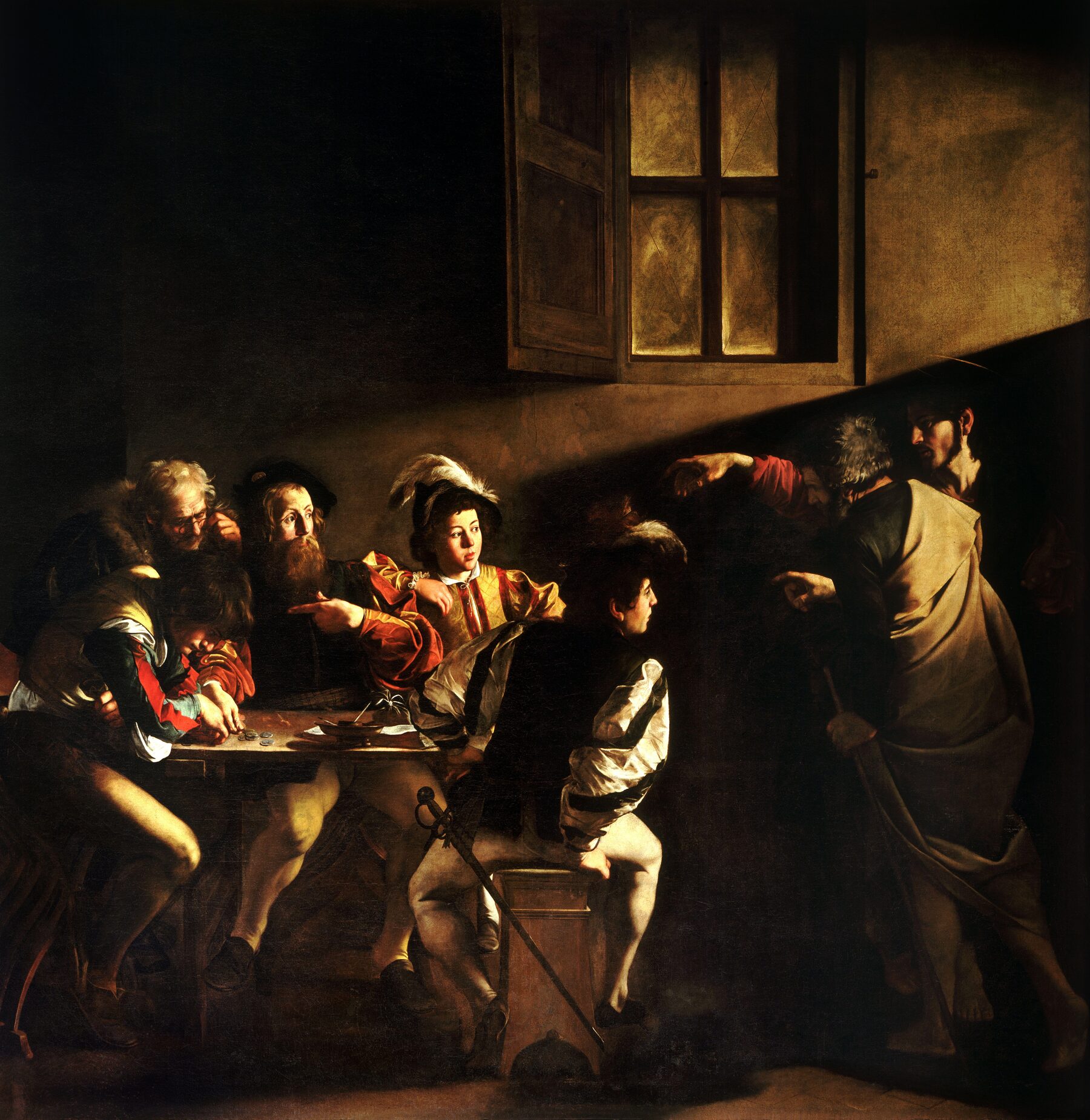
Caravaggio’s Calling of Saint Matthew (1599–1600) hangs in the church of San Luigi dei Francesi in Rome, and for four centuries one simple thing has been argued over: which of the men at the table is Matthew?
The traditional reading points to the bearded man in the middle, who seems to be indicating himself. The more recent reading says he is pointing at the young man with his head down at the end, still counting money — and that the gesture means “him? really?”.
The ambiguity may be deliberate. If it is, it is the best thing in the picture: the man being called is not sure it is meant for him.
The Gospel that bears his name
- Written for Jews. It is the Gospel that quotes the Old Testament most, always with the same formula: “that what was spoken by the prophet might be fulfilled”. It speaks to people already waiting for somebody.
- It opens with a genealogy. Forty-two generations, with the names of ordinary people and of dreadful ones. The tax collector opens the book by showing that God works with what is there.
- It keeps the Sermon on the Mount. The Beatitudes and the Our Father reach us, in the form we pray them, through this book.
- His symbol is the winged man. Of the four living creatures of Ezekiel, the human figure fell to Matthew — because his Gospel opens with the human ancestry of Christ.
Of his later life little is firm: tradition speaks of preaching in Ethiopia or Persia, and of martyrdom. The Church venerates him as a martyr without fixing the story.
“I came not to call the righteous, but sinners.”— Matthew 9:13
“He saw a man and he loved him.”— Saint Bede the Venerable, homily on the calling of Matthew
“He left the goods of earth and followed Him who had nowhere to lay his head.”— ascribed to Saint John Chrysostom
The prayers
Séquere me. Et surgens, secútus est eum.
Follow me. And he rose and followed him.
— Gospel of Saint Matthew 9:9
Deus, qui ineffábili misericórdia beátum Matthæum ex publicáno Apóstolum es dignátus elígere, da nobis, eius exémplo et intercessióne suffúltis, ut, te sequéntes, tibi firmiter adhæreámus.
O God, who with untold mercy were pleased to choose as an Apostle Saint Matthew, the tax collector, grant that, sustained by his example and intercession, we may follow you and hold firm in following you.
Amen.
Sancte Matthæe, ora pro nobis. Saint Matthew, pray for us — and win us the grace to get up from the table without asking for time.
- Saint Januarius — on the 19th.
- Words of the saints — a growing collection, in English and Portuguese.

Comments