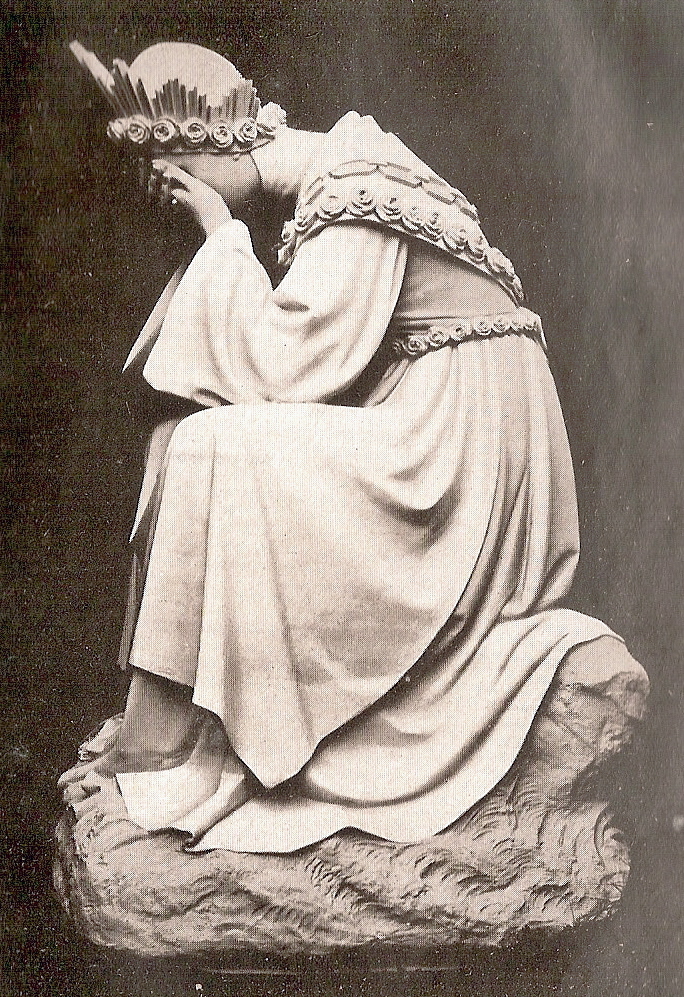
On 19 September 1846, on a mountain above a village in the French Alps, two children minding cows came home with a story no one wanted to believe. Mélanie Calvat was fourteen and could barely read. Maximin Giraud was eleven and could not keep still. They had met a woman sitting on a stone, her face in her hands, weeping.
They were not pious children. They had met three days earlier, they did not much like each other, and neither knew the catechism well enough to be confirmed. Hold on to that. Heaven did not look for two souls already prepared. It looked for two children who would repeat, word for word, something they did not understand — and who would go on repeating it, unchanged, under interrogation, for the rest of their lives.
A woman weeping on a mountain
She was seated, bent over, elbows on her knees, her face in her hands. When they came near she stood, and she spoke first — and her first words were not a reproach.
Avancez, mes enfants, n’ayez pas peur ; je suis ici pour vous conter une grande nouvelle.
Come forward, my children, do not be afraid; I am here to tell you great news.
Notice the order. Before anything else she tells two frightened children not to be afraid, and she calls what is coming news — not a threat, not a sentence. Everything else she said that afternoon must be read from inside that sentence, or it will be read wrongly.
She wept the whole time she spoke. Mélanie, groping for words, said it best: she looked like a mother whose children had beaten her, and who had run off into the mountain to cry.
What she wore
The children described her in detail, and the detail is the message. She was dressed like the women of their own valley — long dress, apron, kerchief crossed and tied behind, a peasant’s cap. Roses crowned her head, edged her kerchief and lay on her shoes. On her shoulders a heavy chain. And on her breast, hung from a finer chain, a blazing crucifix, with a hammer on one side and a pair of pincers on the other. All the light that covered the three of them came from that cross.
Ask any child what those two tools are for and they will tell you: one drives the nails in, the other draws them out. She was wearing, over her heart, the two things a person can do with the Passion of her Son. You can drive the nails deeper. Or you can take them out. There is no third tool on that cross.
“How long I have suffered for you”
Then she spoke about herself, and this is the part that is almost never quoted, though it is the hinge of the whole message.
Depuis le temps que je souffre pour vous autres ! Si je veux que mon Fils ne vous abandonne pas, je suis chargée de le prier sans cesse ; pour vous autres, vous n’en faites pas cas.
Vous aurez beau prier, beau faire, jamais vous ne pourrez récompenser la peine que j’ai prise pour vous.
How long I have suffered for you! If I want my Son not to abandon you, I am charged with praying to him without ceasing; and you — you take no notice of it.
However much you pray, however much you do, you will never be able to repay the trouble I have taken for you.
She is not describing a feeling. She is describing an office: I am charged with praying to him without ceasing. That is intercession, and it is work, and it has been going on the whole time you were not thinking about it. The reproach that follows is not that we sinned spectacularly. It is smaller and worse: you take no notice.
The arm of her Son
Si mon peuple ne veut pas se soumettre, je suis forcée de laisser aller le bras de mon Fils. Il est si fort et si pesant que je ne puis plus le maintenir.
If my people will not submit, I am forced to let go of the arm of my Son. It is so strong and so heavy that I can hold it up no longer.
It is almost always quoted alone, and quoting it alone ruins it. Read it again with the verb in the middle: I am forced. She is not the one striking. She is the one holding the arm up, and she is telling two illiterate children that her arms are giving out. A mother does not say that to frighten you. She says it so that someone will come and help her hold.
The two things that weigh it down
She then named them. Not vague wickedness — two habits, both of them the kind a decent person can slide into without ever noticing.
Je vous ai donné six jours pour travailler, je me suis réservé le septième, et on ne veut pas me l’accorder. C’est ça qui appesantit tant le bras de mon Fils.
Et aussi, ceux qui mènent les charrettes ne savent pas jurer sans mettre le nom de mon Fils au milieu. Ce sont les deux choses qui appesantissent tant le bras de mon Fils.
I gave you six days to work; I kept the seventh for myself, and no one will grant it to me. That is what weighs down my Son’s arm so much.
And also, those who drive the carts cannot swear without putting my Son’s name in the middle of it. These are the two things that weigh down my Son’s arm so much.
A stolen Sunday and a name used as a curse. She does not mention murder. She mentions the two sins a working man commits on an ordinary Tuesday, and she says it is these that are breaking her arms.
The hardest thing she said
And then the passage that is quietly left out of most retellings, because it stings the people most likely to be reading about an apparition.
L’été, il ne va que quelques femmes un peu âgées à la messe. Les autres travaillent le dimanche tout l’été. L’hiver, quand ils ne savent que faire, ils ne vont à la messe que pour se moquer de la religion.
Le carême, ils vont à la boucherie, comme les chiens.
In summer, only a few older women go to Mass. The rest work on Sunday all summer long. In winter, when they have nothing better to do, they go to Mass only to make fun of religion.
In Lent, they go to the butcher’s shop like dogs.
Read that again. They go to Mass only to make fun of religion. The worst thing she names is not absence from church — it is presence in church without faith. A man who stays home is at least honest. The one she weeps over is the one in the pew whose heart is somewhere else, and who would be embarrassed to be caught believing any of it.
And Lent: like dogs. She is not being decorative. A dog eats what is in front of it because a dog cannot do otherwise. A baptised man can. When he stops being able to, something in him has died that he did not notice dying.
She spoke of the spoiled harvest and of the potatoes ruined the year before: I showed it to you last year with the potatoes, and you took no notice. Of wheat that would fall to dust when threshed. Of walnuts turning empty and grapes rotting. Of a great famine coming, and of little children under seven who would be seized with trembling and die in the arms of those holding them.
And then, in the same breath, the way out — unconditional, and out of all proportion: if they are converted, the stones and the rocks will turn into heaps of wheat.
That is the whole logic of La Salette in two sentences. The threat is conditional. The mercy is extravagant.
The question she asked them
In the middle of all that, she stopped and asked the two children a domestic question, the kind a grandmother asks.
— Faites-vous bien votre prière, mes enfants ?
— Pas guère, Madame.
Ah ! mes enfants, il faut bien la faire, soir et matin, ne diriez-vous qu’un Pater et un Ave Maria ; et quand vous pourrez mieux faire, dites-en davantage.
— Do you say your prayers well, my children?
— Hardly ever, Madam.
Ah, my children, you must say them well, evening and morning; even if you say only an Our Father and a Hail Mary. And when you can do better, say more.
They told her the truth and she did not scold them. She gave them a floor, not a ceiling: two prayers, night and morning, and when you can do better, say more. That is the entire ascetical programme of La Salette. It fits in one line. Nobody is too poor, too busy or too ignorant for it — which is exactly why having not done it leaves a man with nothing to say.
And the priests?
This has to be said carefully, because a great deal is attributed to La Salette that La Salette did not say.
In the message the Church examined and approved, the Blessed Virgin says nothing whatever about priests. Not one word. Every reproach is aimed at the people: the Sunday sold for a day’s work, the Name used as a curse, the Mass attended in mockery, Lent broken, prayer abandoned. If you came here looking for a stick to beat the clergy with, she does not hand you one. She hands you a mirror.
The famous passage about priests belongs to a different text — the so-called Secret, which Mélanie published herself decades later, in 1879, long after the apparition was approved. It is not part of what Bishop de Bruillard declared in 1851, and Rome moved against its circulation. Whatever one makes of it, it is honest to say plainly: that is not the message of La Salette.
But there is a real link between this mountain and the priesthood, and it is better than the one people reach for. The Church’s answer to La Salette was priests. On 1 May 1852, the same bishop who approved the apparition announced two things in one document: that a shrine would be built on the mountain, and that a body of missionaries would be founded to carry the message — the Missionaries of Our Lady of La Salette, whose work is preaching, reconciliation and calling people back. And in 1855 his successor, Bishop Ginoulhiac, drew the line under the whole affair in a single sentence:
“The mission of the shepherds is finished; that of the Church begins.”— Bishop Ginoulhiac, 19 September 1855
That is the real rebuke to negligence, and it falls first on whoever has the care of souls. Two children who could not read carried this for five years against interrogation and ridicule. Then it was handed to men who were ordained to carry it. If it is dropped now, it is not being dropped by fourteen-year-olds.
“You will make this known”
She climbed a little way up the slope, turned, and gave them the only command she left behind. Then she rose into the light and was gone.
Eh bien, mes enfants, vous le ferez passer à tout mon peuple.
Allons, mes enfants, faites-le bien passer à tout mon peuple !
Well then, my children, you will make this known to all my people.
Come now, my children, make it well known to all my people!
She said it twice, to be sure they had it. They were interrogated, doubted, separated, questioned for years by men far cleverer than they were, and they never changed a word. On 19 September 1851, five years to the day, the Bishop of Grenoble judged that the apparition bears in itself all the marks of truth, and that the faithful are justified in believing it beyond doubt.
The spring on that mountain had been dry. It has not stopped running since.
“Come forward, my children, do not be afraid; I am here to tell you great news.”— Our Lady of La Salette, 19 September 1846
“How long I have suffered for you!”— Our Lady of La Salette
“I am charged with praying to him without ceasing; and you take no notice of it.”— Our Lady of La Salette
“I gave you six days to work; I kept the seventh for myself, and no one will grant it to me.”— Our Lady of La Salette
“They go to Mass only to make fun of religion.”— Our Lady of La Salette
“If they are converted, the stones and the rocks will turn into heaps of wheat.”— Our Lady of La Salette
“And when you can do better, say more.”— Our Lady of La Salette
“Well then, my children, you will make this known to all my people.”— Our Lady of La Salette
Notre-Dame de La Salette, Réconciliatrice des pécheurs, priez sans cesse pour nous qui avons recours à vous. Our Lady of La Salette, Reconciler of sinners, pray without ceasing for us who have recourse to you.
- Our Lady of Sorrows — the seven swords, on the 15th.
- The Nativity of Our Lady — one of three birthdays the Church keeps.
- Words of the saints — a growing collection, in English and Portuguese.

Comments