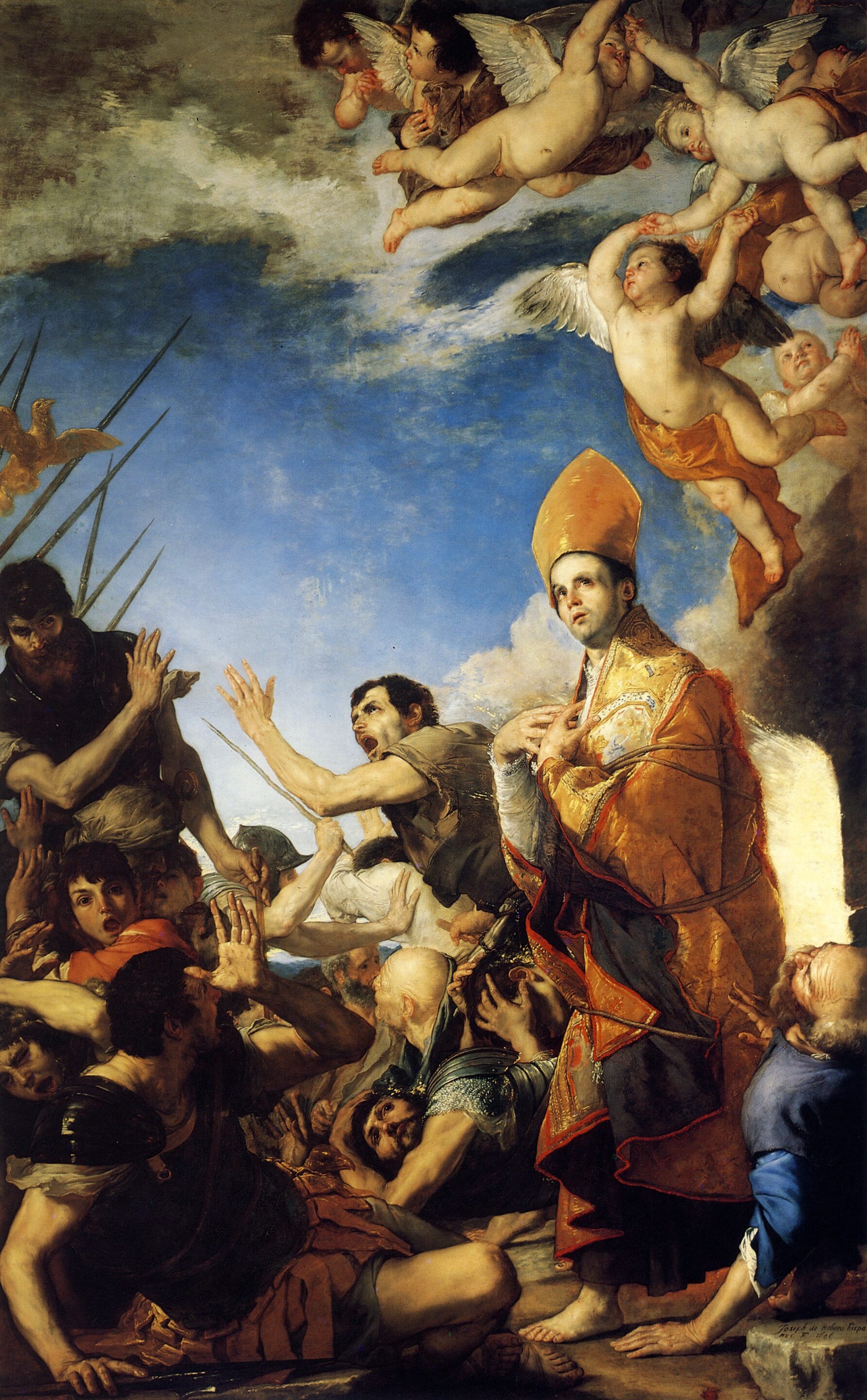
Today, 19 September, the cathedral of Naples fills with people who have come to see whether it happens. Two glass ampoules have held, since the fourth century, a dark solid mass that tradition says is the blood of Saint Januarius. Three times a year it is exposed, and almost always — not always — it turns to liquid.
The bishop of Benevento
Little is known, and the little is firm. Januarius was bishop of Benevento and was killed in the persecution of Diocletian, around 305. He had gone to visit Christians imprisoned at Pozzuoli and was arrested with them.
The acts recount that they were condemned to the beasts in the amphitheatre at Pozzuoli and that the animals would not attack them — and that they were then beheaded near the Solfatara. Tradition says a woman of Naples gathered the blood into two ampoules.
What is documented, and from when
- 1389. That is the date of the first written account of the liquefaction, in an anonymous Neapolitan diary. Since then the records run practically unbroken, year after year, for more than six centuries.
- Three times a year. On the Saturday before the first Sunday of May (the translation of the relics), on 19 September (the feast) and on 16 December (anniversary of the 1631 eruption of Vesuvius).
- It does not always happen. There have been years when it did not liquefy — and Neapolitans tie those failures to disasters: 1939, 1943, 1980, the year of the Irpinia earthquake. That is popular superstition, not doctrine.
- The ampoules have never been opened. Spectroscopic examinations in the 1900s and again in 1989 indicated a spectrum consistent with haemoglobin, but without opening the reliquary no analysis is conclusive.
This matters and is nearly always told badly: the Church has never pronounced on the liquefaction. She has not declared it a miracle, has not imposed it on anyone, has not condemned it. She permits the public cult of Saint Januarius and leaves the phenomenon where it stands.
Nor is anyone obliged to believe in it. A Catholic may hold that there is a natural explanation — several have been proposed, none verified inside the sealed reliquary — and remain a Catholic without the slightest difficulty.
It is worth holding that calmly. Faith does not depend on a phial. But six centuries of records of a phenomenon nobody has reproduced are not to be swept under the carpet either.
Why the city goes
What is striking in Naples on the 19th is not the physics. It is that a whole city — including people who have not been to Mass in years — gathers to look at an object and wait. They call him “our saint”, and speak of him the way you speak of a relative.
There is a familiarity there that more educated religion has lost, and which may be worth more than certainty about the phial: the conviction that the saints are people you know, and not figures in stained glass.
“We honour the relics of the martyrs so that He of whom they are martyrs may be adored.”— Saint Augustine, Contra Faustum
“The blood of the martyrs is the seed of Christians.”— Tertullian, Apologeticus
The prayer of the day
Deus, qui nos beáti Ianúarii mártyris tui atque pontíficis ánnua sollemnitáte lætíficas, concéde propítius, ut, cuius natália cólimus, de eiúsdem étiam protectióne gaudeámus.
O God, who gladden us by the annual solemnity of your blessed martyr and bishop Januarius, graciously grant that, as we celebrate his birth into heaven, we may also rejoice in his protection.
Amen.
Sancte Ianuarie, ora pro nobis. Saint Januarius, pray for us — and teach us to wait without demanding signs.
- Our Lady of Sorrows — on the 15th.
- Words of the saints — a growing collection, in English and Portuguese.

Comments