There was no arena, no crowd, no judge, no sentence. There was a birthday party, a king drunk on vanity in front of his guests, a promise made out loud that he could not take back without losing face, and an executioner sent down to the cells. John the Baptist died of social embarrassment. It is the least glorious martyrdom in the calendar — and that is exactly why the Church keeps it.
The only one with two feasts
Before the story, a fact almost nobody notices. The Church celebrates the birth of three people only: Jesus, Our Lady and John the Baptist. Of all the saints he is the only one whose two dates are both kept — his birth on 24 June, and his death today.
That is not excess affection. It is doctrine in calendar form: the forerunner goes before Christ in everything, including in the manner of leaving. He announced him before being born, baptised him in the Jordan, pointed at him with a finger — and then went ahead of him in prison and in execution too.
The canonical question he died for
It is worth being exact about the reason, because it is stranger than it looks.
Herod Antipas, tetrarch of Galilee, had taken as his wife Herodias, who was his own brother Philip’s wife — and she was still living. John told him, publicly, a sentence of ten words:
“It is not lawful for thee to have thy brother’s wife.” (Mk 6:18)
Notice what is not being said. This is not a denunciation of tyranny, or taxation, or idolatry, or massacre. It is a question of marriage law: that marriage is invalid. John was beheaded for maintaining that a union could not be called a marriage.
Let that settle, because it is the part of the story the twenty-first century finds hardest to swallow — and the part the Church has never given up. The same point, sixteen centuries later, would cost the heads of Thomas More and John Fisher, on an identical question in a different kingdom.
Who actually wanted him dead
Saint Mark’s text is psychologically remarkable and assigns the blame precisely.
Herod did not want to kill him. Mark says he feared John, knowing him to be a just and holy man, and kept him safe; and when he heard him he was perplexed, and yet he heard him gladly (cf. Mk 6:20). It is the portrait of a man fascinated by the truth and incapable of obeying it — who jails the prophet and then goes down to the cells to talk to him.
Herodias wanted it. Mark says she held a grudge and sought to put him to death, and could not. She waited for the occasion. The occasion was a dinner.
At Herod’s birthday, before the leading men of Galilee, Herodias’ daughter danced. The king, showing off, swore to give her whatever she asked, up to half the kingdom. The girl went out to ask her mother what to request. She came back with the answer rehearsed: the head, on a platter, there and then.
And here is the sentence that condemns Herod: “the king was struck sad; yet because of his oath and because of them that were with him at table, he would not displease her” (cf. Mk 6:26). He had a prophet killed to avoid embarrassment in front of his friends. There is no more trivial motive, and no more common one.
The painting at the top of this page
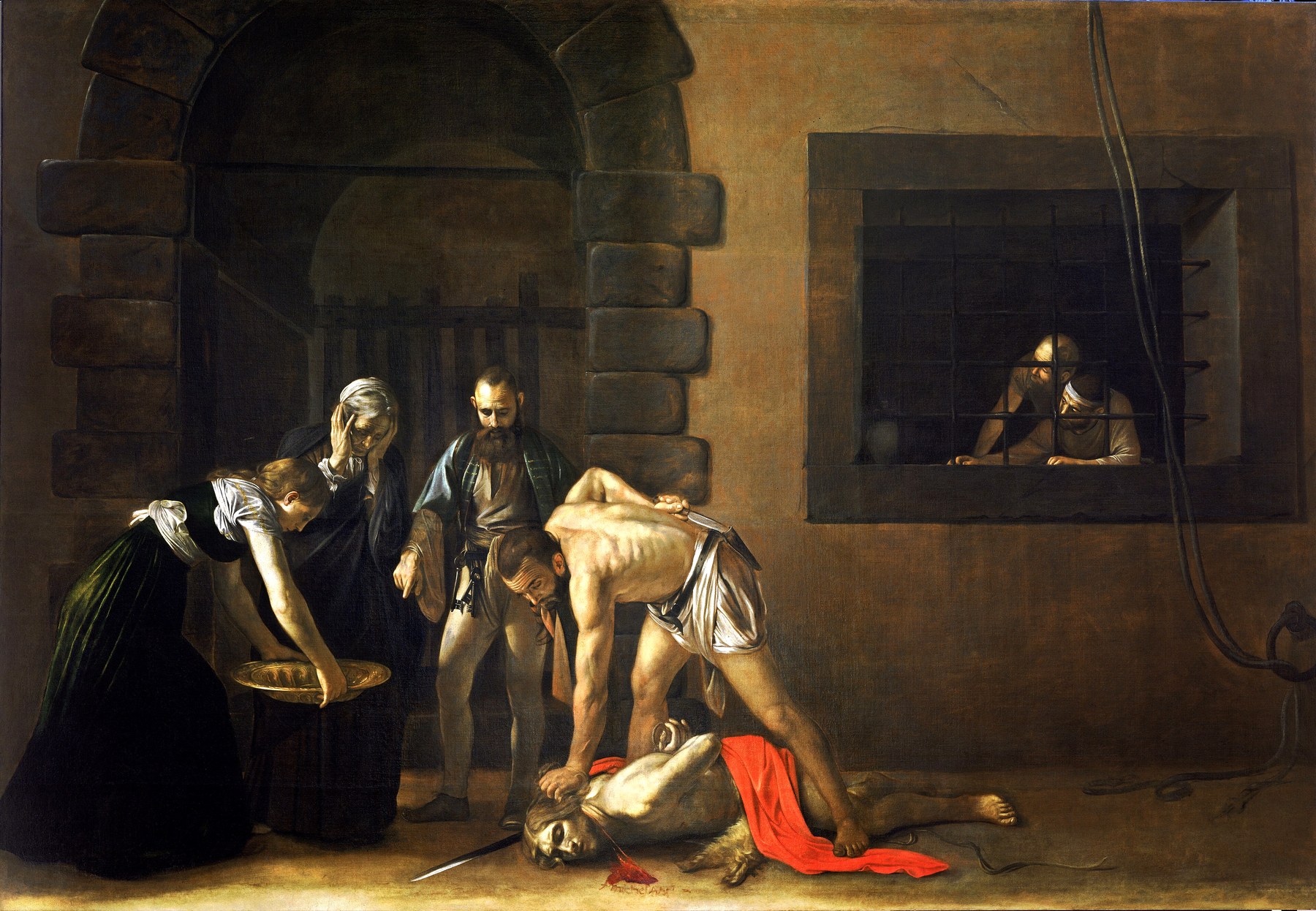
Caravaggio painted this scene in 1608 in Malta, and did something no painter had done with a martyrdom before: he took all the grandeur out of it.
There are no angels, no light from heaven, no palm. There is a prison yard with a huge empty wall, a rope hanging, and two prisoners watching through the window bars — because to them this is entertainment. The body is on the ground. The executioner has already cut once, it was not enough, and he is pulling the knife from his belt to finish the job. The maid holds out the platter with the composure of someone receiving a dish in a kitchen. The old woman on the left has her hands to her head, and is the only person in the picture reacting.
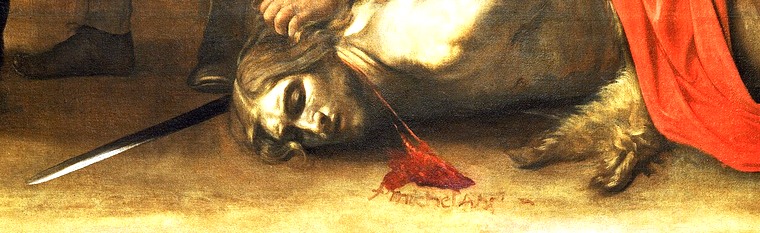
And there is the detail above, one of the most disturbing things in the history of painting. Caravaggio never signed a picture. Not one, in his whole life — except this one. And he signed it in the blood: he wrote his own name inside the pool running from the Baptist’s neck, with the f. for frater, brother, because he had just been received as a knight of the Order of Malta.
A few months later he was arrested after a brawl, expelled from the Order as a “foul and rotten member”, and fled Malta. He died two years afterwards, at thirty-eight. The one painting he ever claimed as his own is the one in which he placed himself, in writing, in the blood of an executed man.
No last words
Notice what is missing from this death. No trial, no defence, no final speech, no witnesses, no honourable grave. John does not know he is dying that night; he has been locked up for months and was probably asleep. Somebody comes down, opens the cell and ends it. He says nothing, because he is given no opportunity to say anything.
It is the exact opposite of everything Christian art usually does with a martyrdom. And it is useful precisely for that: most human faithfulness ends like this — with no audience, no memorable line, and nobody noticing that heroism occurred. John had already done the essential thing long before, when he said ten words to a king knowing the price.
The Gospel closes with a quiet, enormous line: “which his disciples hearing came, and took his body, and laid it in a tomb” (Mk 6:29). Somebody came for him. In a fortress basement, in a kingdom that did not want his name mentioned, a few men turned up to carry off their master’s body and bury it properly. It is the last thing you can do for anyone, and they did it.
“He must increase”
If one sentence sums up the whole life, it is the one he said when his own disciples came to complain that Jesus was baptising more people than he was — that is, when they pointed out that he was being overtaken:
“He must increase, but I must decrease.”
Illum oportet crescere, me autem minui. (Jn 3:30)
Saint John the Baptist, on his own irrelevanceIt is the definition of a forerunner, and the reason he ends as he does. A man whose entire mission was to point at somebody else does not need a glorious ending — and, consistent to the last, he did not get one.
Sancte Ioannes Baptista, ora pro nobis. Saint John the Baptist, pray for us — and win us the nerve to say what has to be said, even when the bill arrives on a platter.
- Saint Lawrence — a martyr who did get last words, and used them for a joke.
- Saint Maximilian Kolbe — another who died on a ten-second decision.
- The call to holiness — the text that closes August.
- Words of the saints — a growing collection, in English and Portuguese.

Comments