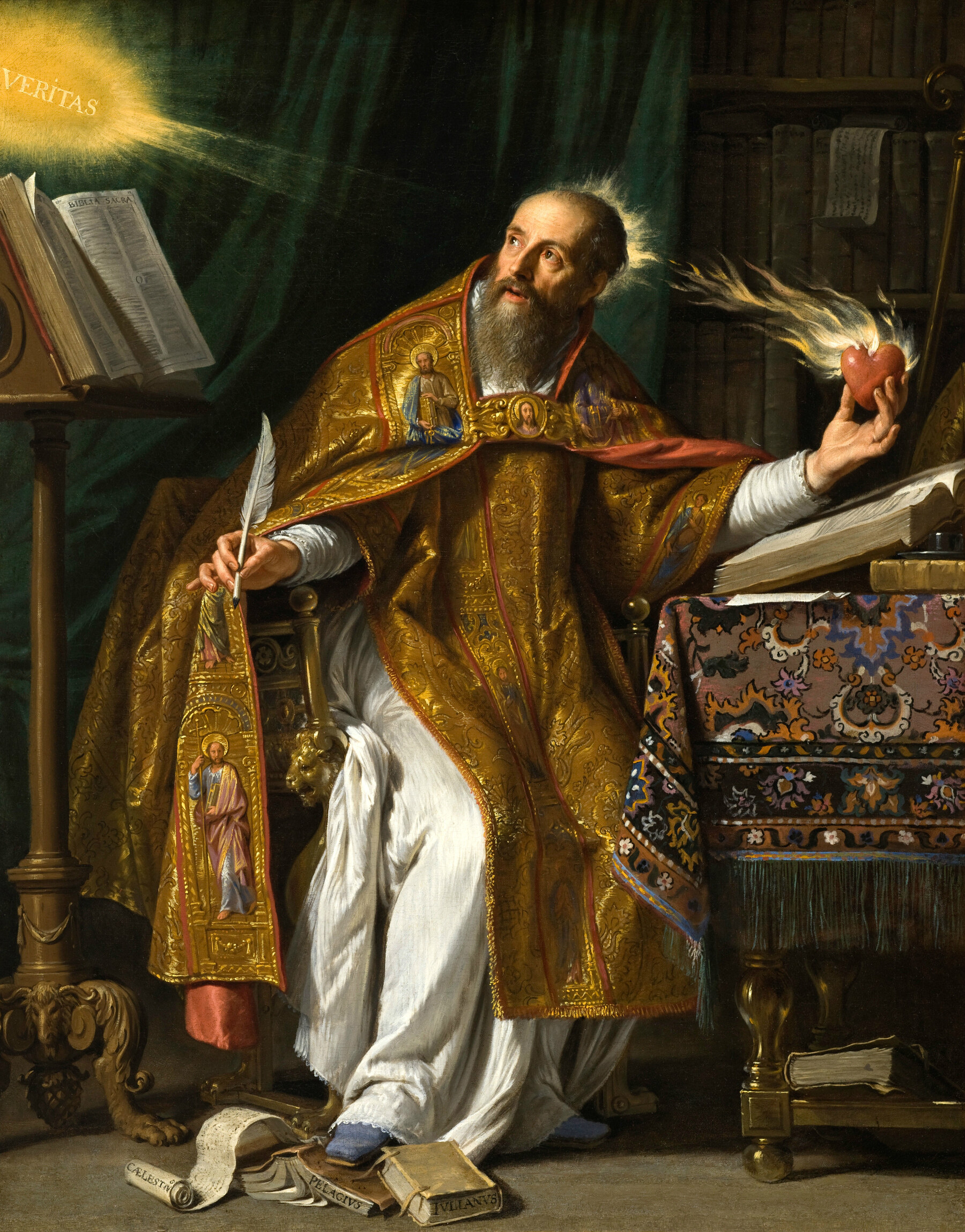
He opens the most influential book of his life with one sentence and spends the next three hundred pages trying to prove it — using himself as the evidence: “you have made us for yourself, and our heart is restless until it rests in you”. That is not a fine opening line. It is a thesis, and the Confessions are the case in which Augustine submits the proofs, all of them against himself.
The pears
If you remember only one story from the Confessions, it is probably this one — and it is nearly always told wrong.
At sixteen, he and a gang of friends stripped a neighbour’s pear tree at night and took the lot. They did not eat them: they threw them to the pigs.
Decades later, a bishop, he returns to the case and examines it with an insistence that has been called excessive. But his point is precise, and the excess is only apparent: the pears were bad. He had better ones at home. He did not steal from hunger, or greed, or need — he stole because it was forbidden. And that is what appals him in his forties: the discovery that there was a moment when he wanted evil for its own sake, at no profit. Purely for the pleasure of standing outside the rule and — he adds — because he was with friends, and alone he would not have done it.
It is the most honest analysis of sin ever written, and it is about spoiled fruit.
The woman he does not name
At seventeen he went to study at Carthage, and there began the life his mother would spend seventeen years trying to undo. He joined the Manichees, made his name teaching rhetoric, and took a woman to live with.
They were together fifteen years and had a son, Adeodatus — “given by God”. He says he was faithful to her the whole time.
Then, in Milan, with his career moving, his family arranged an advantageous marriage, and the woman was sent back to Africa without her son. Augustine writes that she left vowing never to know another man, and that his heart, where she had been joined to him, was cut and wounded, and trailed blood. And then — this is where it hurts — he admits that, unable to endure the two-year wait until the wedding, he took another woman in the interval.
He never writes her name. Some read that as coldness; the likelier reading is the opposite: she was the one person in the book he could protect, and he did.
“Give me chastity — but not yet”
His most quoted prayer is one he confesses with embarrassment, because it describes ours exactly:
“Give me chastity and continence — but not yet.”
Da mihi castitatem et continentiam, sed noli modo.
Saint Augustine, Confessions, VIII, 7He explains the mechanism with clinical clarity: he feared God might hear him too soon, because he wanted to be cured of the disease rather than have the disease taken away. Anyone who has asked God to help them drop something the day after tomorrow knows the sentence is about them.
Tolle, lege
The turn comes in Milan, in a garden, at thirty-one, and it is a scene of collapse — not of serene illumination. He had been intellectually convinced for some time and could not move his will. He writes that he dragged himself under a fig tree and wept like a man who has finally stopped pretending.
And then he heard, from a neighbouring house, a child’s voice repeating in a game: tolle, lege — take and read. He went back, opened Paul’s letter to the Romans at random, and landed on: “put ye on the Lord Jesus Christ, and make not provision for the flesh in its concupiscences” (Rom 13:14).
He says he did not need to read further. He was baptised by Saint Ambrose at Easter 387, together with his son.
The Confessions are generally called the first autobiography in the West, and the description is fair for a specific reason: before him nobody had written about their own interior life — about memory, desire, time, shame — as though investigating an object.
And the title misleads. Confessio, in Christian Latin, does not mainly mean “admission of guilt”: it means praise, acknowledgement out loud. The book is a written prayer — addressed to God from first line to last, in the second person. We are merely listening over his shoulder.
Hippo
He wanted to go back to Africa and live quietly with friends, studying. It did not happen. On a visit to Hippo the congregation surrounded him inside the church and demanded he be ordained a priest — literally shouting, with him in tears. Four years later he was bishop, and he stayed thirty-five years.
He governed a small port diocese, heard civil cases all morning because the bishop was a judge, preached several times a week and, in what was left, wrote some five million words: the Confessions, the City of God, the De Trinitate, over three hundred letters, and hundreds of sermons taken down in shorthand as he spoke. One of his biographers observed that nobody in antiquity left so much material — and he did all of it in the spare hours of a provincial bishop.
The psalms on the wall
The end has the same honesty as the rest. In 430 the Vandals came across North Africa and laid siege to Hippo. Augustine was seventy-five and watched everything he had built burn.
He fell ill during the siege. He then asked that the penitential psalms be copied out on large sheets and pinned to the wall facing his bed, so that he could read them lying down. He spent his last days like that: the greatest theologian in the history of the West, alone in a room, reading psalms of repentance stuck to a wall, weeping.
He died on 28 August 430, with the city under siege. His library survived the siege — practically the only thing that did — and it is the reason we have the texts.
Why the restless heart
Which brings back the opening thesis, now with the evidence in. Augustine did not discover that he was wrong about what he wanted; he discovered he was wrong about where it was. He wanted beauty, pleasure, reputation, friendship, truth — and the argument of the Confessions is not that these are bad, but that none of them is large enough to hold a human being.
“Late have I loved you, Beauty so ancient and so new, late have I loved you! And behold, you were within me and I was outside, and outside I looked for you.”
Sero te amavi, pulchritudo tam antiqua et tam nova, sero te amavi!
Saint Augustine, Confessions, X, 27That is why this saint does not date. The restlessness he describes is the same one that has somebody, tonight, switching tabs for the fortieth time looking for they do not know what. He simply had the uncommon nerve to write down where it took him, and how long it took to arrive.
“You have made us for yourself, and our heart is restless until it rests in you.”— Saint Augustine, Confessions, I, 1
“Late have I loved you, Beauty so ancient and so new, late have I loved you!”— Saint Augustine, Confessions, X, 27
“Give me chastity and continence — but not yet.”— Saint Augustine, Confessions, VIII, 7
Sancte Augustine, ora pro nobis. Saint Augustine, pray for us — and win us the grace to recognise, sooner than you did, where the thing we were looking for outside had been all along.
- Saint Monica — the mother, kept yesterday.
- The call to holiness — what closes the Vocations Month.
- The sacrament of Confession — which he turned into literature.
- Words of the saints — a growing collection, in English and Portuguese.

Comments