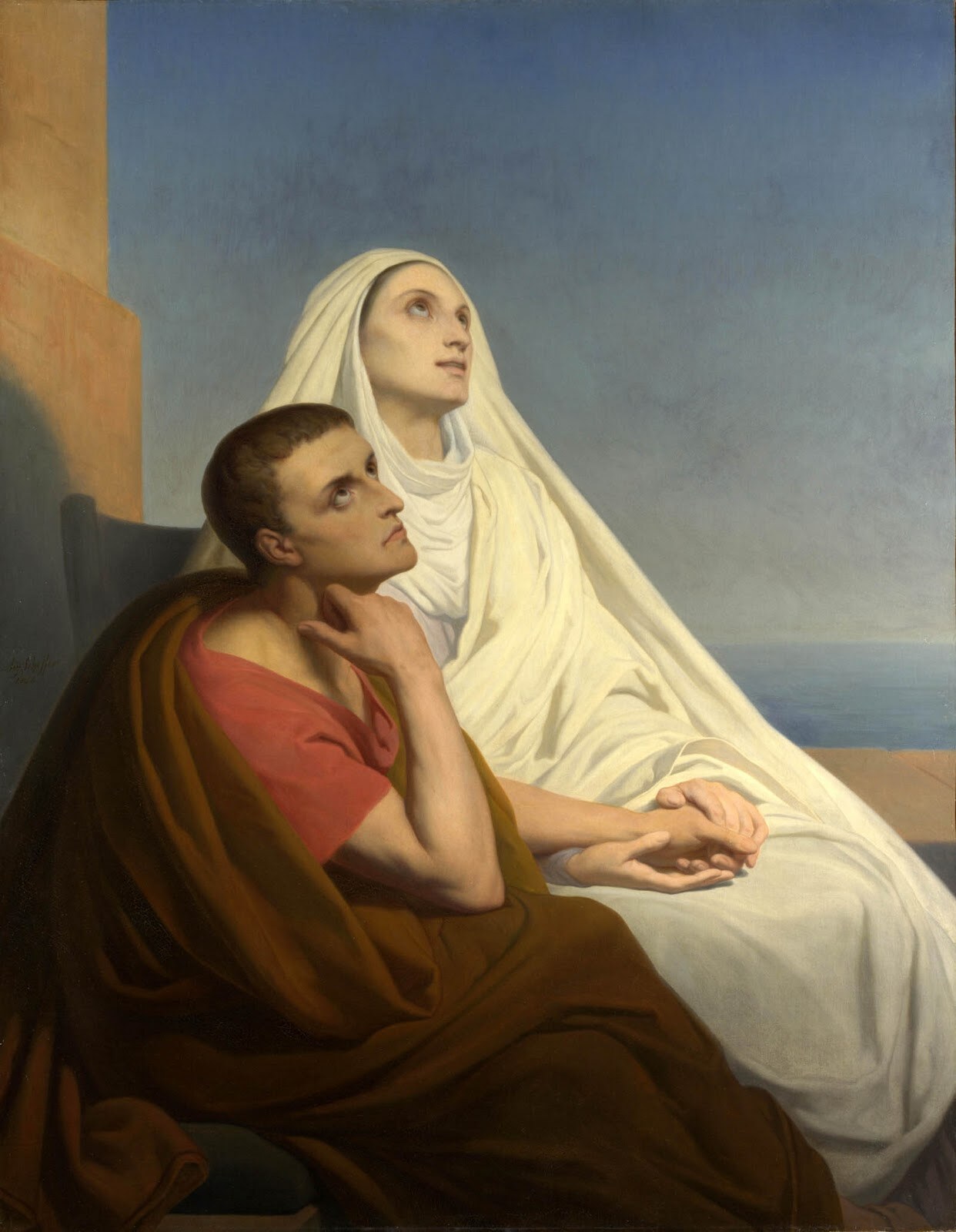
Seventeen years. That is the number that matters in this feast, and it is why the feast is useful. Monica prayed for her son’s conversion for seventeen years — and not seventeen years of rising hope, but seventeen years in which everything got worse: he dropped his mother’s faith, joined a sect, fathered a child outside marriage, moved country to be rid of her, and lied to her face to manage it. If you have been praying for somebody for a long time and nothing is happening, this is the saint who knows exactly where you are.
A girl who drank in secret
It begins with a story Monica told her son, and which the son — being who he was — published in a book the whole world would read.
As a girl in Thagaste she was sent to draw wine from the barrel in the cellar. She began taking a sip before carrying the jug to the table. One sip became two; two became a habit. Until, in an argument, the servant who went with her called her a drunkard. That was all. The shame of the word cured her outright.
Two things are worth noticing. The first is that Augustine put this in the Confessions — about his own mother, already dead, in a text meant for posterity. The second is that she told him. A woman who never pretended to be made of different material from ours, and a son who did not touch her up, is a rare combination in hagiography.
Married to Patricius
She married young to Patricius, a pagan municipal official, bad-tempered and unfaithful. It was not an easy marriage, and Monica developed a method Augustine records with admiration and some humour: she never argued with her husband while he was angry; she waited. Later, with him calm, she explained.
Friends turned up with marks of beatings and asked how she, married to that man, was never hit. Her answer was disconcerting and is her own: that they should look to their own tongues — that many husbands struck after hearing, not before.
Patricius was baptised a year before he died. That one took her decades too.
The night he lied to her
Augustine grew up brilliant and insufferable. At seventeen he went to Carthage, took a partner, had a son — Adeodatus — and joined the Manichees, a sect that despised everything his mother believed. She wept so much that a bishop, tired of her visits, gave her the line that stuck:
“Go your way, and leave me. It is not possible that the son of these tears should perish.”
A bishop of Thagaste to Monica — Confessions, III, 12But the worst had not yet happened. Augustine decided to go to Rome, and Monica, who followed him everywhere by now, resolved to go with him. He did not want that.
So he lied. He told her he was only seeing a friend off, left her praying in a chapel by the harbour at Carthage, and sailed in the night. She woke on the quay, alone, with the ship already gone. Augustine describes the scene in the Confessions with a shame you can still feel sixteen centuries later — and writes that she wept, and that the next day she took the next ship.
Milan
She caught up with him in Rome, then in Milan, and there the turn came — not because she said anything new, but because she was there when things moved. It was Monica who got him to go and hear Saint Ambrose preach, and Augustine went out of professional curiosity: he wanted to assess the man’s style. He stayed for the content.
She saw her son baptised by Ambrose at Easter 387. She was fifty-five and he was thirty-three. It had taken seventeen years.
The window at Ostia
They were on their way back to Africa, waiting for a ship in the port town of Ostia, when the scene took place that is probably the most beautiful passage ever written by a son about a conversation with his mother.
The two of them were leaning on a window overlooking an inner garden, alone, talking very sweetly about what the eternal life of the saints would be like. And as they talked, the conversation climbed: past bodies, past the sky, past the sun and the stars, as far as their own souls — and for one instant they lightly touched what they were looking for, and then came back to the sound of their own voices.
She then told him she had nothing left to do in this world. That the one thing holding her was the desire to see him a Catholic before she died, and that God had given her that with something to spare.
Five days later she fell ill. Within nine days she was dead, at fifty-six.
Monica had spent her life planning to be buried beside her husband at Thagaste. She had even had the tomb prepared. It mattered a great deal to a fourth-century woman.
On her deathbed at Ostia her sons asked whether it did not distress her to die so far from home. Her answer cancels everything she had arranged:
“Lay this body anywhere; do not let care about it trouble you. This only I ask: that you remember me at the altar of the Lord, wherever you are.”
It is the cleanest definition there is of what praying for the dead means — and it comes from someone who had just been given, at the last minute, the one thing she had asked for all her life.
Why this saint is useful
There is a bad way of telling this story: the one in which Monica’s prayer “worked”, as if it were a method with a guaranteed result. That is not what the text says.
- It took seventeen years, and she did not know it would be seventeen. It could have been forty. It could have not happened.
- It got worse before it got better. Every year brought news worse than the year before. She carried on.
- She got the method wrong at times. She pursued, she pressed, she wept where perhaps she should have kept quiet. Augustine says plainly that his mother loved him “more than most mothers” and that this did not always help.
- She is not the one who converted him. That was Ambrose preaching, a book, a child’s voice in a garden. She only made sure he was nearby when it happened — which is exactly what a mother can do.
That is why she is the patron of mothers, of wives of difficult husbands, and above all of anyone praying for somebody who is not coming back. Tomorrow the Church keeps the son: Saint Augustine. Two feasts on consecutive days is not a calendar coincidence. It is one sentence said in two parts, and the first part is the one that cost seventeen years.
Sancta Monica, ora pro nobis. Saint Monica, pray for us — and win for those who have prayed for years without seeing anything the grace not to stop in the year that was missing.
- Saint Augustine of Hippo — the son, kept tomorrow.
- Marriage and the domestic Church — the home as the first place of faith.
- Do not give up — on carrying on when nothing shows.
- Words of the saints — a growing collection, in English and Portuguese.

Comments