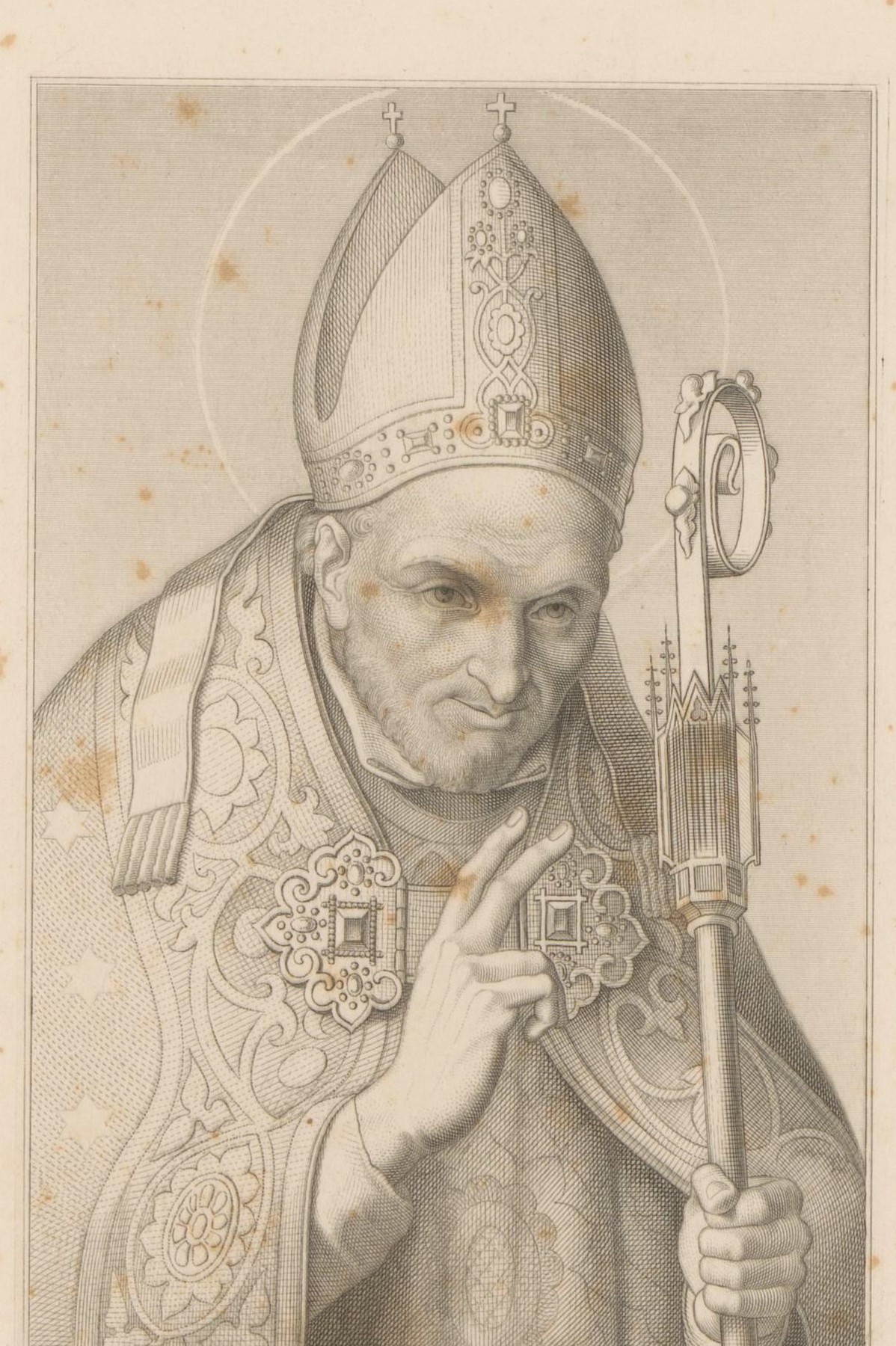
Today, 1 August, the Church keeps the feast of Saint Alphonsus Mary Liguori (1696–1787) — the brilliant lawyer who walked out of the courts, the bishop who bent double under illness and never stopped writing, the founder of the Redemptorists, and one of the Doctors of the Church. He is the man who rescued moral theology from rigorism and handed it back to mercy; the man who wrote that he who prays is saved. Here is his life, his work, why the Church named him a Doctor, his famous books — and, at the end, his prayer, in Latin and English.
The lawyer who never lost a case
He was born on 27 September 1696 at Marianella, just outside Naples, the eldest son of a family of the minor nobility. He was a boy of frightening gifts. Taught at home by the best masters, he held a double doctorate — in civil and canon law — from the University of Naples by the age of sixteen, so young that he needed a dispensation to receive the degree, and so small that the gown swallowed him and the hall laughed when he stood.
He set up practice, and for about eight years he was one of the most sought-after advocates in the city. It was said he never lost a case. Until, in 1723, in a great suit between powerful houses, he overlooked one detail in a document — a clause that turned the whole law of the matter against his client. He lost, in open court. He went home, refused food for days, and said the sentence that ends a life: “O world, now I know you.” The honour he had chased so hard had shown itself, in an instant, to be the size of a sheet of paper.
The sword on Our Lady’s altar
It was not the defeat that converted him, but what came after it. Alphonsus began to spend his days at the Hospital for Incurables, serving the most abandoned sick of Naples. It was there, among those wards, that he heard within himself, with complete clarity: “Leave the world and give yourself to me.” He rose, went out, and walked to the church of Our Lady of Ransom. Before her altar he unbuckled his gentleman’s sword and laid it on the stone. The lawyer had changed courts.
Against his father’s furious will he entered the studies for the priesthood and was ordained on 21 December 1726, at the age of thirty. In Naples he gathered the labourers and the poor into “evening chapels” — small nightly circles of prayer, led by the laymen themselves, which grew into the hundreds. Everything he would become was already there: a man consumed by the souls no one else was looking for.
The Redemptorists: a mission to the forgotten
Ill health sent him to rest in the hills of Scala, above Amalfi, and there he discovered, appalled, the spiritual abandonment of the countryside: whole villages of goatherds and peasants who almost never saw a priest, died without the sacraments, and did not know the essentials of the faith. It struck him as a second vocation inside the first. On 9 November 1732 he founded at Scala the Congregation of the Most Holy Redeemer — the Redemptorists — with a single aim: to go after the poorest, most forgotten souls, preaching popular missions.
And he preached in a deliberately plain way. He forbade his men their flourishes: a sermon, he said, must be able to be understood by the oldest and least lettered woman in the back pew, or it is useless. “Preach,” he ordered, “so that no one need ask what you meant.” It was the eloquence of the advocate placed at the service of those who had no advocate at all. In 1762, at sixty-six, the Pope compelled him to accept the bishopric of Sant’Agata dei Goti; he governed it with reform and charity until illness forced him to resign in 1775 and return to his own.
The work: the Doctor the Church needed
Alphonsus wrote as long as he lived — some 111 works, from the highest theology to the humblest tract, later translated into more than seventy languages, which makes him one of the most widely read Catholic authors in all of history. But the heart of his work, and the reason for his doctorate, lies in moral theology.
His age was caught between two errors. On one side, a rigorism of Jansenist temper that filled the faithful with fear, delayed absolution, drove souls from Communion, and made of God a judge impossible to satisfy. On the other, a laxism that made light of sin. In his monumental Theologia Moralis, Alphonsus opened a firm and merciful road between them — a prudent method by which the confessor could lead a soul without crushing it and without deceiving it. He gave back to the sacrament of confession its face of mercy. It is no accident that in 1871 Pope Pius IX proclaimed him a Doctor of the Church, and that tradition gave him the title Doctor Zelantissimus — the “Most Zealous Doctor,” the most ardent for souls. Later, in 1950, Pius XII declared him the heavenly patron of all confessors and moral theologians.
The Glories of Mary (1750) — his Marian masterpiece, a commentary on the Salve Regina gathering what the Fathers and saints said of Our Lady; still the most influential book of Marian devotion ever written.
The Practice of the Love of Jesus Christ (1768) — which he considered his most useful work; a meditation on the love of Christ built on Saint Paul’s “hymn of charity.”
Uniformity with God’s Will — a small treatise he said would be enough, if practised, to make a saint.
Preparation for Death — meditations on the eternal truths, a classic of retreats.
Visits to the Blessed Sacrament and to the Blessed Virgin Mary — thirty-one short visits that formed generations in Eucharistic adoration.
The Great Means of Prayer (1759) — the book we come to next. And, in a wholly different key, it was he who composed the Christmas carol “Tu scendi dalle stelle” — Alphonsus was a musician and painter too.
“He who prays is saved”: the Doctor of prayer
If one sentence sums up Saint Alphonsus, it is this: “He who prays is saved; he who does not pray is damned.” He wrote it in his treatise The Great Means of Prayer, and he said that, if he could, he would print that book in enough copies to place one in the hand of every person on earth. His thesis is simple and cutting: the grace to persevere and be saved, God ordinarily grants to those who ask for it — and not to ask is, in the end, to refuse it.
So for Alphonsus prayer is no ornament of the devout life but the necessary means of salvation: the rope thrown to a drowning man. It is the same conviction that runs through the spiritual-direction texts on this site about offering the day to God — begin early, begin simply, and never stop asking.
The Glories of Mary
Alphonsus loved Our Lady with the love of a son and of a doctor at once. In the Glories of Mary he defended, with all the authority of his learning, that Mary is the Mediatrix of all graces — that God, having given us everything in Christ, willed those gifts to reach us through the hands of the one who is Full of Grace. And he left a promise that has consoled millions: it is impossible for a faithful servant of Mary to be lost, one who honours her and has recourse to her. When the weight comes, Alphonsus’s remedy is always the same — to turn to her.
And, in passing, Italy’s Christmas carol
There is a detail that almost never makes the biographies and says a great deal about the man. Alphonsus was a trained musician — he played the harpsichord from childhood, and well enough to perform in public.
At Christmas 1732, during a parish mission in the countryside near Naples, he wrote both words and melody for a carol in Neapolitan dialect for the peasants to sing at the crib. It is called Tu scendi dalle stelle — “You come down from the stars”.
Nearly three hundred years later it is still the most sung Christmas carol in Italy: it is in every church, every piazza and every house in the country each December, and most of the people singing it have no idea the words belong to a Doctor of the Church.
It is worth noticing what that reveals about his method. The same man who wrote the volumes of Moral Theology that confessors would use for two centuries sat down to make a song simple enough for a goatherd to memorise — because, once again, the target was the people nobody else was going after. His most widely known work is not a treatise. It is a Christmas song.
The dark night and a holy death
Alphonsus’s last years were one long passion. A fierce rheumatic arthritis bent his spine and drove his chin into his chest — the deformity art has fixed forever — so severely that a hollow had to be cut in his collar and, at last, his beard shaved because the skin was raw. To all this were added years of scruples and a true dark night, in which the man who had taught half the world to trust in mercy saw himself at the edge of the abyss.
And there was added the hardest humiliation of all: the affair of the Regolamento in 1780, when, nearly blind and deaf, he was manoeuvred by others into signing an altered version of the Rule of his own congregation — and ended, by decree, excluded from the order he had himself founded. He accepted it all in silence. He died on 1 August 1787 at Pagani, aged ninety, at the noonday Angelus, his eyes fixed on an image of Mary. He was canonized in 1839 by Gregory XVI. From the loss of a lawsuit to exclusion from his own religious family, his life was a long lesson in what he most preached: to give oneself over and to conform one’s will to God’s.
- Prayer is necessary. Not a pious extra, but the means by which the grace of perseverance is asked for and received.
- Mercy is greater. Against the rigorism that drives away, the confessor must lead the soul to God, not lock it outside.
- Do the will of God. All perfection consists in uniting our will to His — in health and in sickness, in honour and in humiliation.
- Love Jesus Christ. The whole holiness of a soul comes down to a single verb: to love.
- Have recourse to Mary. Mediatrix of all graces, sure refuge of those who entrust themselves to her.
The prayer of Saint Alphonsus
No practice is so bound to his name as the Spiritual Communion: the act by which, when we cannot receive the Eucharist, we ask Jesus to come at least spiritually into the heart. The form below is the one Saint Alphonsus left in his Visits to the Blessed Sacrament, and which the Church has prayed in his words ever since.
“My Jesus, I believe that you are truly present in the Most Holy Sacrament of the altar. I love you above all things and I desire to receive you into my soul. Since I cannot now receive you sacramentally, come at least spiritually into my heart. I embrace you as if you were already there, and unite myself wholly to you; never permit me to be separated from you.”
Iesu mi, credo Te in sanctissimo Eucharistiae Sacramento vere praesentem esse… veni saltem spiritualiter in cor meum. Ne permittas me umquam a Te separari.
Spiritual Communion — Saint Alphonsus, Visits to the Blessed SacramentWords of Saint Alphonsus
Some of his sentences are now kept in this site’s collection of the quotes of the saints:
“He who prays is saved; he who does not pray is damned.”— St Alphonsus Liguori, The Great Means of Prayer
“All the holiness and perfection of a soul consists in loving Jesus Christ.”— St Alphonsus Liguori, The Practice of the Love of Jesus Christ
“It is impossible for a faithful servant of Mary, who honours her and has recourse to her, to be lost.”— St Alphonsus Liguori, The Glories of Mary
You can read them beside Augustine, Teresa, the Curé of Ars and many others in the collection of the quotes of the saints here on the site.
Sancte Alphonse, ora pro nobis. Saint Alphonsus, pray for us — and win for us the grace you most preached: never to stop praying, and to trust, to the last day, in the mercy that does not tire.
- Saint Bonaventure, the Seraphic Doctor — another Doctor of the Church, the theologian who joined learning and love.
- Saint Ignatius of Loyola — the soldier who traded the sword for the mission; yesterday’s feast, 31 July.
- Marian consecration — according to St Louis de Montfort, the other great doctor of love for Mary.
- Prayers of Carmel — more Latin prayers with translation, in the same vein as this one.
- Quotes of the saints — a growing collection, in English and Portuguese.

Comments