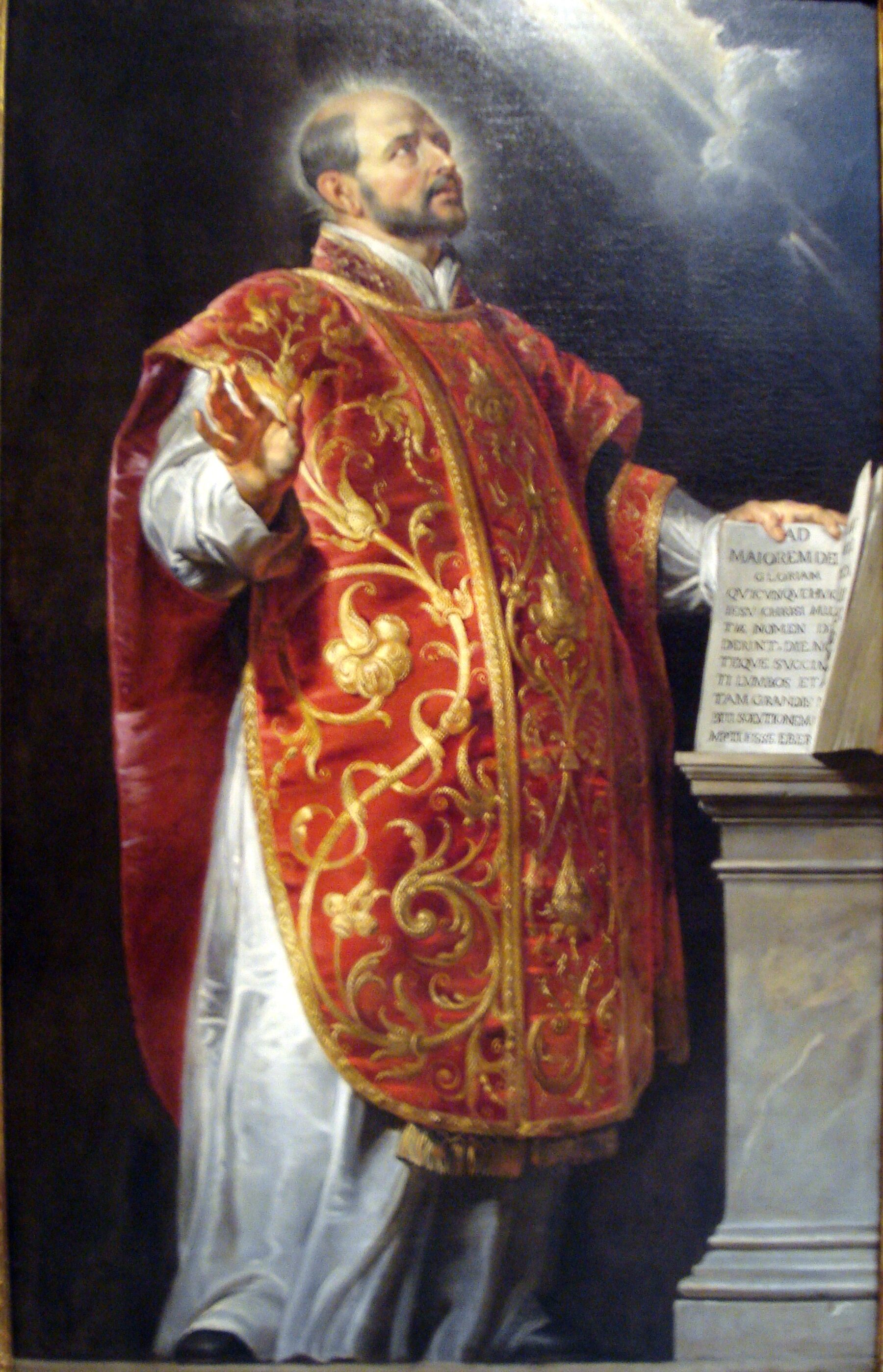
Today, 31 July, the Church keeps the feast of Saint Ignatius of Loyola (1491–1556) — a Basque soldier whose leg was shattered by a cannonball, who read two books because there was nothing else to read, and who ended by founding the Society of Jesus and giving the Church the Spiritual Exercises. This is his life, the order he founded, the heart of his spirituality, and the prayer of total surrender he left us, in Latin and English.
The cannonball at Pamplona
He was born Íñigo López de Loyola in 1491, the youngest of thirteen children, in the tower-house of Loyola at Azpeitia in the Basque country. He was sent as a boy to the household of the chief treasurer of Castile, and there he became exactly what a minor nobleman of his century was meant to become: a courtier and a soldier, vain about his appearance, quick with a sword, and by his own later admission “given over to the vanities of the world.”
On 20 May 1521 the French stormed the citadel of Pamplona. The garrison wanted to surrender; Íñigo would not hear of it. A cannonball passed between his legs, shattering the right one and tearing the left. The fortress fell within hours. His enemies, impressed by his courage, carried him home on a litter to Loyola, where the bone was set badly, broken again, and re-set — a butchery he endured without a sound, partly so that his leg would look well in the tight hose of a courtier.
Two daydreams, and the discovery of a lifetime
The convalescence took months, and he was bored. He asked for the chivalric romances he loved. There were none in the house. All they could find were two books: a Life of Christ by Ludolph of Saxony, and the Flos Sanctorum — a collection of the lives of the saints.
He read them because there was nothing else, and then he began to notice something. When he daydreamed about serving a great lady and winning glory in arms, the dreaming was delicious — and afterwards he was left dry, restless, sad. When he daydreamed about doing what Saint Francis and Saint Dominic had done, that too was delightful — but afterwards the joy stayed. He was still consoled hours later.
That observation, made by a bored convalescent on his back in a Basque manor house, became one of the most influential discoveries in the history of Christian spirituality: consolation and desolation can be read. The movements of the heart are not random. They have authors, and one can learn to tell them apart. Everything Ignatius later wrote about the discernment of spirits grows out of that bedroom.
Montserrat and the cave at Manresa
In early 1522 he left home for good. At the Benedictine abbey of Montserrat he made a general confession of his whole life over three days, gave his fine clothes to a beggar, put on rough sackcloth — and then kept an all-night vigil before the image of Our Lady, at the end of which he hung up his sword and dagger beside her altar and never carried a weapon again. The knight had changed masters.
He meant to sail for Jerusalem. Plague and shipping delayed him at the little town of Manresa, and he stayed there about eleven months — the decisive year of his life. He begged his bread, let his hair and nails grow, prayed seven hours a day and scourged himself. He was also nearly destroyed: a storm of scruples fell on him, an obsessive terror that his sins were unforgiven, so black that he was tempted to throw himself from a window. He came out of it by sheer obedience and by learning, at his own cost, that such thoughts do not come from God.
And then, sitting one day by the river Cardoner, he was given an illumination he could never afterwards describe. He said only that in that hour he understood more than in all the rest of his life put together, and that if all the truths of the faith were taken from him he would still be ready to die for them because of what he saw that day. Out of Manresa he came with a notebook. That notebook became the Spiritual Exercises.
The book that made retreats
The Spiritual Exercises is not a book to be read. It is a manual for the person giving a retreat — a set of instructions, meditations, examinations and rules, tested first on Ignatius himself and then on hundreds of others, and refined over twenty-five years before he let it be printed. Paul III approved it in 1548.
First Week — sin, mercy, and my own history seen honestly; the grace of shame and gratitude rather than despair.
Second Week — the life of Christ, meditated scene by scene, with the great choices: the Call of the King, the Two Standards, the Three Kinds of Humility.
Third Week — the Passion, walked through slowly, asking to suffer with Christ suffering.
Fourth Week — the Resurrection, and the grace of joy; closing with the Contemplation to Attain Love, where the Suscipe is prayed.
Its opening principle is one sentence that Ignatius never let anyone soften: “Man is created to praise, reverence, and serve God our Lord, and by this means to save his soul.” Everything else in the book — and arguably everything else in his life — is a working out of that.
Friends in the Lord: the Society of Jesus
He was thirty-three when he went back to school, sitting with boys to learn Latin grammar in Barcelona. Then Alcalá and Salamanca, where he was twice questioned and briefly imprisoned by the Inquisition for teaching about the spiritual life without a theology degree; he was forbidden to speak of such things until he had studied properly. So he went to Paris, and studied properly, and took his Master of Arts.
In Paris he gathered friends, one at a time, mostly by giving them the Exercises. On 15 August 1534, the feast of the Assumption, seven of them climbed to the chapel of Saint-Denis on Montmartre: Ignatius, Peter Faber (the only priest among them, who said the Mass), Francis Xavier, Diego Laínez, Alfonso Salmerón, Nicolás Bobadilla and Simão Rodrigues. They vowed poverty, chastity, and a pilgrimage to Jerusalem. They had no plan to found an order. They called themselves simply amigos en el Señor — friends in the Lord.
Jerusalem proved impossible; war closed the sea. They were ordained in Venice in 1537 and put themselves at the disposal of the Pope instead. On the road to Rome, at a roadside chapel at La Storta, Ignatius was given a vision of the Father placing him with the Son who carried His cross, and the words “Ego vobis Romae propitius ero” — “I will be favourable to you in Rome.”
On 27 September 1540 Pope Paul III approved the new order in the bull Regimini militantis Ecclesiae. Ignatius insisted it bear no founder’s name and no place’s name, but the name of Jesus: the Society of Jesus. He was elected its first Superior General in 1541, refused, was elected again, and gave in only when his confessor told him to.
He then spent his last fifteen years mostly at a desk in Rome, writing the Constitutions and some six thousand eight hundred letters — governing by post an order that had gone to India with Xavier, to Brazil, to the Congo, to Japan. He founded the Roman College in 1551, the ancestor of the Gregorian University, and made teaching a work of the order; the Jesuit school was born. When he died there were about a thousand Jesuits, twelve provinces and more than thirty colleges.
A quiet death, and the Church’s verdict
He died early on the morning of 31 July 1556 in his room beside the Roman church of Santa Maria della Strada, aged sixty-five. It came faster than anyone expected: the man who had directed thousands of souls to a holy death died so suddenly that there was no time to bring him the last sacraments. He was beatified by Paul V in 1609 and canonised by Gregory XV on 12 March 1622 — on the same day as Francis Xavier, Teresa of Ávila, Philip Neri and Isidore the Farmer. His body lies in the Church of the Gesù in Rome. In 1922 Pius XI declared him the heavenly patron of all spiritual exercises and retreats, which is to say: of the very practice of going apart to let God rearrange your life.
The heart of Ignatian spirituality
Ignatius is not a mystic of the cloister. His holiness is designed to work in traffic. Jerónimo Nadal, who knew him, described him in two words that have stuck ever since: in actione contemplativus — contemplative in action.
- Finding God in all things. Not withdrawal from the world but attention to it; God is met in the work, the person, the interruption in front of you.
- Indifference. Not coldness — freedom. Holding health and sickness, riches and poverty, honour and dishonour loosely enough that you can choose whichever better serves the end for which you were made.
- Discernment of spirits. Learning to read consolation and desolation, and to distrust the beautiful thought that leaves you agitated.
- The Examen. Five minutes at the end of the day, reviewing it with God. Ignatius held on to this one when he let his men drop almost everything else.
- The magis. Never simply “good” but the greater — the more useful service, the more loving choice.
- Sentire cum Ecclesia. Thinking and feeling with the Church, in obedience, especially where obedience costs.
“Love ought to show itself in deeds more than in words.”
El amor se debe poner más en las obras que en las palabras. — Spiritual Exercises 230
Ad Maiorem Dei Gloriam
Ignatius wrote a phrase so often that it became the signature of everything he founded: Ad Maiorem Dei Gloriam — for the greater glory of God. It runs through his letters and through the Constitutions, usually as a test rather than a slogan: of two good options, which one is ad maiorem? Generations of Jesuit schoolboys shortened it to four letters at the head of a page — AMDG — so that even a Latin exercise was offered up.
Those four words are also, quite deliberately, the name of a company. AMDG Core is the studio I run with Felipe Cunha; we design and build websites and brand identities. We took the name from Ignatius’s motto because a motto is supposed to be a measure, not a decoration: that ordinary commercial work — code, type, a client’s launch — can be done carefully and offered for the greater glory of God, or done carelessly and offered to nothing at all. On his feast day it seemed right to say where the name came from.
The prayer of Saint Ignatius: the Suscipe
At the very end of the Exercises, in the Contemplation to Attain Love, Ignatius puts into the retreatant’s mouth the most complete act of surrender in the Church’s prayer books. It is short. It is also, if you mean it, the hardest prayer there is.
Sume et suscipe, Domine, universam meam libertatem. Accipe memoriam, intellectum atque voluntatem omnem. Quidquid habeo vel possideo, mihi largitus es: id tibi totum restituo, ac tuae prorsus voluntati trado gubernandum. Amorem tui solum cum gratia tua mihi dones, et dives sum satis, nec aliud quidquam ultra posco.
Take, Lord, and receive all my liberty, my memory, my understanding, and my entire will — all that I have and possess. You have given it all to me; to You, Lord, I return it. It is all Yours; dispose of it wholly according to Your will. Give me only Your love and Your grace, for that is enough for me.
Amen.
And this second prayer is not his — it is older, from the fourteenth century — but Ignatius loved it so much that he set it at the front of the Spiritual Exercises and told his men to pray it. It has been known as an Ignatian prayer ever since.
Anima Christi, sanctifica me.
Corpus Christi, salva me.
Sanguis Christi, inebria me.
Aqua lateris Christi, lava me.
Passio Christi, conforta me.
O bone Iesu, exaudi me.
Intra tua vulnera absconde me.
Ne permittas me separari a te.
Ab hoste maligno defende me.
In hora mortis meae voca me.
Et iube me venire ad te,
ut cum Sanctis tuis laudem te
in saecula saeculorum.
Soul of Christ, sanctify me.
Body of Christ, save me.
Blood of Christ, inebriate me.
Water from the side of Christ, wash me.
Passion of Christ, strengthen me.
O good Jesus, hear me.
Within Thy wounds hide me.
Suffer me not to be separated from Thee.
From the malignant enemy defend me.
In the hour of my death call me.
And bid me come unto Thee,
that with Thy saints I may praise Thee
for ever and ever.
Amen.
Words of Saint Ignatius
Two of his sayings are already kept in the collection of saints’ quotes on this site:
“The mortified man can enter into the presence of God in five minutes.”— St. Ignatius of Loyola
“There will be no excuse if we are not good and perfect, for God on His part never fails.”— St. Ignatius of Loyola
Both are in the growing collection of quotes of the saints here on the site, where you can read them alongside Augustine, Teresa, John Vianney and the rest.
Tradition also puts on his lips the charge he is said to have given his men as he sent them out across the world — four Latin words that have been shouted from Jesuit pulpits ever since: “Ite, inflammate omnia.” Go, set everything on fire.
Sancte Ignati, ora pro nobis. Saint Ignatius, pray for us — and obtain for us the grace to want, in the small things of today, not merely the good but the greater glory of God.
- Saint Benedict of Nursia — the father of Western monasticism, his Rule, and the Medal explained letter by letter.
- Five ways to offer your day to God — the morning offering, which is the Suscipe made practical.
- Quotes of the saints — a growing collection, in English and Portuguese.


Comments Comentários