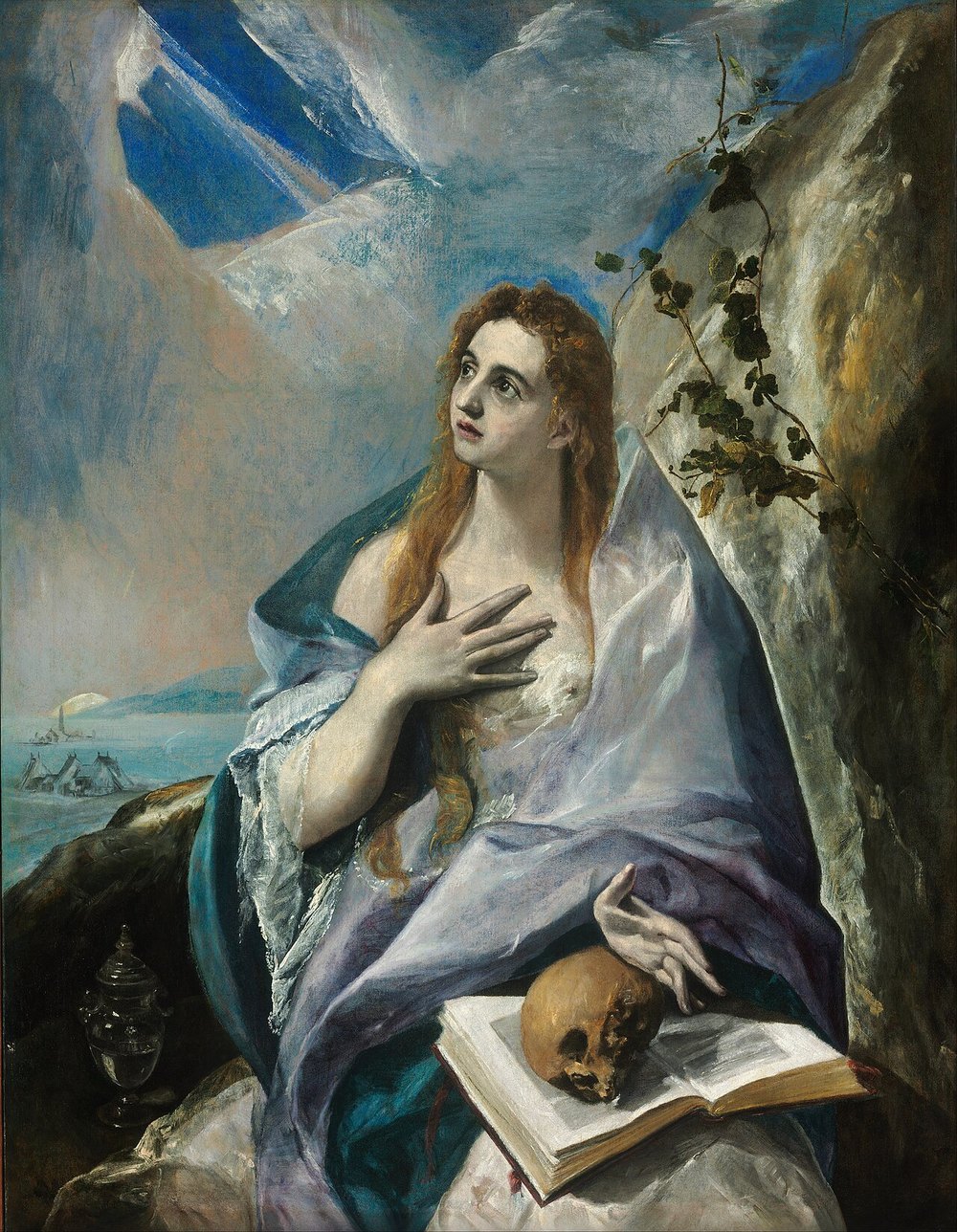
On the 22nd of July the Church keeps the feast of Saint Mary Magdalene — the woman from whom the Lord cast out seven demons, who stood by His Cross when almost everyone else had fled, and who, in the grey light of Easter morning, became the first human being to see the Risen Christ and the first to be sent to proclaim Him. Ancient tradition gives her a title that no other woman of the Gospel carries: apostola apostolorum, the Apostle to the Apostles.
Her life in the Gospels
Mary is called “Magdalene” after Magdala, a fishing town on the western shore of the Sea of Galilee. Saint Luke introduces her among the women who followed Jesus and provided for Him out of their own means: “Mary who is called Magdalen, out of whom seven devils were gone forth” (Lk 8:2). Whatever the “seven devils” precisely were — the number seven signifying a bondage that was total — she had been utterly delivered by Christ, and her whole remaining life was the answer of a soul that had been given back to itself.
From that healing she never left Him. She is named at the Crucifixion in all four Gospels, standing near the Cross with the Mother of God when the apostles, save John, had scattered. She followed the body to the tomb and watched where it was laid. And when the Sabbath had passed, it was she who came first, in the dark, to anoint the dead — and found the stone rolled away.
“Mary”: the first witness of the Resurrection
Saint John gives us the scene with unforgettable tenderness. Weeping at the empty tomb, she takes the Risen Lord for the gardener: “Woman, why weepest thou? whom seekest thou?” He asks; and she answers, “Sir, if thou hast taken him hence, tell me where thou hast laid him, and I will take him away” (Jn 20:15). Then comes one of the most beautiful moments in all of Scripture — a single word:
“Jesus saith to her: Mary. She turning, saith to him: Rabboni (which is to say, Master)” (Jn 20:16).
He is known by the calling of her name. And immediately she is not allowed to keep Him for herself but is turned outward, into mission: “Do not touch me, for I am not yet ascended to my Father. But go to my brethren” (Jn 20:17). She obeys at once — “Mary Magdalen cometh, and telleth the disciples: I have seen the Lord” (Jn 20:18). The Gospel of the Resurrection is first entrusted to a woman, and the men who would preach it to the world first receive it from her lips.
The penitent who loved much
In the Latin West a venerable tradition, shaped above all by Pope Saint Gregory the Great in a homily of the year 591, joined Mary Magdalene with the sinful woman who washed the Lord’s feet with her tears in Luke 7, and with Mary of Bethany, the sister of Martha and Lazarus. Of that penitent woman Jesus said: “Many sins are forgiven her, because she hath loved much” (Lk 7:47) — a line that the West heard as the very portrait of the Magdalene. The Christian East, by contrast, kept the three figures distinct, and modern study leans the same way; the Roman calendar since 1969 no longer identifies them.
Yet the image the West received is not a mistake to be simply discarded, for it carries a true doctrine: that no past, however dark, is beyond the reach of Christ’s mercy, and that great forgiveness begets great love. Whether or not she was the woman of Luke 7, Mary Magdalene remains in the Church’s memory the icon of the converted heart — the penitent whose love outran her sin, and outran, in the end, the faith of the Twelve.
What the saints and the Church say of her
The Fathers and Doctors did not hesitate to raise her high. Saint Gregory the Great praised the perseverance of her love: the apostles left the tomb, but “the love of that woman held her fast to the place.” Saint Augustine called her the one who, in loving, “sought the living among the dead.” Above all, Saint Thomas Aquinas gave her the title the whole tradition would keep — apostolorum apostola, “the Apostle to the Apostles” — because she was sent by Christ Himself to announce the Resurrection to those who would be sent to announce it to the world. The Benedictine Rabanus Maurus and Saint Anselm sang of her in the same key. She is honoured as patroness of penitents and converts, of contemplatives, and of all who mourn and seek the Lord.
How she is venerated as a saint
Mary Magdalene has been venerated as a saint from the earliest centuries, in East and West alike. Her relics have been treasured at Vézelay and, since the thirteenth century, at Saint-Maximin-la-Sainte-Baume in Provence, where the Dominican friars still guard her shrine. On the 3rd of June 2016 Pope Francis raised her liturgical celebration from a memorial to a feast, giving her the same rank in the calendar as the apostles. The decree, fittingly titled Apostolorum Apostola, explained that the Holy Father wished the faithful to reflect more deeply “on the dignity of women, on the new evangelisation and on the greatness of the mystery of divine mercy” — for she who was the first witness of the Risen Lord is a sign of the Church herself, called to seek Christ, to find Him, and to announce Him.
That is why the Church gives her to us today: not as a relic of controversy over her identity, but as a living pattern of the Gospel. She teaches that Christ can heal what seven demons have ruined; that love keeps vigil at the Cross and at the tomb when courage has failed; and that the reward of such love is to hear the Lord speak one’s own name, and to be sent. Saint Mary Magdalene, apostle to the apostles, pray for us.

Comments