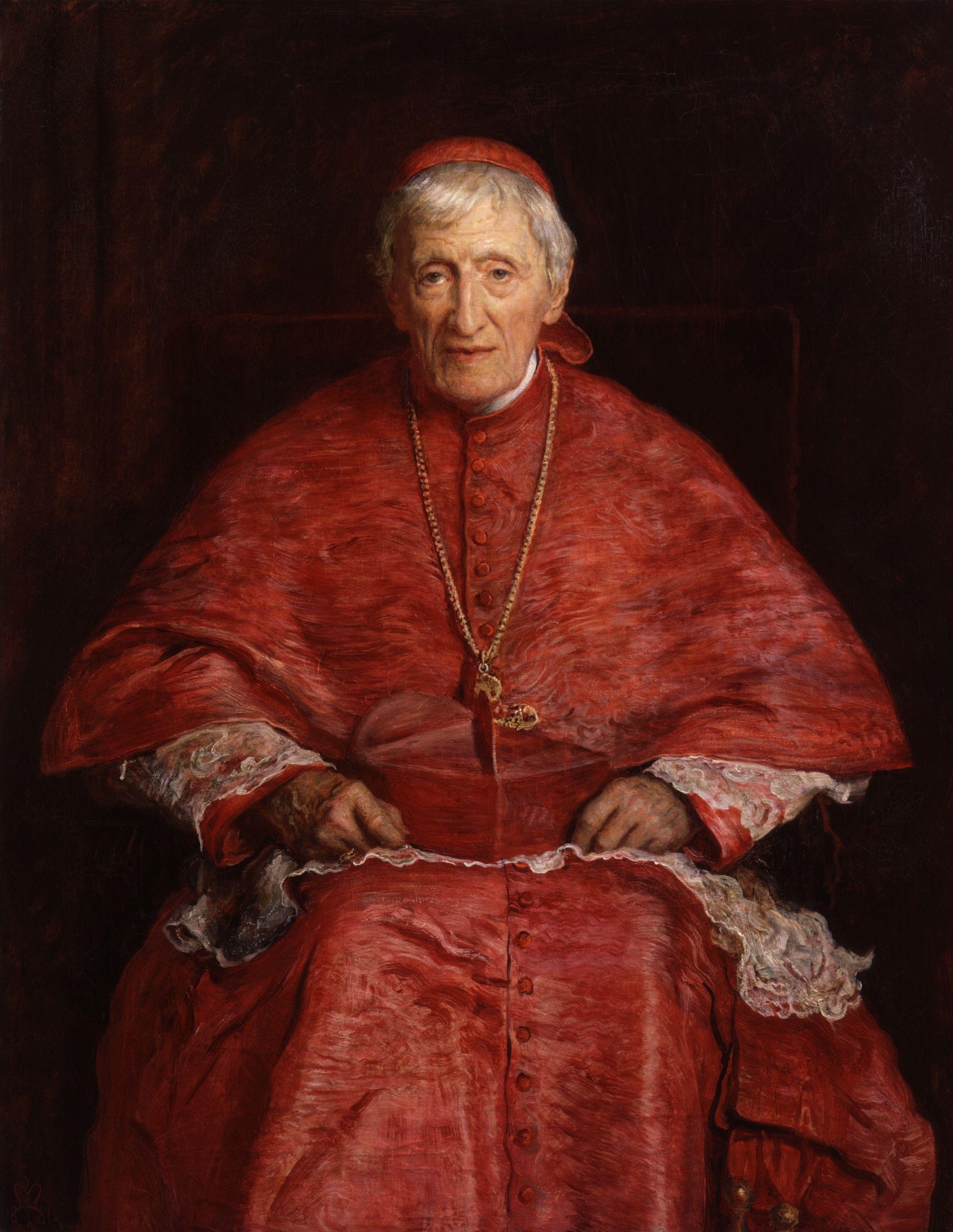
Today, 9 October, the Church keeps Saint John Henry Newman, priest and Doctor of the Church — an optional memorial that a decree of 3 February 2026 wrote into the General Roman Calendar. The date is no accident: it was on 9 October 1845, at Littlemore near Oxford, that he asked to be received into the Catholic Church. The evening before, he had written to his friends about the priest he was expecting that night: “He is a simple, holy man; and withal gifted with remarkable powers. He does not know of my intention; but I mean to ask of him admission into the One Fold of Christ.”
The Oxford clergyman
He was born in London on 21 February 1801. Ordained an Anglican deacon in 1824 and priest in 1825, he was for more than twenty years a Fellow of Oriel College and vicar of the university church of St Mary, in Oxford. Studying the history of the early Church in depth, he was drawn, step by step, towards the Catholic faith.
In 1841 he published Tract 90, on the Thirty-Nine Articles; in 1842 he withdrew with a few companions to Littlemore, to a life almost monastic; on 25 September 1843 he preached his last sermon as an Anglican, The Parting of Friends. In those years he was writing the Essay on the Development of Christian Doctrine. He tells us himself that before he reached the end he resolved to be received, and that the book stayed as it was, unfinished.
9 October 1845
The simple, holy man of the letter was the Italian Passionist Dominic Barberi (1792–1849), now a Blessed. A friend of Newman’s at Littlemore had been received by him on Michaelmas Day, at the Passionist house at Aston, near Stone; at the start of October the priest was passing through London on his way to Belgium, and agreed to turn aside to Littlemore. According to the accounts, he arrived soaked through by the rain; Newman knelt before him and asked to be received. He made his confession and his profession of faith; the next morning Barberi said Mass for him and two companions.
Years later, in the Apologia pro Vita Sua, he wrote that, once received, it was “like coming into port after a rough sea”.
In 1833, his health shattered by a fever in Sicily, Newman waited three weeks in Palermo for a ship. Before leaving his inn on the morning of departure he sat down on his bed and began to sob; to the servant who asked what ailed him he could only answer: “I have a work to do in England.”
He got away in an orange boat bound for Marseilles and was becalmed a whole week in the Straits of Bonifacio. It was there that he wrote Lead, Kindly Light. He dated the poem: “At Sea, June 16, 1833”. In 2025, when he proclaimed him a Doctor of the Church, Pope Leo XIV quoted those lines in his homily.
From Birmingham to Dublin
He was ordained a Catholic priest in Rome on 30 May 1847 and founded the Oratory of Saint Philip Neri in England, at Birmingham, where he lived for nearly forty years. Invited by the Irish bishops, he became the first rector of the Catholic University of Ireland in Dublin, founded in 1854, and stayed about four years; from that experience came The Idea of a University. There followed the Apologia (1864) and the Grammar of Assent (1870).
On 12 May 1879 Leo XIII created him a cardinal. He chose as his motto Cor ad cor loquitur — “heart speaks to heart”. He died at Birmingham on 11 August 1890 and was buried at Rednal; on the grave is the inscription Ex umbris et imaginibus in veritatem — out of shadows and images into truth.
What the Church has recognised in him
- Blessed and saint. Beatified by Benedict XVI on 19 September 2010, at Birmingham, and canonised by Pope Francis on 13 October 2019.
- Doctor of the Church. Proclaimed by Leo XIV on 1 November 2025, at the Mass of the Jubilee of the World of Education — the thirty-eighth Doctor of the Church.
- Co-patron of education. The same day the Pope named him co-patron of the Church’s educational mission, alongside Saint Thomas Aquinas.
- A memorial in the Roman Calendar. The decree of the Dicastery for Divine Worship, signed on 9 November 2025 and released on 3 February 2026, fixed the memorial on 9 October.
“Ten thousand difficulties do not make one doubt.”— John Henry Newman, Apologia pro Vita Sua, ch. 5
“Here below to live is to change, and to be perfect is to have changed often.”— Essay on the Development of Christian Doctrine, ch. 1, sect. 1 (1878 edition)
“To be deep in history is to cease to be a Protestant.”— Essay on the Development of Christian Doctrine, Introduction (1878 edition)
The prayers
The Collect of the memorial, in Latin, ends with the words Newman left carved on his grave. The other two texts are his own: the poem of 1833 and the meditation on vocation that the decree of the memorial itself quotes.
Deus, qui sanctum Ioánnem Henrícum, presbýterum, lumen benígnum tuum sequéntem pacem in Ecclésia tua inveníre contulísti, concéde propítius ut, eius intercessióne et exémplo, ex umbris et imagínibus in plenitúdinem veritátis tuæ perducámur.
O God, who granted that Saint John Henry, priest, following your kindly light, should find peace in your Church, mercifully grant that, through his intercession and example, we may be led out of shadows and images into the fullness of your truth.
Per Dominum. — Latin text from the decree of the Dicastery for Divine Worship (9/11/2025); English translation ours.
Lead, Kindly Light, amid the encircling gloom,
Lead Thou me on!
The night is dark, and I am far from home—
Lead Thou me on!
Keep Thou my feet; I do not ask to see
The distant scene—one step enough for me.
I was not ever thus, nor pray’d that Thou
Shouldst lead me on.
I loved to choose and see my path, but now
Lead Thou me on!
I loved the garish day, and, spite of fears,
Pride ruled my will: remember not past years.
So long Thy power hath blest me, sure it still
Will lead me on,
O’er moor and fen, o’er crag and torrent, till
The night is gone;
And with the morn those angel faces smile
Which I have loved long since, and lost awhile.
— Verses on Various Occasions, no. 90 (“The Pillar of the Cloud”)
God has created me to do Him some definite service; He has committed some work to me which He has not committed to another. I have my mission—I never may know it in this life, but I shall be told it in the next. Somehow I am necessary for His purposes, as necessary in my place as an Archangel in his—if, indeed, I fail, He can raise another, as He could make the stones children of Abraham. Yet I have a part in this great work; I am a link in a chain, a bond of connexion between persons. He has not created me for naught. I shall do good, I shall do His work; I shall be an angel of peace, a preacher of truth in my own place, while not intending it, if I do but keep His commandments and serve Him in my calling.
Therefore I will trust Him. Whatever, wherever I am, I can never be thrown away.
— Newman, Meditations and Devotions, Part III, meditation for 7 March
Sancte Ioánnes Henríce, ora pro nobis. Saint John Henry Newman, pray for us — and win for us the grace to follow the light even when we can see only one step.
- Words of the saints — a growing collection, in English and Portuguese.

Comments