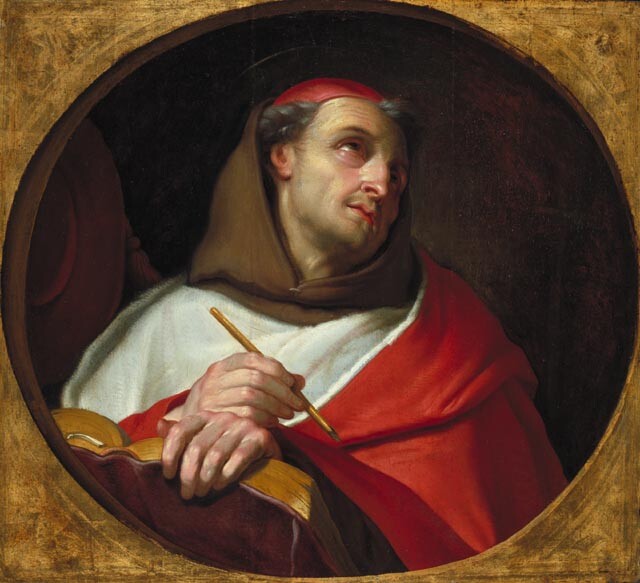
Today the Church honours Saint Bonaventure (c. 1221–1274) — on 14 July in the traditional calendar, 15 July in the current one. Franciscan friar, minister general of the Order, cardinal-bishop and Doctor of the Church, he is called the Seraphic Doctor: the theologian who taught that the mind reaches God not by cold argument but by love. This is his life, his spirituality, and — set below like an illuminated page — the prayer after Holy Communion that has carried his name for seven centuries.
The child of Bagnoregio
He was born Giovanni di Fidanza around the year 1221 at Bagnoregio, in central Italy. Tradition tells that as a small boy he fell gravely ill, and his mother carried him to Saint Francis of Assisi, still living, who prayed over him and foretold his recovery — and that Francis, seeing what the child would become, exclaimed “O buona ventura!”, “O good fortune!” From that cry, the story says, came the name by which the world would know him.
As a young man he went to Paris, the great university of the age, and there entered the Order of Friars Minor — the Franciscans — around 1243. He studied under Alexander of Hales and became a master of theology at the same hour as his friend Saint Thomas Aquinas. The two doctors — one Dominican, one Franciscan; one the doctor of the intellect, the other the doctor of the heart — are the twin summits of the century. An old story tells that Thomas once asked Bonaventure from what books he drew his wisdom; Bonaventure pointed to the crucifix and answered, “This is the source of all my learning.”
The second founder of the Franciscans
In 1257, still only in his thirties, Bonaventure was elected Minister General of the Franciscans. The young Order was torn between those who wished to soften Francis’ poverty and those who pushed it to fanatical extremes. With patience and firmness he held it together and gave it back its soul — so that he is often called the Order’s “second founder.” At the friars’ request he wrote the Legenda Maior, the official Life of Saint Francis, drawn from those who had known him; and it was on the holy mountain of La Verna, where Francis had received the stigmata, that Bonaventure composed his masterpiece.
The Seraphic Doctor: his spirituality
That masterpiece is the Itinerarium Mentis in Deum — “The Journey of the Mind into God.” In it Bonaventure maps the soul’s ascent to God in six steps, like the six wings of the seraph that Francis saw: we find God first in the traces He leaves in creation, then in the image of Him stamped upon our own souls, and at last above ourselves — in silence and love, where knowing gives way to loving and the mind comes to rest in God.
This is the heart of his teaching. For Bonaventure the whole world is a book written by God, and every creature a word, a vestige, a footprint of the Trinity. Learning is good, but it is not the goal; the goal is love. “Do not imagine that reading suffices without unction,” he warned, “speculation without devotion, inquiry without wonder…” His theology is warm, Christ-centred and Marian — a wisdom that ends on its knees. It earned him his title: the Seraphic Doctor, the doctor of burning love.
Cardinal, the Council of Lyon, and a holy death
In 1273 Pope Gregory X named him Cardinal-Bishop of Albano. The legend runs that when the papal envoys arrived with the red hat they found the humble friar washing the dishes, and he asked them to hang it on a tree until his hands were free. As cardinal he was the guiding mind of the Second Council of Lyon (1274), which sought — for a while — to heal the breach between the Latin and Greek Churches. He preached, he laboured, he reconciled — and there, worn out in the Church’s service, he died during the Council, on 15 July 1274, aged about fifty-seven.
He was canonised in 1482 by the Franciscan Pope Sixtus IV, and declared a Doctor of the Church in 1588 by Pope Sixtus V, who gave him for ever the name Doctor Seraphicus.
His prayer after Holy Communion
Of all that he left us, one page is still prayed at the altar rail. Its heart is drawn from Bonaventure’s little spiritual work, the Soliloquium, and in the form below — “Transfige, dulcissime Domine Iesu” — it has been said for centuries as a thanksgiving after Holy Communion. It is the pure Seraphic Doctor: not a request for things, but one burning plea — to be wounded through and through by the love of God. Here it is, in Latin and English, as on an illuminated page:
Transfige, dulcissime Domine Iesu, medullas et viscera animae meae suavissimo ac saluberrimo amoris tui vulnere, vera serenaque et apostolica sanctissima caritate, ut langueat et liquefiat anima mea solo semper amore et desiderio tui, te concupiscat et deficiat in atria tua, cupiat dissolvi et esse tecum.
Da ut anima mea te esuriat, panem Angelorum, refectionem animarum sanctarum; panem nostrum cotidianum, supersubstantialem, habentem omnem dulcedinem et saporem, et omne delectamentum suavitatis. Te, in quem desiderant Angeli prospicere, semper esuriat et comedat cor meum, et dulcedine saporis tui repleantur viscera animae meae; te semper sitiat fontem vitae, fontem sapientiae et scientiae, fontem aeterni luminis, torrentem voluptatis, ubertatem domus Dei.
Te semper ambiat, te quaerat, te inveniat, ad te tendat, ad te perveniat, te meditetur, te loquatur, et omnia operetur in laudem et gloriam nominis tui, cum humilitate et discretione, cum dilectione et delectatione, cum facilitate et affectu, cum perseverantia usque in finem; ut tu sis solus semper spes mea, tota fiducia mea, divitiae meae, delectatio mea, iucunditas mea, gaudium meum, quies et tranquillitas mea, pax mea, suavitas mea, odor meus, dulcedo mea, cibus meus, refectio mea, refugium meum, auxilium meum, sapientia mea, portio mea, possessio mea, thesaurus meus, in quo fixa et firma et immobiliter semper sit radicata mens mea et cor meum. Amen.
Pierce, O most sweet Lord Jesus, my inmost soul with the most joyous and healthful wound of Thy love, with true, serene, and most holy apostolic charity, that my soul may ever languish and melt with love and longing for Thee, that it may yearn for Thee and faint for Thy courts, and long to be dissolved and to be with Thee.
Grant that my soul may hunger after Thee, the bread of angels, the refreshment of holy souls, our daily and supersubstantial bread, having all sweetness and savour and every delight of taste; let my heart ever hunger after and feed upon Thee, upon whom the angels desire to look, and may my inmost soul be filled with the sweetness of Thy savour; may it ever thirst after Thee, the fountain of life, the fountain of wisdom and knowledge, the fountain of eternal light, the torrent of pleasure, the richness of the house of God.
May it ever compass Thee, seek Thee, find Thee, run to Thee, attain Thee, meditate upon Thee, speak of Thee, and do all things to the praise and glory of Thy name, with humility and discretion, with love and delight, with ease and affection, and with perseverance unto the end; may Thou alone be ever my hope, my entire assurance, my riches, my delight, my pleasure, my joy, my rest and tranquillity, my peace, my sweetness, my fragrance, my sweet savour, my food, my refreshment, my refuge, my help, my wisdom, my portion, my possession and my treasure, in whom may my mind and my heart be fixed and firmly rooted immovably henceforth and for ever. Amen.
Attributed to Saint Bonaventure; its heart drawn from his Soliloquium and later set at the head of the Stimulus Amoris. Traditionally prayed in thanksgiving after Holy Communion.
His legacy
Bonaventure left the Church a rare thing: a theology at once rigorous and warm, learned and prayerful. Where others parted the head from the heart, he wedded them — and Pope Leo XIII would call him the “prince of mystics.” Seven centuries on, students still climb his Itinerarium, friars still read his Life of Francis, and Catholics who have never heard his name still whisper his Transfige after Communion. The Seraphic Doctor asked one thing only — to be pierced by love — and in that single desire he left a whole school of prayer.
Sancte Bonaventura, ora pro nobis.Saint Bonaventure, pray for us.
- Saint Benedict of Nursia — his life, the Rule, and the Cross and Medal explained.
- The Litany of the Most Precious Blood — in Latin and English, side by side, ready to pray.

Comments