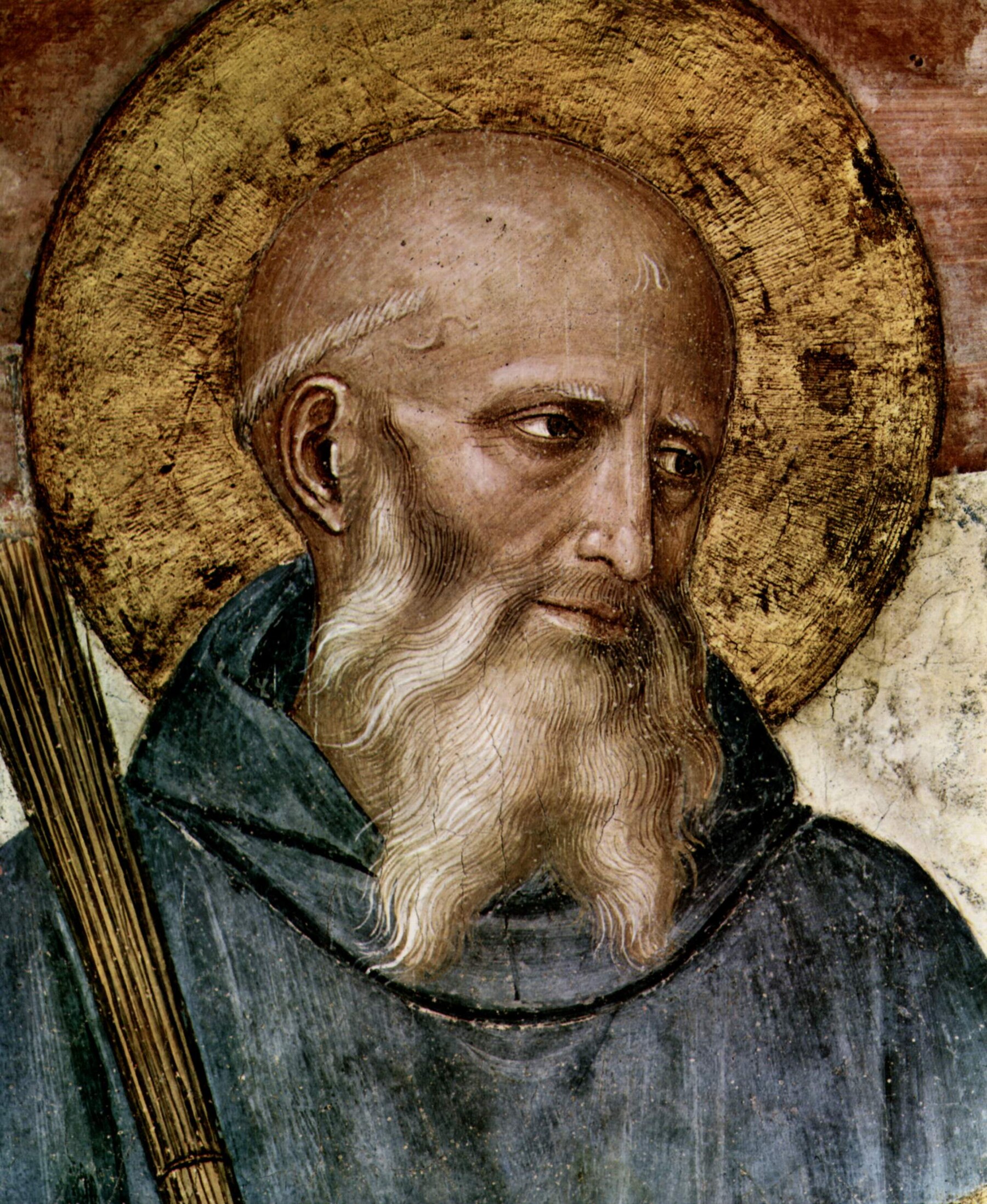
Today, 11 July, the Church keeps the feast of Saint Benedict of Nursia (c. 480–547), the father of Western monasticism and a Patron of Europe. From a cave in the hills above Rome he drew out a way of life so wise and so gentle that it has formed monks, scholars and whole nations for fifteen centuries. This is his story, the Rule he left, why the Church calls him a saint — and the famous Cross and Medal that bear his name, with every Latin letter explained.
The man of Nursia
Benedict was born around the year 480 at Nursia (Norcia) in the mountains of Umbria, the twin brother of Saint Scholastica. Sent to Rome to study, he was so repelled by the vice he saw around him that he abandoned his books and slipped away into the wilderness. At Subiaco he found a narrow cave — the Sacro Speco, the “Holy Grotto” — and lived there hidden for three years as a hermit. A monk named Romanus, sworn to secrecy, lowered bread to him on a cord let down the cliff.
Word of his holiness spread and disciples came. Benedict gathered them into twelve small monasteries of twelve monks each. But holiness draws opposition: a jealous priest named Florentius tried to kill him with a poisoned loaf, which (the old accounts say) a raven carried away at the saint’s command; and once, asked to lead a lax community, he blessed a cup of poisoned wine and it shattered in his hand as though struck by a stone. It is from these deliverances that his cross came to be invoked against poison and every evil.
To be free of strife, Benedict went south to Monte Cassino around the year 529. On its summit he cast down an old altar of Apollo, raised chapels to Saint Martin and Saint John the Baptist, preached to the country people — and there wrote his Rule. He died at Monte Cassino, foretelling the day; carried into the oratory and strengthened by the Body and Blood of the Lord, he breathed his last standing upright, his hands lifted toward heaven, held up by his brethren in prayer. Nearly all we know of him comes from the Dialogues of Pope Saint Gregory the Great, written a generation later.
The Rule: Ora et Labora
The Rule of Saint Benedict — seventy-three short chapters — is one of the most quietly influential books ever written. It opens with a father’s voice: “Listen, my son, to the master’s instructions, and incline the ear of your heart.” Benedict wanted a “school for the Lord’s service” in which there would be “nothing harsh, nothing burdensome.” Its genius is balance — a day woven of prayer, work, and holy reading, summed up ever after in two words: Ora et Labora, “Pray and Work.”
- The Work of God. Nothing is to be preferred to the Opus Dei, the round of psalms and prayer that gives the day its shape.
- Prayer and labour together. The monk lives by the work of his hands as much as by prayer, so that neither idleness nor pride can take root — “idleness is the enemy of the soul.”
- Stability, obedience, conversion of life. The Benedictine binds himself to one community and to daily conversion, not to wandering or to his own will.
- Humility. A whole chapter climbs the twelve steps of humility, like Jacob’s ladder, from the fear of God to the love that casts out fear.
- Hospitality. “Let all guests who arrive be received as Christ” — the poor and the pilgrim above all.
- That God be glorified in all. Even the tools of the monastery are to be treated as sacred, “that in all things God may be glorified.”
A saint for all Europe
Benedict was venerated as a saint from the earliest times. Because his traditional day, 21 March, almost always falls in Lent, the Church keeps his feast on 11 July, the old commemoration of the moving of his relics. On 24 October 1964, at the rebuilt abbey of Monte Cassino, Pope Paul VI proclaimed him Patron of Europe in the letter Pacis Nuntius — “Messenger of Peace” — for it was Benedict’s sons who, in the ruin of the ancient world, kept learning and faith and prayer alive and built Christendom anew. He is invoked against poison and temptation, for a happy death, and as patron of students and of Europe. In 2005 a pope took his name in his honour: Benedict XVI.
The Cross of Saint Benedict
The Medal of Saint Benedict is one of the oldest and most treasured sacramentals of the Church. On its back is a cross covered with letters — the initials of Latin prayers, some of them a spoken renunciation of the devil. What looks at first like a puzzle is in fact a small exorcism written in stone and metal. Here is the medal itself — Saint Benedict on the front, and on the back the Cross ringed by its Latin prayer — with every letter explained below:
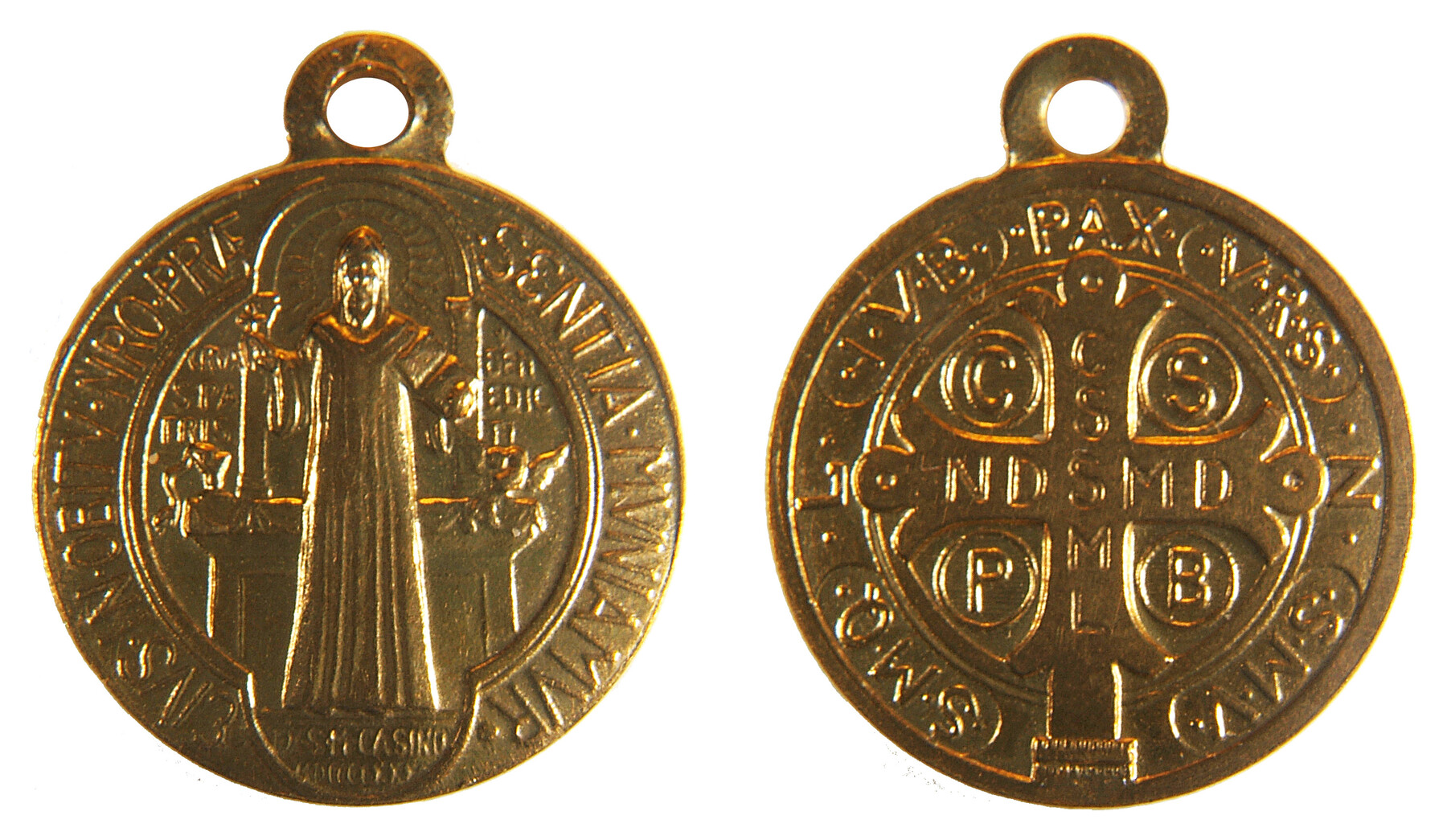
N S M V
I V B
On the front, Saint Benedict stands with the cross in one hand and the Rule in the other. Around him runs the prayer of a good death — Eius in obitu nostro praesentia muniamur: “May we be strengthened by his presence in the hour of our death.”
The medal is not a charm; it is a prayer we carry. Worn or kept with faith, blessed by a priest, it is the Church asking, through Benedict, for protection against evil and the grace of perseverance — the cross of Christ held up against the dragon.
Five words from Saint Benedict
“Listen, my son, to the master’s instructions, and incline the ear of your heart.”Obsculta, o fili, praecepta magistri, et inclina aurem cordis tui.— Rule of St Benedict, Prologue
“Let them prefer nothing whatever to Christ.”Christo omnino nihil praeponant.— Rule of St Benedict, ch. 72
“Idleness is the enemy of the soul.”Otiositas inimica est animae.— Rule of St Benedict, ch. 48
“Let all guests who arrive be received as Christ.”Omnes supervenientes hospites tamquam Christus suscipiantur.— Rule of St Benedict, ch. 53
“Seek peace, and pursue it.”Inquire pacem et sequere eam.— Rule of St Benedict, Prologue (Psalm 34:14)
Sancte Benedicte, ora pro nobis. Saint Benedict, pray for us.
- Saint John the Baptist: the burning and shining lamp — the forerunner, his feast, and the fires of Ireland.
- The Litany of the Most Precious Blood — in Latin and English, side by side, ready to pray.


Comments Comentários