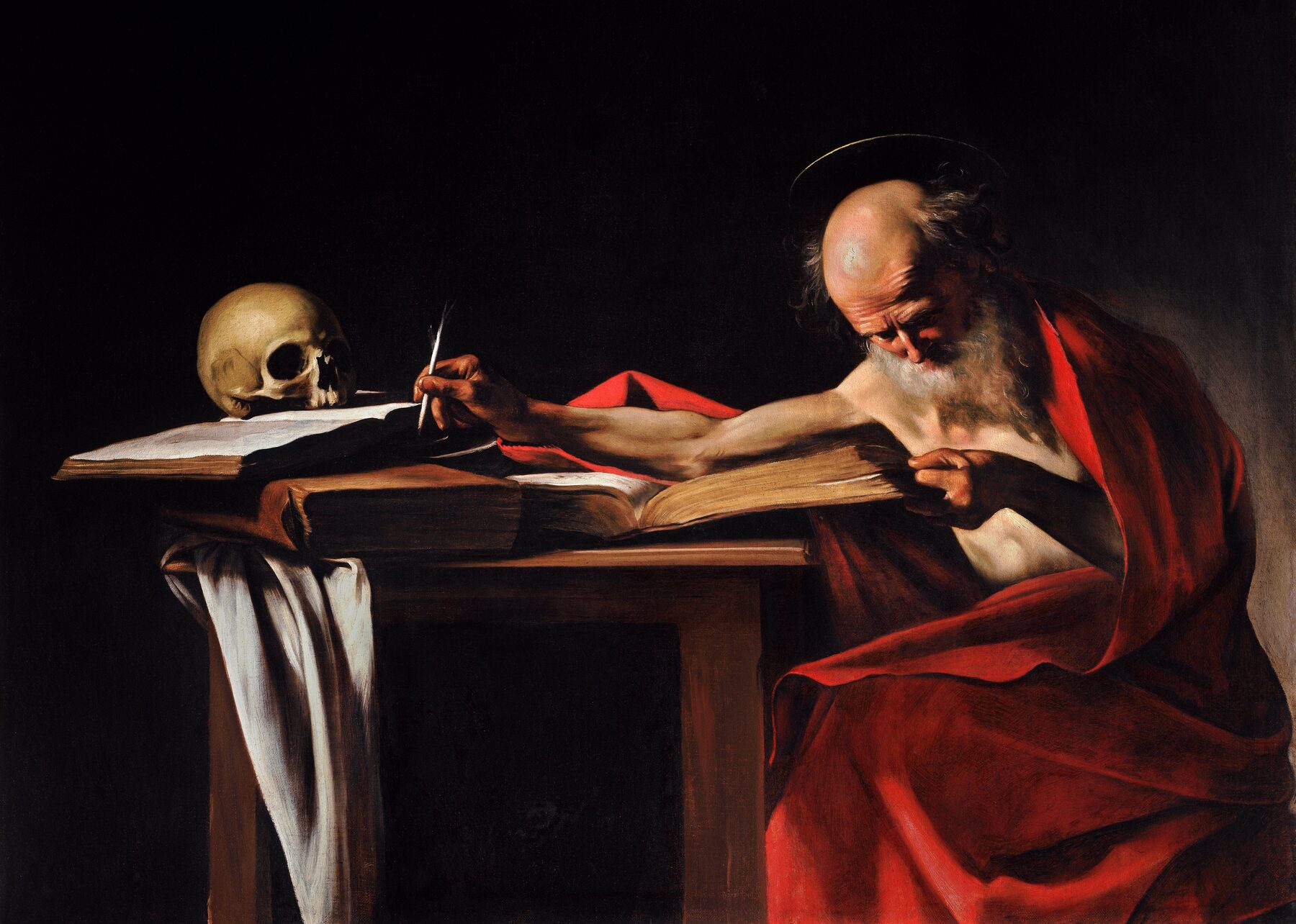
Today, 30 September, the Church keeps Saint Jerome (c. 347–420), priest and Doctor of the Church. If you have ever heard a reading at Mass, his work stands behind it. He translated nearly the whole Old Testament from the Hebrew and revised the Gospels from the Greek, in a cave at Bethlehem — and the Church read, sang and prayed with that translation for more than fifteen hundred years.
In the calendar it is an obligatory memorial. Jerome is one of the four great Doctors of the Latin Church, with Saint Ambrose, Saint Augustine and Saint Gregory the Great — the four Pope Boniface VIII honoured together in 1298. He is patron of translators, of librarians and of those who study the Bible; and because of him the United Nations made 30 September International Translation Day.
The dream at Antioch
He was born at Stridon on the Dalmatian frontier around 347. He studied at Rome under the best masters and fell in love with the Latin classics — above all with Cicero, whose prose he knew by heart.
Around 375, ill and feverish at Antioch, he had the dream he himself recounted in a famous letter (Ep. XXII, to Eustochium). He saw himself dragged before the judgement seat of God. He was asked who he was. He answered: a Christian. And he heard the reply that split his life in two:
“You lie. You are a Ciceronian, not a Christian: for where your treasure is, there is your heart also.”
He woke with the decision made. He went to the desert of Chalcis in Syria to live as a hermit — and there, between fasts, he did something distinctly unromantic that would change the history of the Bible: he set about learning Hebrew from a Jewish convert. He hated every minute. He wrote that he had traded the elegance of Latin for the “harsh hissing” of those consonants. He did not stop.
The Vulgate
In 382 he went to Rome as secretary to Pope Saint Damasus I, who set him an enormous task: to bring order to the Latin versions of Scripture, which circulated in copies that diverged and were sometimes dreadful. He began with the Gospels.
After Damasus died, with Rome turned hostile, he left for the Holy Land. He settled at Bethlehem in 386, beside the cave of the Nativity, and stayed there until he died, thirty-four years later.
- He translated from the original. Jerome’s great decision was to go to the Hebrew rather than translate the Greek translation, as everyone else did. He called it hebraica veritas — the Hebrew truth. Saint Augustine wrote to him worried about the scandal it would cause in the parishes. Jerome did not give way.
- Nearly all, not all. Between 390 and 405 he translated the books of the Old Testament from the Hebrew; the New he revised. Some books stayed in the Old Latin version, and the Psalms the Church sang for centuries in the Office are another version of his, made from the Greek — the Gallican Psalter. Even so, the Vulgate is, in substance, the work of one man.
- Helped. The work was sustained by Saint Paula and her daughter Saint Eustochium, Roman noblewomen who sold what they had, went to Bethlehem, and paid for the manuscripts and the copyists.
- Fifteen centuries. The version became known as the Vulgate — the “divulged”, the one in common use. The Council of Trent declared it authentic in 1546. Only in 1979 did the Church publish its revision, the Nova Vulgata, which is today the typical Latin edition.
- He commented on what he translated. He wrote commentaries on nearly the whole of Scripture, letters by the hundred, and ferocious polemics against anything he judged an error.
He died at Bethlehem on 30 September 420. Tradition holds that his remains were later taken to Rome and rest in the basilica of Saint Mary Major — near the crib, once again.
Jerome was not pleasant and did not pretend to be. His letters are full of sarcasm; he quarrelled with Rufinus, a friend from boyhood, and spared nobody. He knew it himself: more than once he asked pardon for his tongue.
The legend of the lion — the one he is said to have healed by drawing a thorn from its paw, and which stayed on at the monastery — is medieval, and probably came from a confusion with another saint. The Church has never taught it as fact. It stayed in the paintings because it tells a truth about him: a man of leonine temper, tamed by the Word.
The line that stayed
It stands in the prologue to his commentary on the prophet Isaiah — the text the Church reads today in the Office of Readings — and it is the line he is remembered for:
Ignorátio Scripturárum ignorátio Christi est.
Ignorance of the Scriptures is ignorance of Christ.
— Saint Jerome, prologue to the Commentary on Isaiah
It is not a line about scholarship. It is about knowing somebody. He spent thirty-four years in a cave translating word by word because he was convinced that on the far side of that text there was a Person — and that whoever does not open the book goes without knowing him.
What the Church has said of him
Few saints have been quoted so often by popes and councils, and nearly always for the same reason: he is the man who teaches the Church to read.
- The Second Vatican Council set his line at the heart of Dei Verbum, the constitution on Revelation (no. 25): the Council urges all the faithful to learn “the surpassing knowledge of Jesus Christ” by frequent reading of the divine Scriptures, “for ignorance of the Scriptures is ignorance of Christ”. The Catechism repeats the same quotation (no. 133).
- Benedict XV, on the fifteen-hundredth anniversary of his death, gave him a whole encyclical, Spiritus Paraclitus (1920), on the inspiration and the reading of the Bible.
- Benedict XVI spoke of him in two Wednesday catecheses in November 2007 and summed up the lesson: we must learn from Jerome to love the Word of God and to read it in personal dialogue with him.
- Pope Francis chose this very day twice. On 30 September 2019 he signed Aperuit illis, which instituted the Sunday of the Word of God, kept on the Third Sunday in Ordinary Time. And on 30 September 2020, sixteen hundred years after Jerome’s death, he published the letter Scripturae Sacrae affectus — whose title is taken from the collect of today’s Mass.
The Church even rewards the reading. The Manual of Indulgences grants a plenary indulgence to those who read Sacred Scripture with the veneration due to the word of God, as spiritual reading, for at least half an hour — under the usual conditions: confession, Communion, prayer for the Pope’s intentions and no attachment to sin. For those who do not read the Bible, today is the day to begin; for those who do, it is the day to do it with that intention.
How he taught people to read
Jerome left no method; he left advice, scattered through his letters, to monks, to mothers of families, to young priests. It all says the same thing: the Bible is not something you consult, it is something you live with.
- To the young priest Nepotian: “Read the divine Scriptures often; indeed, never let the sacred reading leave your hands” (Letter LII).
- To Eustochium: “Let sleep find you holding the book, and let the sacred page catch your face as it drops” (Letter XXII).
- To the monk Rusticus: “Love the knowledge of the Scriptures, and you will not love the vices of the flesh” (Letter CXXV).
Today’s Mass readings say the same. In the first, Saint Paul reminds Timothy that from childhood he has known the sacred writings, and that “all Scripture is inspired by God and is useful for teaching, for refutation, for correction, and for training in righteousness” (2 Tim 3:14-17). In the Gospel, Jesus speaks of the scribe who has become a disciple of the kingdom, “like the head of a household who brings from his storeroom both the new and the old” (Mt 13:52). It is hard not to hear the dream at Antioch again: his treasure had moved, and from it he brought out things new and old to the end.
The prayer of today’s Mass
The collect asks for exactly what his life was: a living taste for Scripture, and in it a spring.
Deus, qui beáto Hierónymo presbýtero suávem et vivum Scriptúræ Sacræ afféctum tribuísti, da, ut pópulus tuus verbo tuo ubérius alátur, et in eo fontem vitæ invéniat. Per Dóminum nostrum Iesum Christum Fílium tuum, qui tecum vivit et regnat in unitáte Spíritus Sancti, Deus, per ómnia sæcula sæculórum.
O God, who gave the Priest Saint Jerome a living and tender love for Sacred Scripture, grant that your people may be ever more fruitfully nourished by your Word and find in it the fount of life. Through our Lord Jesus Christ, your Son, who lives and reigns with you in the unity of the Holy Spirit, God, for ever and ever.
Amen.
The old prayer of the feast
Until 1969 the Missal gave him another title, which says it all: Doctor maximus, the “greatest Doctor” in expounding the Holy Scriptures. The old collect does not only ask for love of the Bible — it asks that we do what he taught “by word and by work”.
Deus, qui Ecclésiæ tuæ in exponéndis sacris Scriptúris beátum Hierónymum Confessórem tuum, Doctórem máximum provídere dignátus es: præsta, quæsumus; ut, eius suffragántibus méritis, quod ore simul et ópere dócuit, te adiuvánte, exercére valeámus. Per Dóminum nostrum Iesum Christum Fílium tuum, qui tecum vivit et regnat in unitáte Spíritus Sancti, Deus, per ómnia sæcula sæculórum.
O God, who were pleased to give your Church blessed Jerome, your Confessor, as its greatest Doctor in expounding the Holy Scriptures, grant, we pray, that, aided by his merits and with your help, we may put into practice what he taught by word and by work. Through our Lord Jesus Christ, your Son, who lives and reigns with you in the unity of the Holy Spirit, God, for ever and ever.
Amen.
A prayer of Saint Jerome
Devotional tradition keeps a prayer ascribed to him. No one knows which of his works it comes from, and it has no known Latin original; but the tone is entirely his: a man who knew the Gospel parables by heart and recognised himself in the two wounded figures in them — the man robbed on the road to Jericho, and the lost sheep.
O Lord, show your mercy to me and gladden my heart. I am like the man on the way to Jericho who was overtaken by robbers, wounded and left for dead: O Good Samaritan, come to my aid. I am like the sheep that went astray: O Good Shepherd, seek me out and bring me home in accord with your will. Let me dwell in your house all the days of my life, and praise you for ever and ever with those who are there.
Amen.
Before you open the Bible
And for anyone who wants to take his advice today, a verse of Psalm 118(119), in the Vulgate he left us — to pray before reading:
Revéla óculos meos, et considerábo mirabília de lege tua.
Open my eyes, that I may consider the wonders of your law.
Amen.
“Ignorance of the Scriptures is ignorance of Christ.”— Saint Jerome, prologue to the Commentary on Isaiah
“You are a Ciceronian, not a Christian: for where your treasure is, there is your heart also.”— the voice in the dream, Letter XXII
“Read the divine Scriptures often; indeed, never let the sacred reading leave your hands.”— Saint Jerome, Letter LII
“Love the knowledge of the Scriptures, and you will not love the vices of the flesh.”— Saint Jerome, Letter CXXV
Sancte Hieronyme, ora pro nobis. Saint Jerome, pray for us — and win us the grace to open the book we keep at home and never open.
- The Archangels — Michael, Gabriel and Raphael, with their prayers, yesterday, the 29th.
- Our Lady of the Rosary novena — from 28 September to 6 October, with the Scripture of each day.
- Padre Pio — fifty years with the wounds, on the 23rd.
- Words of the saints — a growing collection, in English and Portuguese.

Comments