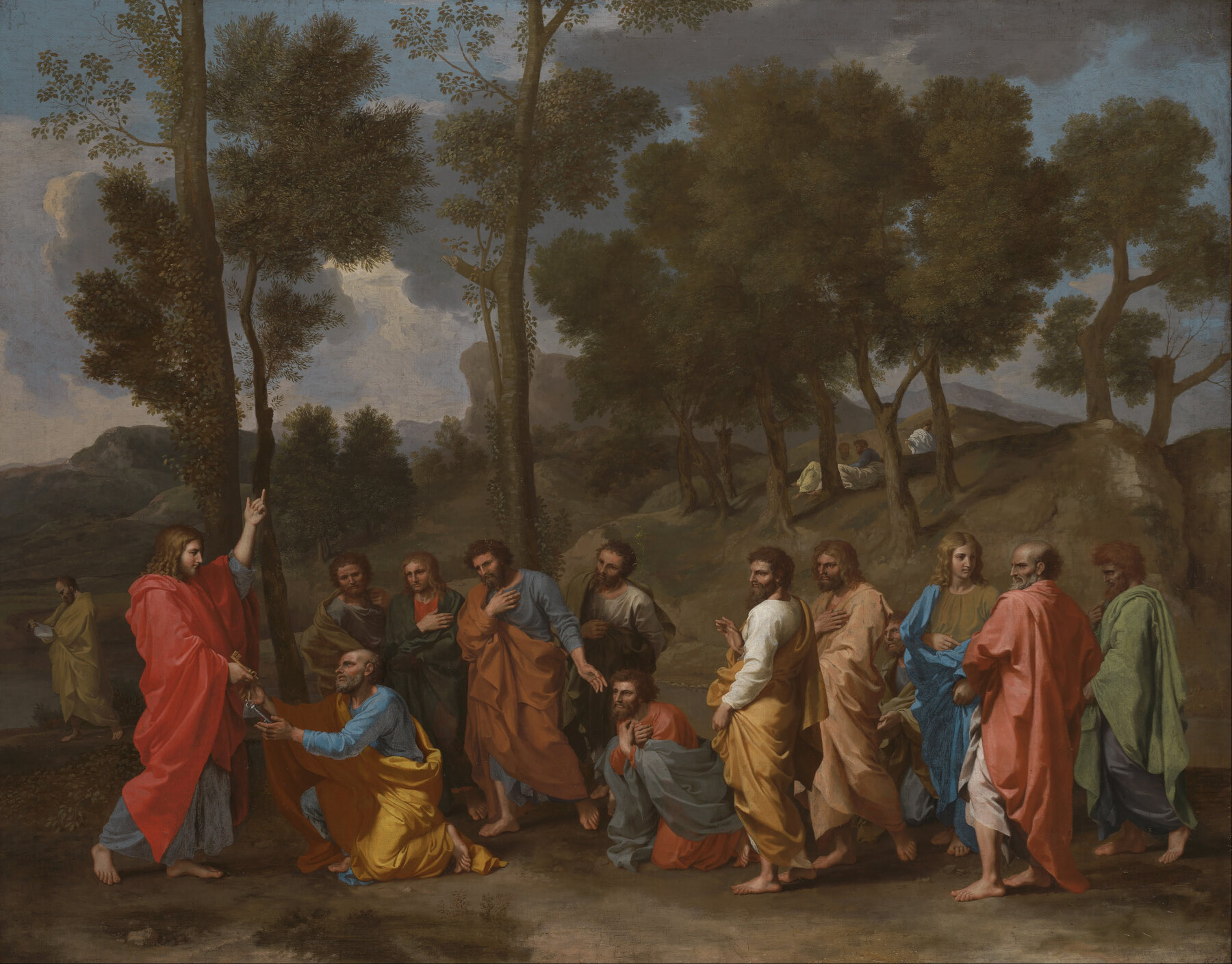
The Catholic priesthood was not created by a document, voted in at a council, or instituted by papal decree. It began in a borrowed room in Jerusalem, the night before an execution, in the middle of a supper — and in two words. Jesus said “do this”. Everything the Church has said about priests in the twenty centuries since is the unpacking of one verb in the imperative.
Two words, and what they order done
Saint Luke records the moment with an economy that almost hides what is happening:
“And taking bread, he gave thanks and brake and gave to them, saying: This is my body, which is given for you. Do this for a commemoration of me.” (Luke 22:19)
Look at the last clause. It is not a devout aside: it is an order, given to particular people, about a particular action. Jesus did not say “remember me”. He said do this — and “this” was what he had just done with the bread.
And there is a detail in the Greek that English does not carry. The verb is poieîte, from poiein. It is an ordinary word, “to do” — but it is also the verb the Greek Old Testament uses, dozens of times, to mean to offer sacrifice: “you shall offer one lamb in the morning and another at evening”, where do means immolate. A Jewish ear at that table did not hear “repeat this dinner”. It heard a ritual instruction.
The Council of Trent, in session XXII, settled the reading without leaving room: whoever says that by those words Christ did not constitute the apostles priests, or did not order that they and other priests should offer his Body and Blood, stands outside the faith of the Church.
The most audacious sentence a man can say
It is worth stopping at a detail that goes unnoticed from sheer repetition. At the central moment of the Mass the priest does not say “this is the body of Christ”. He changes grammatical person and says:
“This is my body.”
Hoc est enim corpus meum.
The words of consecration — in the first personIt is not a slip of the liturgy nor a quotation in inverted commas. It is the whole thing. The Church calls this acting in persona Christi: in that instant the priest is not speaking about Christ, he is speaking as Christ, and that is why the bread stops being bread. It is for that reason, and no other, that Orders is not an administrative post to be redistributed for pastoral convenience.
From which follows the hard consequence the first week of the Vocations Month exists to state: no priests, no Mass. A community can have a church, catechesis, a choir, groups, social works, everything. Without an ordained priest it does not have Calvary on the altar. It has everything except the essential.
Dachau, block 26
If anyone wants to know what that sentence is worth, the test has already been run, and not in a faculty of theology.
The concentration camp at Dachau had a barracks reserved for clergy — the Priesterblock. Some 2,700 priests, seminarians and religious passed through it, most of them Polish. Close to a thousand died there.
Among them was Karl Leisner, a German deacon of twenty-nine, tubercular, imprisoned since 1939 for a remark against Hitler. He was dying, and one thing was missing: ordination to the priesthood. As it happened there was also a French bishop in the camp, a prisoner like the rest — Gabriel Piguet of Clermont-Ferrand.
The prisoners organised it in secret over several weeks. A Benedictine sister smuggled the holy oils into the camp, with the authorisation of the bishop of Munich. They made a mitre out of paper and lining, a crozier from scavenged wood, and a ring. On 17 December 1944, inside Dachau, Karl Leisner was ordained a priest. It is the only ordination in history celebrated in a concentration camp.
He was too weak to celebrate. He waited nine days. On 26 December 1944, the feast of Saint Stephen, he said his first and only Mass. He never said another. He was liberated in May, died in August 1945, and was beatified by Saint John Paul II in 1996.
Starving men in an extermination camp spent weeks at risk of death to manufacture a priest in secret — so that there would be one Mass. No treatise explains better why the Church begs for vocations.
One priesthood, two ways of sharing in it
There is usually confusion here, and the distinction is worth half a minute. Every baptised person shares in the priesthood of Christ — that is doctrine, not a courtesy. Saint Peter writes to ordinary faithful that they are “a chosen generation, a kingly priesthood” (1 Pet 2:9).
But the Second Vatican Council, in Lumen Gentium, insists that the common priesthood of the faithful and the ministerial priesthood differ essentially, and not only in degree. They are not the same thing in different doses.
- The common priesthood belongs to the baptised: it offers God one’s own life, work, suffering and prayer. That is genuinely priestly, and it is not a figure of speech.
- The ministerial priesthood belongs to the ordained: it consecrates the Eucharist, forgives sins in Christ’s name, anoints the sick, shepherds the people.
- One serves the other. The ministerial exists so that the common can be exercised. The priest is not above the people; he is at the service of the priesthood of the whole people.
At ordination the bishop anoints with holy chrism the palms of the new priest’s hands — not the head, not the brow: the hands, because they are what will touch the Eucharist.
An old custom attaches to that gesture: the linen cloth that wipes away the chrism, the manutergium, was given to the priest’s mother, who kept it all her life and was buried holding it. When she was asked at the end what she had done with her life, she could produce that.
God does not call the capable
The first week of the Vocations Month falls with the feast of Saint John Mary Vianney on 4 August, and there is no better argument against the idea that vocation is for the brilliant: the seminary let him go for incapacity, and the Church made him patron of every parish priest in the world. His story is told here.
The pattern is biblical and constant. Moses stammered. Jeremiah pleaded that he was too young. Peter denied three times before receiving the keys. God does not call the capable: he capacitates the called — and whoever waits to be ready before answering never answers, because nobody is ever ready.
Vocations are not the seminary’s business
There is a comfortable misunderstanding worth dismantling: that vocations are the responsibility of the seminary, the diocese, the clergy. They are not.
No boy discovers he could be a priest in a seminary. He discovers it at home, seeing his parents pray; in the parish, serving at the altar; and above all when he meets a happy priest. One cheerful priest generates more vocations than ten campaigns. The reverse is also true, which is why we pray so hard for the holiness of the clergy.
Three concrete things for this week
- Pray for one priest by name. Not “for priests” in general — for that one, with a surname, who heard your confession or baptised your child.
- Tell him so. A note, a message, three lines. Priests almost never get anything back, and nobody lasts many years speaking into the dark.
- Ask the question at home. Ask a son, a nephew, a godson, without ceremony, whether he has ever thought about it. A great many vocations die because nobody ever said it out loud.
“Lord Jesus, who called those whom you willed: call many of us to work with you, to work for you. You who enlightened with your word those you called: enlighten us with the gift of faith in you. You who sustained them in their difficulties: help us to overcome our own.”
From the prayer for vocations — Saint Paul VI- Saint John Mary Vianney — the seminarian they threw out, made patron of parish priests.
- Consecrated life — the second week of the Vocations Month.
- The mystery of the Holy Mass — the thing only a priest can do.
- Words of the saints — a growing collection, in English and Portuguese.

Comments