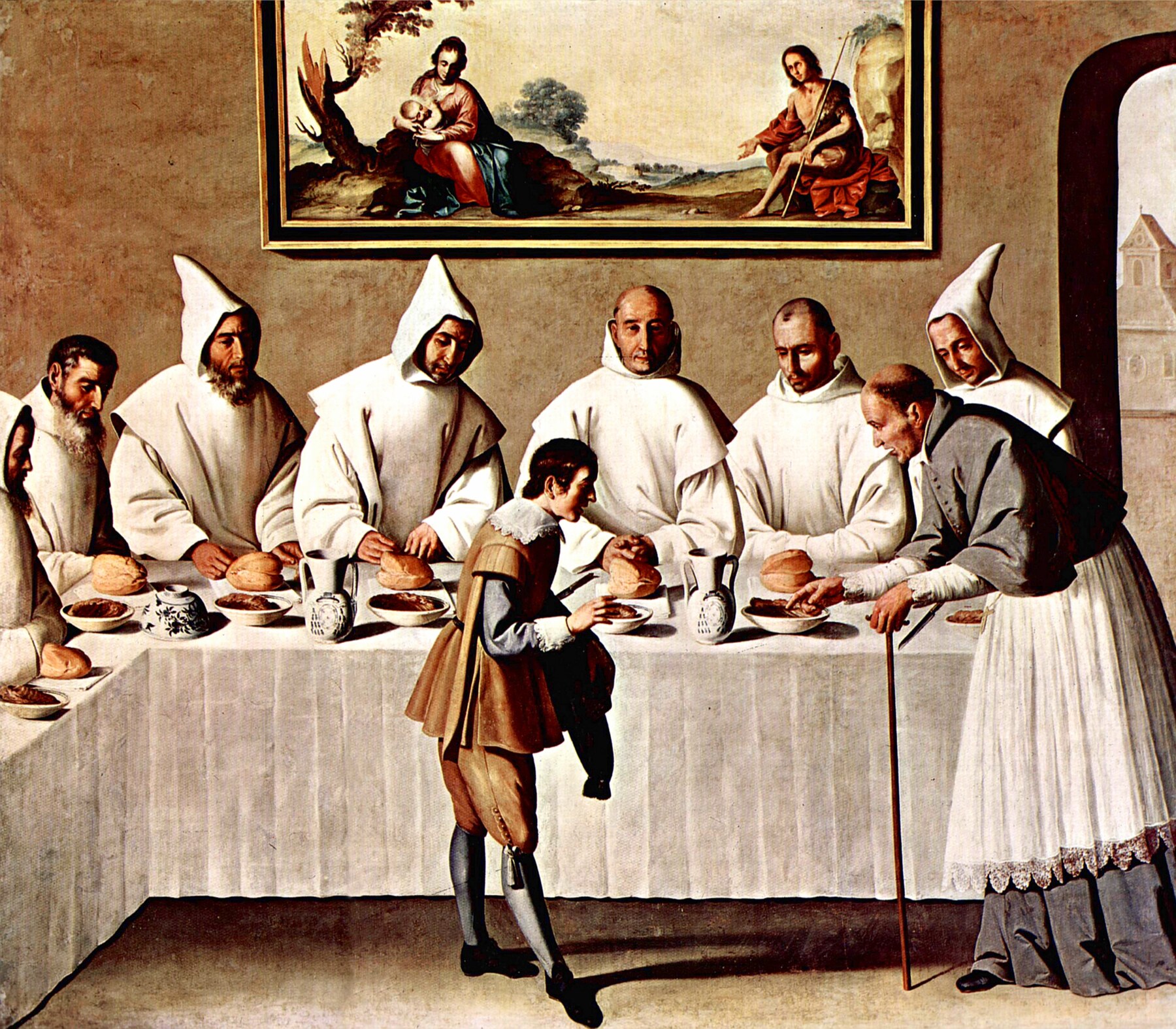
After the rich young man went away sad, Peter said out loud the sum the other eleven were doing in silence: and us — we left everything; what do we get out of it? It is an embarrassing question, very nearly mercenary, and it is worth noticing what Jesus did with it. He did not rebuke it. He did not say that one loves expecting nothing. He answered with a number.
The question Peter had the nerve to ask
“Behold we have left all things and have followed thee: what therefore shall we have?” (Mt 19:27)
And the answer:
“And every one that hath left house, or brethren, or sisters, or father, or mother, or wife, or children, or lands for my name’s sake, shall receive an hundredfold, and shall possess life everlasting.” (Mt 19:29)
A hundred for one. That is not the language of renunciation, it is the language of a deal — and of a deal absurdly favourable to whoever takes it. Consecrated life, before it is a sacrifice, is a bet placed on that exchange rate.
Why the hundredfold is paid already in this life
Saint Mark, telling the same scene, adds a precision that changes everything. The hundredfold comes “now in this time” — houses, brothers, sisters, mothers, children — with persecutions; and life everlasting comes in the world to come (cf. Mk 10:30).
So it is not a promise deferred until after death. It is payment on the spot. Whoever enters a monastery loses one family and receives hundreds of brothers; loses a house and gains an order spread across the world, arriving in any country to a bed, a table and a name. Loses control of his own day and gains something almost nobody has: the certainty that the day is for something.
And Mark, being honest, did not leave out the small print: with persecutions. It comes back at the end of this piece, with seven names.
The three counsels, and what each one disarms
Consecrated life is built on three vows that tradition calls the evangelical counsels. They are not arbitrary rules invented by severe founders: each disarms one of the three things that hold a human being hardest.
- Poverty — against having. Not destitution, not contempt for things; it is not being an owner. Whoever owns nothing cannot be owned by anything.
- Chastity — against using. Not the refusal of human love; the renunciation of a legitimate love in favour of a more direct Love.
- Obedience — against commanding. The hardest of the three and the least discussed. Handing over your money is difficult; handing over your will is another order of thing.
Notice that the Church calls them counsels, not commandments. Nobody is obliged. They are the road of those who want to go beyond what is required — and in the Gospel, going beyond is never display: it is answer.
“For the kingdom of heaven”
Shortly before that same conversation Jesus said something strange, and said it plainly: there are those who “have made themselves eunuchs for the kingdom of heaven” (Mt 19:12). And he added: he that can take, let him take it — conceding, in the sentence itself, that this was not going to fit in everybody’s head.
Saint Paul develops the idea without a trace of romanticism: the unmarried are concerned with the things of the Lord; the married are concerned — legitimately — with the things of the world and with pleasing a spouse (cf. 1 Cor 7:32-34). It is not a criticism of marriage. It is an observation about where a human heart’s attention has to divide.
The commonest misreading
The world reads consecrated chastity as subtraction — something missing from a life, a faculty switched off, a part amputated in the name of religion.
It is exactly the opposite, and the reason is simple: nobody gives what he does not have. Those who consecrate themselves do not hand God a dead affectivity or a sexuality that did not work out. They hand over a living and entire capacity to love, and they hand it over whole. A nun who cannot love is not a chaste nun — she is a cold one, and the difference between the two is everything.
Nine centuries without changing the subject
It is worth trading theory for a concrete case, and the case is in the painting at the top of this page.
Those men in white habits sitting in silence are Carthusians. The order was founded by Saint Bruno in 1084 at the Grande Chartreuse, in the French Alps. Each monk lives alone in a cell with a small walled garden, prays much of the night, eats one meal a day passed through a hatch, and meets his brothers in practice only at the liturgy and on a weekly walk.
They have been doing this, without significant alteration, for more than nine hundred years. A sentence is said of them that no other institution in the West can say of itself: never reformed because never deformed. Their motto is Stat crux dum volvitur orbis — the cross stands while the world turns.
The scene has a plot. Tradition holds that Saint Hugh, bishop of Grenoble and protector of the first Carthusians, had meat served to the monks. They fell into ecstasy at the table and stayed that way for many days; when they woke, the meat on the plates had turned to ash.
The bishop took the point and never pressed it again. Carthusians eat no meat to this day. Zurbarán paints precisely the moment after waking — which is why nobody at the table is eating.
And what about the married?
Here is the question most readers are asking, and it is a fair one: this is all very fine, but I am married, I have children and I have bills.
The answer is that the three counsels are not the property of cloisters; they are the extreme form of three things asked of every Christian.
- Poverty, for the married, is practical detachment: not letting the standard of living decide the big choices, not measuring a family by what it owns, giving what is left over — and sometimes what is not.
- Chastity is not celibacy: it is loving without using anyone. Inside marriage it has its own name, fidelity — in the head, on the phone and in the body, in that order, because that is the order in which it is lost.
- Obedience is the one lay people forget and the one they meet most: obedience to God when what he asks is expensive, and to the reality of a vocation already taken on, which is where a married person’s holiness actually happens.
Everyone without exception is called to a kind of virginity of the heart: to love without turning anyone into an instrument. The monastery is where that is lived radically and visibly; the family home is where it is lived hidden — and in God’s accounts neither is worth less.
“With persecutions”: Tibhirine
Mark’s small print still has to be paid, and it has an address.
In the mountains of Algeria, at Tibhirine, there was a small Trappist monastery: nine French monks living in a Muslim country, running the village clinic, praying the hours, working the garden with their neighbours. In the 1990s the Algerian civil war reached them, and the monks began receiving warnings to leave.
They discussed it for months as a community, and voted. They decided to stay — not out of heroism, but because, as they wrote, a monk does not walk out on his neighbours when things get bad; that was precisely what they were there for. In March 1996 they were kidnapped. Seven of them were killed in May.
The prior, Christian de Chergé, had left a sealed testament with his family, written three years earlier, in case what happened happened. The document ends by addressing the man who would kill him:
“And also you, the friend of my final moment, who would not be aware of what you were doing. Yes, for you too I wish this THANK YOU — and this A-DIEU, in whose face I contemplate you. And may we meet again, happy thieves, in paradise, if it please God, the Father of us both.”
Christian de Chergé, prior of Tibhirine — testament opened in 1996The seven were beatified in 2018. And this is what the second week of the Vocations Month asks us to understand: the hundredfold is real, it is paid in this life, and persecutions come in the package — because a person who has handed everything over has nothing left to lose, and that is exactly the freedom the world finds frightening.
Two requests for this week
- Pray for one concrete religious community. A monastery, a convent, a house of sisters you know of — for that one, by name. Contemplative communities pray for the whole world and almost nobody prays for them.
- Ask the Lord, honestly: is there anything I still have not given you? That is not a question for religious. It is the question that opened today’s Gospel, and the rich young man walked away without answering it.
- The priesthood was born at the Last Supper — the first week of the Vocations Month.
- Saint Clare of Assisi — forty years enclosed, and the first Rule written by a woman.
- The power of virginity — on chastity as a capacity, not a lack.
- Words of the saints — a growing collection, in English and Portuguese.

Comments