Four weeks, four roads: priesthood, consecrated life, marriage, the lay state. The Vocations Month ends today, and the most important thing is still to be said — and it is also the least discussed: there is a vocation prior to all four, without which none of them stands, and you have already received it. There is nothing to discover about it.
A sentence with no margin
Paul writes the Thessalonians a line that leaves no room to negotiate:
“This is the will of God, your sanctification.” (1 Thess 4:3)
Notice that it does not say “one of God’s wills”, nor “God’s will for some people”. And it does not say that you should be good, or decent, or balanced. It says holy, which is another order of thing — and it says this is his will concerning you, already formed, not waiting on your discovering it.
The chapter the Council moved
There is an editorial detail in Lumen Gentium, Vatican II’s constitution on the Church, that is worth more than many paragraphs.
The original draft dealt with the people of God and went on to the religious state — holiness turning up, naturally enough, in the chapter about people who take vows. The Council fathers changed that. They inserted a whole chapter on the universal call to holiness, chapter 5, and placed it before the chapter on religious.
The order is the argument. First it is stated that all in the Church, of whatever state or condition, are called to the fullness of Christian life and the perfection of charity; only then does it speak of those who pursue it by vows. Holiness stopped being an upper floor of the building and became the ground.
One practical effect: the excuse is gone. If holiness were a monastic subject, a busy father of a family would be exempt with a clear conscience. He is not.
The mistake of waiting
Here is the habit this text exists to undo. A great many people live waiting to discover their vocation, as though for a telegram that has not arrived — and, until it does, treat the spiritual life as being on hold.
God almost never begins there, and the reason is logical before it is pious:
- He asks first for today’s holiness. This morning’s prayer, this afternoon’s work done well, tonight’s tongue held. Ordinary-sized things, available now.
- Whoever is faithful in that ends up discovering the rest. Clarity about a state of life usually comes from inside a life already in order, not before it. It is the same reason you cannot see well by standing still in the dark.
- Whoever waits sitting down hears nothing — and not as a punishment. There is simply nothing to add to someone who is not using what he already has. Spiritual direction about non-existent material is conversation.
Put another way: the question “what is my vocation?” nearly always arrives too early, and the right question for today is far duller — what is God asking of me before six this evening?
Saint Francis de Sales, who directed mostly married and busy people, had a sharp diagnosis for spiritual perfectionism: sometimes we so desire to be angels that we forget to be good men.
He pressed something else, and it is the most liberating thing in this text: devotion must be practised differently by the craftsman, the servant, the prince, the widow, the young girl and the married woman — and a devotion that gets in the way of somebody’s duties is, for that very reason, false.
Nobody is asked to stop being who they are. They are asked to be exactly that, entirely for God.
The secret is the conjunction
Hence the formula that sums up the whole month, and it is grammatically simple: holiness does not replace what you are, it adds a conjunction to it.
Young and holy. A mother and holy. An engineer and holy. Ill and holy. A priest and holy. A widow and holy.
The common mistake is to read the “and” as “in spite of”. It is not. It is the same life, with the owner declared. Nobody is sanctified alongside their vocation, in their spare hours: they are sanctified with precisely its material — the meetings, the nappies, the night shifts, the exams, the bills.
The crowd in the painting
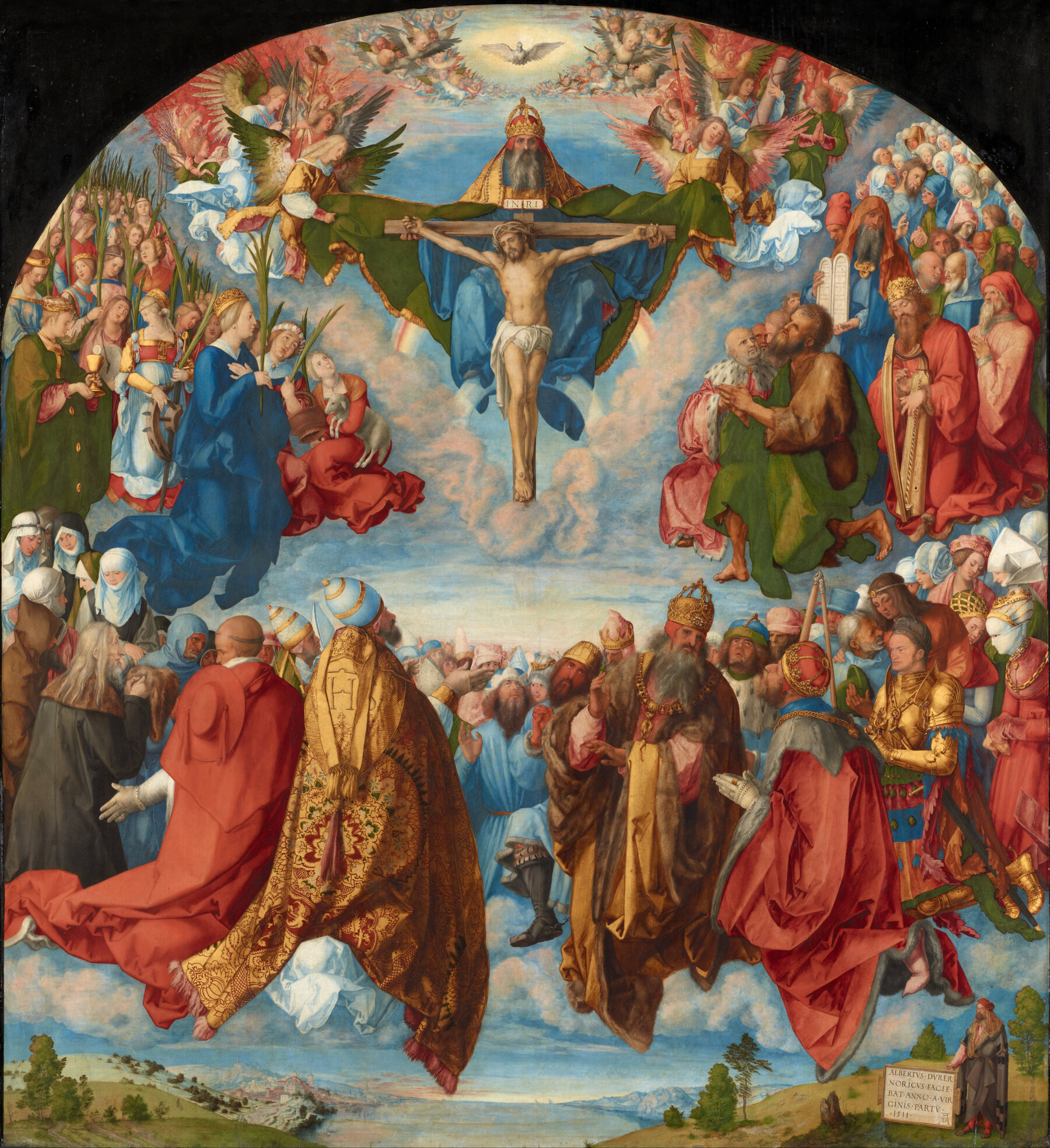
Go back to the image at the top of this page. Dürer painted the Trinity adored by a crowd, and it is worth noticing who is in it.
There are popes, bishops and kings, yes — but they are a minority and they are not in the centre. The bulk of the panel is ordinary people: peasants with tools, mothers with children on their hips, craftsmen, an elderly couple, people with no name, no attribute, no caption. Dürer even painted himself down at the bottom, tiny, in the corner of the landscape, holding a tablet.
It is a theologically exact portrait of heaven. The overwhelming majority of the saints were never canonised and nobody knows their names. They founded nothing, wrote nothing, were not martyred in front of an audience. They were faithful in a small place for a long time — which is, statistically, the normal way of getting there.
One last task, and it is not small
The month closes with the request it opened on, now reversed. In the four previous weeks we prayed for priests, for religious, for families and for the laity. What remains is what holds all four up:
- Pray every day for vocations — in your family, your parish, your diocese. Not in general: for concrete people, by name.
- Choose one thing only for this week. One. Holiness never reached anybody through a twelve-point plan; it arrives by a small habit kept for a long time.
- Stop waiting. If your vocation is not yet clear, it will become clear inside a life already handed over — and not before.
The Church does not need more spectators. She needs people who answer — and the first answer, the one that depends on discovering nothing at all, fits entirely inside today.
Haec est enim voluntas Dei, sanctificatio vestra. This is the will of God: your sanctification. May he give us the grace to begin with today, and not with the day when everything is clear.
- Week 1 — The priesthood was born at the Last Supper
- Week 2 — Consecrated life: the hundredfold already in this life
- Week 3 — Marriage and the domestic Church
- Week 4 — The vocation of the laity
- Words of the saints — a growing collection, in English and Portuguese.

Comments