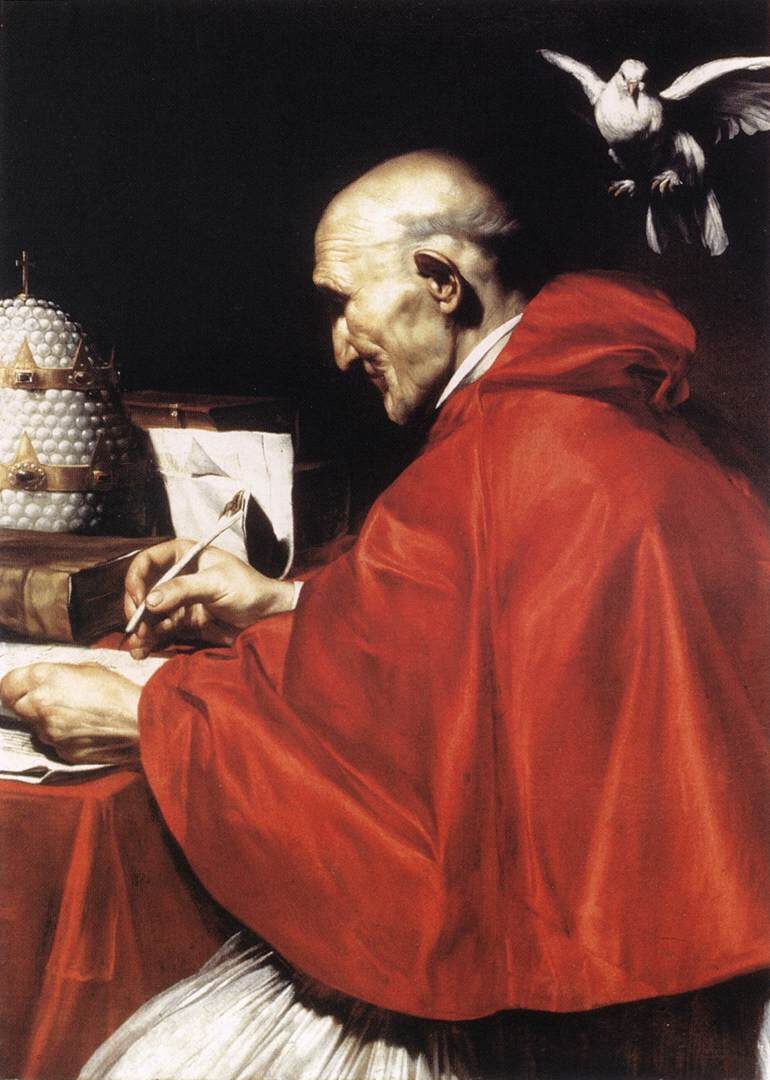
Today, 3 September, the Church keeps Saint Gregory the Great (c. 540–604). He was the first monk to become pope, and he hated it. The letter in which he accepts the election is a lament: he writes that he has lost the peace of the cloister and finds himself “flung into the open sea”. He governed for fourteen years and changed the Church so thoroughly that the West kept the shape he gave it.
Prefect of Rome, and then a monk
He was born to a patrician family around 540, in a ruined Rome — the city had been taken and retaken, plague came and went, and the population had fallen to a fraction of what it was. He made a career: he became prefect of the city, the highest civil office, still in his early thirties.
And he gave it all up. He turned the family house on the Caelian Hill into a monastery and founded six more in Sicily with the money from the estates. They were, he said later, the only truly happy years of his life.
The Church did not leave him there. He was made deacon, then apocrisiarius — the pope’s envoy at Constantinople for six years — and in 590, with plague killing Rome and Pope Pelagius II dead of it, he was elected. He tried to run. He did not manage it.
What he did, and what lasted
- He coined a title. Against the patriarch of Constantinople, who was calling himself “universal bishop”, Gregory began signing himself servus servorum Dei — servant of the servants of God. Popes have signed that way for fourteen hundred years.
- He had England converted. In 596 he sent Saint Augustine of Canterbury with forty monks. The story is Gregory’s — Bede tells it — of seeing fair-haired boys in a Roman slave market and, on being told they were Angli, answering: “Not Angles, but angels.”
- He gave the chant its name. Gregorian chant is called after him. Modern scholarship shows the repertory took shape later, but the ordering of the Roman chant and liturgy began in his pontificate.
- He wrote the pastor’s handbook. The Pastoral Rule was for centuries the book handed to a bishop on the day of his consecration. Alfred the Great had it translated into Old English.
- He fed the city. With the empire absent, it was Gregory who ran the granaries, negotiated with the Lombards and paid ransoms for captives. Rome survived because her bishop did the work the state had abandoned.
Gregory died on 12 March 604, and for centuries the Church kept him on that day. But 12 March falls almost always in Lent, which swallows memorials.
So the reform of the calendar moved the feast to 3 September — the day in 590 on which he was consecrated bishop of Rome. It stopped being the death and became the beginning of the service.
A sick man who did not stop
He spent the whole pontificate ill: gastritis, gout, fevers, long spells in bed. He writes in his letters that there are days he cannot get up, and then dictates another book. He died in 604, worn out.
The name the Great stayed with him. He is one of the four great Doctors of the West, beside Ambrose, Augustine and Jerome — whom the Church keeps at the end of this same month.
“The proof of love is in the works.”— Saint Gregory the Great, Homily 30 on the Gospels
“Scripture grows with the one who reads it.”— Saint Gregory the Great, Moralia in Job
“Not Angles, but angels.”— ascribed to Saint Gregory, before the English boys in the market
The prayers
His signature is a short prayer in itself — and the best definition of authority the Church has produced:
Servus servórum Dei.
Servant of the servants of God.
— Saint Gregory the Great
And this is the Collect of the day’s Mass. Notice how it ends: that the progress of the sheep may be the eternal joy of the shepherds.
Deus, qui pópulis tuis indulgéntia cónsulis et amóre domináris, da spíritum sapiéntiæ, beáto Gregório papa intercedénte, quibus dedísti regímen disciplínæ, ut de proféctu sanctárum óvium fiant gáudia ætérna pastórum.
O God, who care for your people with gentleness and rule them in love, through the intercession of Pope Saint Gregory endow with a spirit of wisdom those to whom you have given authority to govern, so that the progress of the holy flock may become the eternal joy of the shepherds.
Amen.
Sancte Gregori, ora pro nobis. Saint Gregory the Great, pray for us — and win for those who command the grace to serve.
- The Nativity of Our Lady — on the 8th.
- Saint Jerome — another of the four Doctors of the West, on the 30th.
- Words of the saints — a growing collection, in English and Portuguese.

Comments