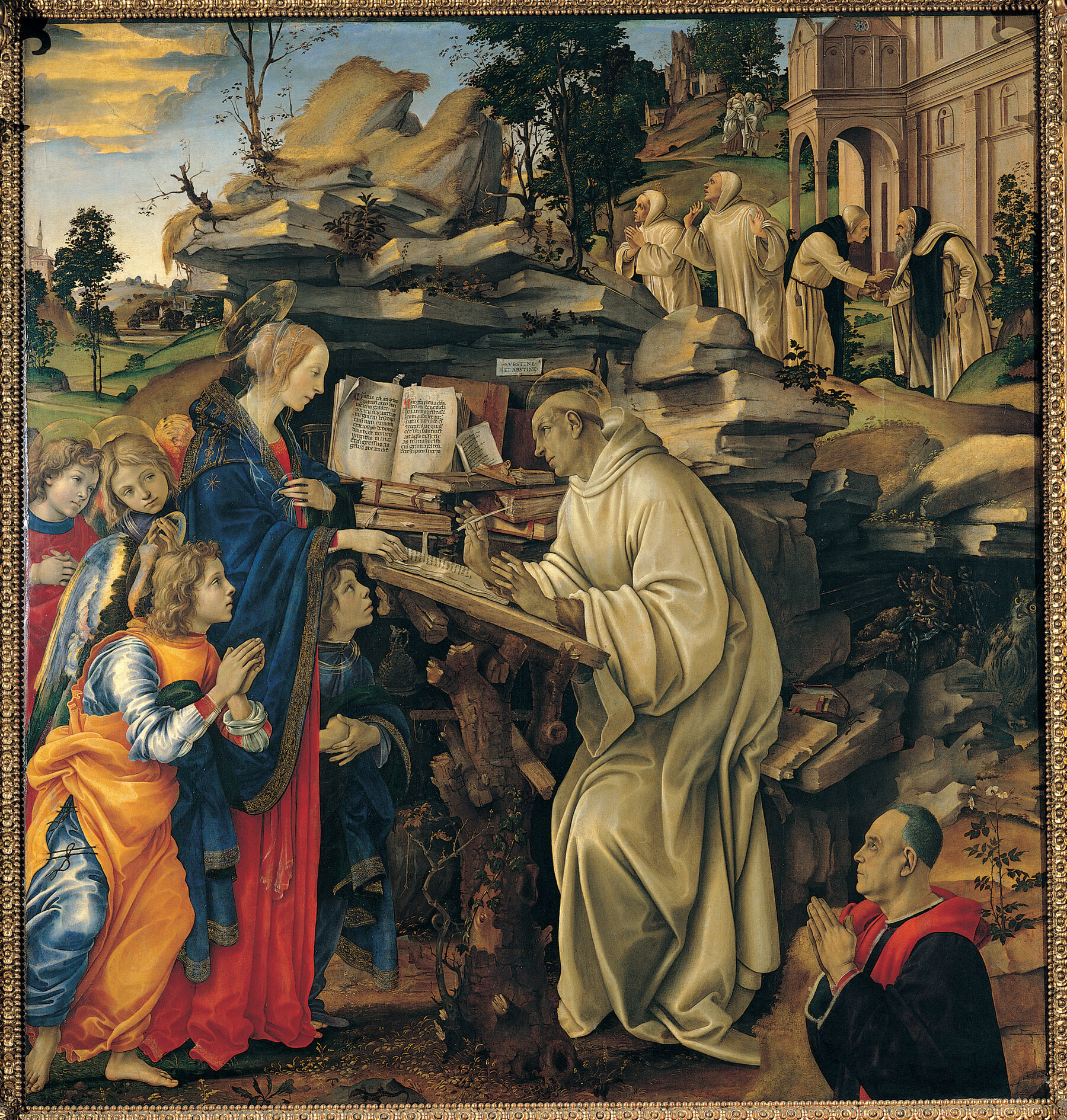
He was never pope, nor bishop, nor cardinal, nor king. He died holding the same office he began with: abbot of a monastery out in the woods. And yet when there were two popes at once, it was he who decided which was the real one; when kings quarrelled, he arbitrated; when Europe marched east, it was because he asked. Bernard of Clairvaux is the most extreme case in Church history of power without office — and he spent his whole life trying to get back to his cell.
The young man who brought the family
He was born in 1090 in Burgundy, to a noble house. At twenty-two he decided to enter Cîteaux, a new, poor, severe monastery that was close to closing for want of vocations.
Here is the first sign of what he was. Bernard did not go alone: he talked around thirty relatives and friends into going with him — four brothers, an uncle, cousins. To the youngest brother, left behind because he was a child, he said he could keep the whole inheritance; the boy replied that this was a poor bargain, and later followed him in.
A man of twenty-two who turns up at the gate of a dying monastery with thirty men behind him is not a devout youth. He is a force of nature that does not yet know it.
Three years later he was sent to found a new house in a valley he named Clairvaux. He stayed thirty-eight years, and sixty-eight monasteries were founded from it in his lifetime.
“No one can be perfect without being different”
His preaching emptied the schools. Mothers hid their sons when Bernard came to town, because those who heard him tended to leave as monks — it was notorious enough to be a joke of the period.
What he said was not complicated. It was only taken seriously to the end:
“Why do you wonder? No one can be perfect without being different.”
Saint Bernard of ClairvauxThe monk who decided who was pope
In 1130 two candidates were elected pope on the same day: Innocent II and Anacletus II. Christendom split, and every king picked one. There was no court to settle it.
A council was called at Étampes and the case handed to a single man: the abbot of Clairvaux. Bernard examined it, decided for Innocent II, and then spent eight years on the road persuading Europe — France, Germany, England, Italy, kings and cities — and won. A monk with no jurisdiction whatever resolved a papal schism on foot.
In the following decades a former pupil of his was elected pope as Eugene III. Bernard then wrote him the De consideratione, a treatise on the dangers of the papal office itself — probably the frankest text ever addressed to a pope by somebody who liked him. He warns that the Curia will eat him alive with litigation, that he must keep time to think, and that he has inherited not the throne of Constantine but the poverty of Peter.
The crusade, and the rarest thing he did
In 1146 the pope asked him to preach the Second Crusade. Bernard preached — at Vézelay before the king of France, and then across Germany. It was probably the most effective communications campaign of the Middle Ages: crowds enlisted, the cloth for the crosses ran out, and he tore up his own habit to make more.
The crusade was a total disaster. The armies got lost, fell out among themselves and came home beaten, and Europe went looking for someone to blame. It found him quickly: the monk who had told everyone to go.
And here is the most striking thing about him. Bernard did not defend himself with the obvious argument — that he had preached and others had commanded badly. He wrote, in the De consideratione, addressing the pope and posterity, that he would rather the complaints fell on him than on God, and took the weight of the failure publicly.
It is exceedingly rare. The most influential man on the continent put in writing, in his own lifetime, that the largest undertaking of his career had gone wrong and that the bill was his.
They called him the Mellifluous Doctor — “the one from whom honey flows” — for the sweetness of his Latin, and the nickname stuck so hard it became an official title: Pius XII wrote an encyclical under that name in 1953, on the eight hundredth anniversary of his death.
Notice the contrast. The same man of the sweet Latin wrote letters to kings with a bluntness that would end a career today. Sweetness, in him, was never a synonym for mildness.
Mary, and the star
If one inheritance of his has outlasted everything, it is Marian. Bernard preached and wrote about Our Lady with a tenderness that changed the devotion of the West — and the image that stayed is this one:
“If the winds of temptation rise, if you run upon the rocks of tribulation, look to the star, call on Mary. If she holds you, you do not fall; if she protects you, you fear nothing.”
Respice stellam, voca Mariam.
Saint Bernard, Homilies in praise of the Virgin MotherThe prayer Remember, O most gracious Virgin Mary is attributed to Saint Bernard by a tradition of centuries, and that is how most books present it.
To be honest about it: the form we pray today is documented in the fifteenth century, and was spread in the seventeenth by a French priest called Claude Bernard — which may well explain the confusion between the two Bernards. The content, though, is thoroughly Bernardine: it is the star of the sea turned into a petition.
The Church has never withdrawn the attribution, and the prayer is worth exactly the same under either hypothesis.
The end
He died on 20 August 1153 at Clairvaux, worn out, at sixty-three, having spent his life complaining about being away from the monastery and going back on the road the moment he was asked.
He was canonised only twenty-one years later and declared a Doctor of the Church in 1830. He is the last of the Fathers, in the settled phrase — the end of one age and the beginning of another, written by a man whose only office, from first to last, was abbot.
“If the winds of temptation rise, look to the star, call on Mary. If she holds you, you do not fall; if she protects you, you fear nothing.”— Saint Bernard of Clairvaux
“The measure of loving God is to love him without measure.”— Saint Bernard of Clairvaux
“All time that we do not dedicate to the glory of God is in vain.”— Saint Bernard of Clairvaux
Sancte Bernarde, ora pro nobis. Saint Bernard, pray for us — and win us the nerve to own our mistakes as readily as we own our successes.
- The vocation of the laity — where his line about being different comes back.
- Saint Alphonsus Liguori — another Doctor in love with Mary.
- Consecration to Our Lady — where the star of the sea reaches the end of the road.
- Words of the saints — a growing collection, in English and Portuguese.

Comments