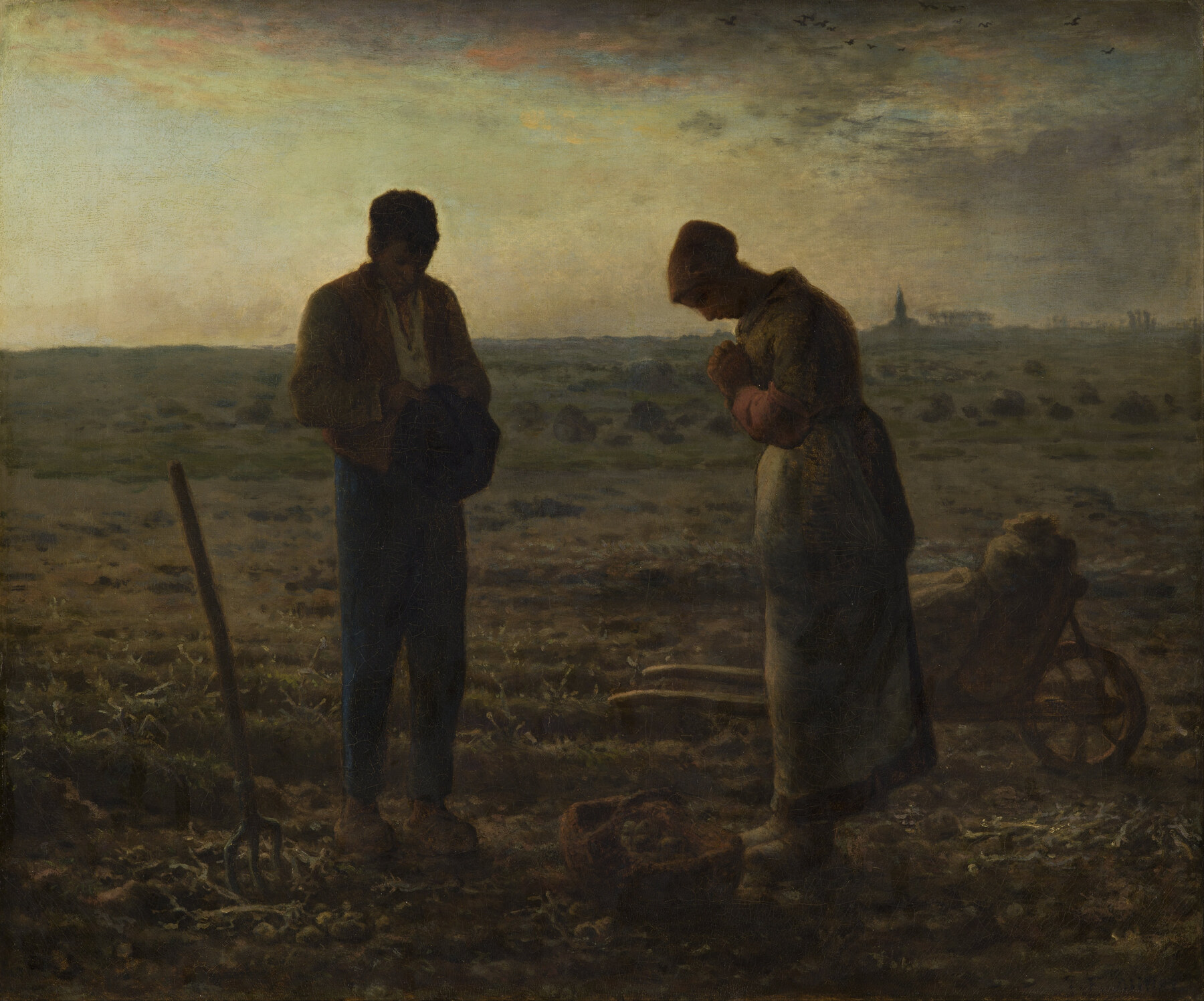
Look at the painting above before reading anything. Two peasants, late in the day, stop working in the middle of a field because a bell rang somewhere. They are not in a church, there is no priest, there is no altar. There is a basket of potatoes, a wheelbarrow, a fork stuck in the earth — and two people praying standing on their own patch of ground. It is the most exact portrait there is of the lay vocation, and it explains this whole week better than any document.
The world is not what you leave
There is a diffuse and very comfortable idea that serious spiritual life happens somewhere else: in the monastery, the sacristy, the retreat house. On that reckoning the layman is a second-class Catholic — the one who lacked the nerve to leave everything.
The Second Vatican Council shut that door with a technical phrase: the secular character is proper to the laity. That is: the world is not the obstacle to be got past in order to be holy. The world is the assignment.
And it is an assignment nobody else can carry out. The priest is not in the board meeting, or the site changing room, or the classroom at seven in the morning, or the family group chat when somebody posts a lie. You are. On that square metre, the Church is you or it is nobody.
Three offices received at baptism
Every baptised person is priest, prophet and king. This tends to be said as vague praise; they are three functions, and each has a practical translation.
- Priest — to offer. Not the Eucharist, which belongs to the ordained, but the raw material of your own life: the work, the tiredness, the illness, the annoyance of the morning. Offering is what turns an ordinary day into matter for worship, and it is free.
- Prophet — to say. Not to preach in the street: to tell the truth where it costs something, and to be able to explain why you believe it. Someone who cannot explain his own faith is not humble, he is unprepared.
- King — to order. To govern what is under your responsibility — the children, the team, the money, your own time — according to God rather than according to habit. King, here, means administrator with judgement.
What was already being said in the second century
There is an anonymous text, written around the year 200 to explain Christians to a curious pagan, that describes the lay vocation better than any modern document. It is called the Letter to Diognetus:
“Christians are not distinguished from other men by country, language or customs (…). They dwell in their own homelands, but as strangers. They marry as everyone does, they beget children, but they do not expose their infants. They share their table, but not their bed. They are in the flesh, but do not live according to the flesh. They spend their time on earth, but their citizenship is in heaven (…). In a word: what the soul is in the body, that Christians are in the world.”
Letter to Diognetus, second centuryNotice what the text does not say. Nothing about outward signs, dress, a special vocabulary, geographical separation. The difference is invisible to the eye and absolute in practice — and the closing image is exact: the soul is present in the whole body and appears nowhere in it.
“No one can be perfect without being different”
The line is Saint Bernard’s, whose feast was the day before yesterday, and it is worth pinning down what it means — because a good deal of unpleasantness passes for Christian coherence these days.
Different does not mean odd. It does not mean unpleasant, it does not mean winning arguments online, it does not mean flying your opinion like a flag.
It means being the person who does not lie out of convenience. Who does not laugh at the filthy joke because everyone else is laughing. Who treats well the one who is of no use to him. Who hands back the extra change. Who does not discuss the colleague who is not in the room. And who, when somebody finally asks why are you like this, can answer without embarrassment and without a sermon.
St Paul said the same in five words: “be not conformed to this world” (Rom 12:2). The verb is the one for taking the shape of a mould. That is this week’s question: who is shaping whom.
Saint Gianna Beretta Molla (1922–1962) was a paediatrician in Milan, married, mother of four. She skied, liked opera, went to work. Canonised in 2004, with her husband and children in the square.
Blessed Pier Giorgio Frassati (1901–1925) was an engineering student in Turin, a mountaineer, a political militant, the son of a newspaper owner. He died at twenty-four of polio, contracted in all likelihood among the poor he was secretly helping — his family only found out at the funeral, when the whole city turned up.
Carlo Acutis (1991–2006) was a Milanese teenager who wrote code and catalogued Eucharistic miracles on a website. He died of leukaemia at fifteen.
None of the three founded an order, wrote a treatise, or left the world. They did the opposite: they stayed exactly where they were.
Nobody is going to authorise you
There is a quiet habit of waiting for permission — for the parish priest to invite you, the diocese to organise something, the movement to call. And the permission does not come, because there is no permission to be given: your Baptism already sent you. No second summons is scheduled.
Try a simple calculation. If every Catholic in a medium-sized town lived coherently for a single month — no campaign, no poster, nothing announced — that town would be a different place in thirty days. That is the arithmetic, and it is why the Church presses so hard on a subject that looks small: there is no substitute for ordinary people being reliable.
This week’s request
- Choose one concrete person in your daily surroundings — a colleague, a neighbour, a relative you have drifted from — and do something for them that nobody asked for and that they cannot repay.
- Pray the Angelus once, standing, in the middle of work, as in the painting. It takes forty seconds and reorganises the whole day.
- Be able to answer. Pick one thing about the faith you could not explain if asked, and study it this week. That is the prophetic office, and it requires preparation.
This is how the Kingdom advances: not by campaigns, but by people who decided to be different where they already are.
- Marriage and the domestic Church — the previous week of the Vocations Month.
- The call to holiness — the week that closes the series.
- The family of the Church — an older text on belonging where you are.
- Words of the saints — a growing collection, in English and Portuguese.

Comments