Brothers and sisters, so dearly loved and cherished by God, what a joy it is to begin another week in God’s holy grace, to have the mercy of the Lord, the presence of a beautiful and wonderful God at our side, who does not treat us with indifference, as so many people who do not know us treat us, but treats us with a love so sublime and unique that St Thomas Aquinas, a saint and Doctor of the Catholic Church, used to say that He loves us so much that He treats us as if we were ‘His God’.
God loves us so much, and so unconditionally, that He does not look at what we have done or failed to do; He does not care whether this love is returned, but He loves freely, fully, as if we were the best person in the world and did only what is pleasing in His eyes.
This love reaches such a point that, as if it were not enough to do everything He can — that is, what is impossible for us — He sends His own Son to die on a cross, to show us the size, the greatness, the strength, the breadth, the expanse, the glorious, the extraordinary and tremendous magnitude of His love for us.
“For God so loved the world that he gave his only-begotten Son, that whoever believes in him should not perish but have eternal life. For God sent the Son into the world, not to condemn the world, but that the world might be saved through him. He who believes in him is not condemned; but he who does not believe is condemned already, because he has not believed in the name of the only-begotten Son of God. And this is the judgment, that the light has come into the world, and men loved darkness rather than light, because their deeds were evil. For everyone who does evil hates the light, and does not come to the light, lest his deeds should be exposed. But he who does what is true comes to the light, that it may be clearly seen that his deeds have been wrought in God.” (Jn 3:16-21)
I do not know whether you understood what you have just read, but in this short passage we have the fullest expression of a God who is madly and passionately in love with humanity, yet who was rejected. The light came into the world, but men preferred the darkness. And what does God do in the face of this? He waits for us to choose and to opt for His wonderful light. He waits for us! That is why, even if you have been distant, even if you have been far away, even if you have wandered through the world roaming every corner, seeking a place to be happy, with the Adoração e Vida ministry we want to invite you to come back...
As if this tremendous love and this proof that He loves us like no one else in the entire Universe were not enough — for neither in Heaven nor on Earth is there anyone who loves us in this way — Jesus instituted the memorial of His passion (as we reflected last week) so that we would never forget what He did for us. And it is precisely on this wonderful mystery of love that we are going to reflect today.
What is the Holy Mass? Why do we treat it as a mystery? Who can enter into these mysteries? What does the world want to do with the Holy Mass? What happens at every Holy Mass celebrated on the face of the Earth? These and other questions will be dealt with today, to lead us to a true and deep love for Jesus Christ and to increase in our soul the desire to know the riches of the Holy Mass.
Once again we will have a post filled with doctrine and content so that we may go deeper and dive headlong into the faith, so that we may grow as persons — physically, psychologically and spiritually — as followers of Jesus Christ, as men and women who have a direction in life. We are not lost, nor do we remain lost; rather, we are following and declaring: I AM GOING IN THIS DIRECTION.
May God bless you, and may you have a good reading, attentive to every sentence, to every highlighted expression, to every biblical passage, to every phrase spoken by those people who died in holiness, loving and giving their lives for Christ — the saints, men and women, who now enjoy blessedness in Heaven. Make good use of this post!
A Frenchman, without much understanding and with difficulty in learning, was ordained a priest because he prayed the rosary well, and was sent to be parish priest in a small settlement that had an empty church, in a town called Ars, in France. His devotion to Mary Most Holy, his love for Jesus in the Blessed Sacrament, his long hours of adoration before the Most Blessed Sacrament, his prayer, fasting, penance, constant sacrifices and his celebration of the Holy Mass with an uncommon love, transformed the society and the surroundings of that church.
The devil appeared before him — on one of the countless times he appeared — and set fire to his bed and, pressing him against the wall, said to him in fury: “If there were three priests like you, my kingdom would be finished here in France.” He was a man who had understood the mystery of the Mass! He, St John Mary Vianney, used to say: “If we knew what the Holy Mass is, we would die of love.”
A young man, at fifteen years of age, entered the seminary to be ordained a priest, following the example of a Franciscan religious, Friar Camillo. By a special grace of God, he was the only priest of the Catholic Church to receive the stigmata of Christ in his body, which he carried with great love for fifty years. He had supernatural gifts and understood so vehemently what it is to be a priest of the Lord (a theme we will explore in other posts) that he consumed his life out of love for Jesus Christ, for the Virgin Mary, for the Holy Mass and for the Holy Catholic Church.
A hundred years before the ordination of this priest — canonized under the name St Pio of Pietrelcina — before he had even been born, the angels served the friars of that place because of their dignity. Jesus is called “the Lamb of God,” and St Pio, because of the intimate and radical union he lived with Christ, is called “the lamb of Jesus.” He, who understood very clearly the mystery of the Holy Mass, used to say: “It would be easier for the Earth to exist without the sun than without the Holy Mass.”
Another Franciscan friar, a defender of poverty, held by the Church in as high regard as St Thomas Aquinas — that is, a Seraphic Doctor — named St Bonaventure, who had also understood the mystery of the Holy Mass, used to say: “The Holy Mass is a work of God in which all the love He has for us is set before us. In a certain way, it is the synthesis and sum of all the favors He has granted us.”
There is in the Church of Heaven a saint who lived in Italy, considered the first patriarch of Venice, a radical and reforming bishop (not like the “reform” carried out by Martin Luther, who had the misfortune of separating himself from the Church of Christ without understanding the mystery of the Holy Mass, but like St Francis of Assisi, who also, in a certain way, reformed the Church, yet who understood, lived and loved with the most faithful tenderness of his soul the mysteries of God), named St Lawrence Justinian, who used to say: “No human tongue can recount the favors that spring, as from a fountain, from the Sacrifice of the Mass: the sinner who is reconciled with God, the just man who becomes more just, the faults that are cancelled, the vices that are uprooted, the virtues and merits that grow, the snares of the devil that are confounded.”
Beloved of God, we need to learn and understand the extraordinary, supreme and complete manner in which the Lord loves us, and we will only begin to understand this from the moment we become aware of and come to know the most holy and most important riches that our Lord Jesus Christ left us when He was here on Earth, which are called: the Holy Mass and the Virgin Mary. It is by these paths that He wants us to walk, so that we may reach heaven, where He is!
Let us focus and give our attention to the first of these riches, in the order in which they were left to us by Christ, but with the awareness that the Virgin Mary helps us and leads us to live with greater intensity, greater love, greater spiritual penetration and understanding what the Holy Mass is.
Let us begin from where Jesus instituted it, from the physician St Luke:
“And when the hour came, he sat at table, and the apostles with him. And he said to them, ‘I have earnestly desired to eat this passover with you before I suffer; for I tell you I shall not eat it until it is fulfilled in the kingdom of God.’ And he took a cup, and when he had given thanks he said, ‘Take this, and divide it among yourselves; for I tell you that from now on I shall not drink of the fruit of the vine until the kingdom of God comes.’ And he took bread, and when he had given thanks he broke it and gave it to them, saying, ‘This is my body which is given for you. Do this in remembrance of me.’ And likewise the cup after supper, saying, ‘This cup which is poured out for you is the new covenant in my blood...’” (Lk 22:14-20)
Notice what Jesus said: I HAVE EARNESTLY DESIRED TO EAT THIS PASSOVER WITH YOU BEFORE I SUFFER. That is, the first Holy Mass ever celebrated on the face of the Earth was celebrated with a longing, with an ardent desire, with a hunger, a thirst, a yearning that burned in the heart of Jesus and that He so wanted to share with His apostles, who were ordained priests when He entrusted to them the ministry of confession with the breath of the Holy Spirit, the mission of celebrating the memorial of His passion through His own words, and the other sacraments (all themes that we will explore in detail).
Now, the will of God is that the Holy Mass be celebrated! The word “Mass,” translated from the Latin, means sending. Sending of what? Sending for what? It is the sending that all who take part receive, to be salt and light in the world (cf. Mt 5:13-14), to bear witness to what they lived at the Holy Mass, which, as we reflected in the previous post, is the renewal of the one and eternal sacrifice of Jesus Christ, the memorial of His passion.
It is not a dramatization; it does not merely represent, it does not merely recall — it makes the sacrifice of Christ present. Jesus said: THIS IS MY BODY! THIS IS MY BLOOD! These are the same words that the priest pronounces at the moment when the transformation of the bread and wine into the body and blood of Jesus Christ takes place, by the action of the Holy Spirit (a mystery we call transubstantiation, which we will explore in other posts) at every Holy Mass celebrated.
The Globo network broadcast a few weeks ago, on the program Globo Repórter, in a feature about faith, some moments of the celebration of the Holy Mass, and the presenter said: “The faithful receive the consecrated host that represents the body of Christ.” Diabolically and deliberately that man said this, entering into many Catholic homes, to destroy faith in the mystery of the Mass, especially in the life of wretched and lukewarm Catholics who do not live their faith, to shake those who have doubts, and to try to draw away from the Mass those who live it.
Here we have already answered what the world wants to do with the Mass, knowing that it is the will of God, that it is a treasure, that it is the fountain to which all men ought to come to be supplied, nourished, to adore and to live. The corrupt world, governed by the devil, hates the sacrifice of Christ, hates this renewal, hates and is repulsed by the blood of Christ, by His wounds, by the salvation that comes to us from Calvary.
That is why the devil invests so much, attacking priests, religious, and nuns, through television, radio, songs, fashions, and thousands of things each day, to draw away our attention and to try to make us forget the memorial of the Lord’s passion. Open your eyes to see this! Sadly, how many there are who are losing the faith and giving ear to the lies of the modern world.
Woe to those who rise up against the Catholic Church! Woe to those who rise up against the mystery of the Holy Mass! Woe to those who rise up against the Virgin Mary! Little do they know that they are rising up against God Himself, against His will, against His infinite majesty. Grievous and painful will be the judgment of all those who try to put themselves in the place of God, imitating Lucifer, who is their father. Their end will be sorrowful at the final judgment (yet another theme for us to enter into).
But let us explain what happens at every Holy Mass; and as we study, we will come to understand better why the satanists invade and profane the Catholic Church, why the Freemasons steal and buy the body of Christ, why the heretics attack it and do whatever they can against it. This does not happen in Protestant churches, because they know that there the mystery that occurs only in the Catholic Church does not exist.
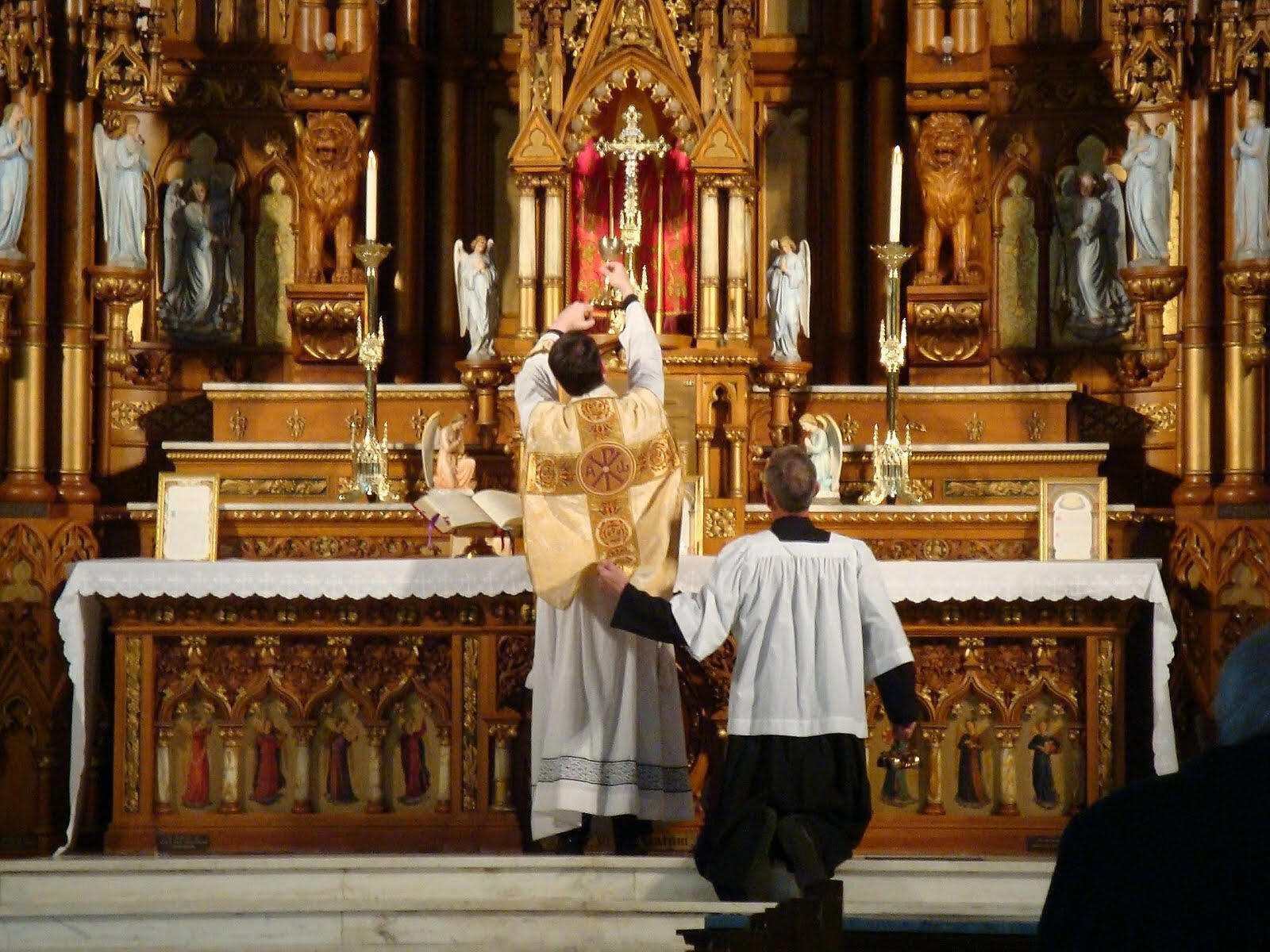
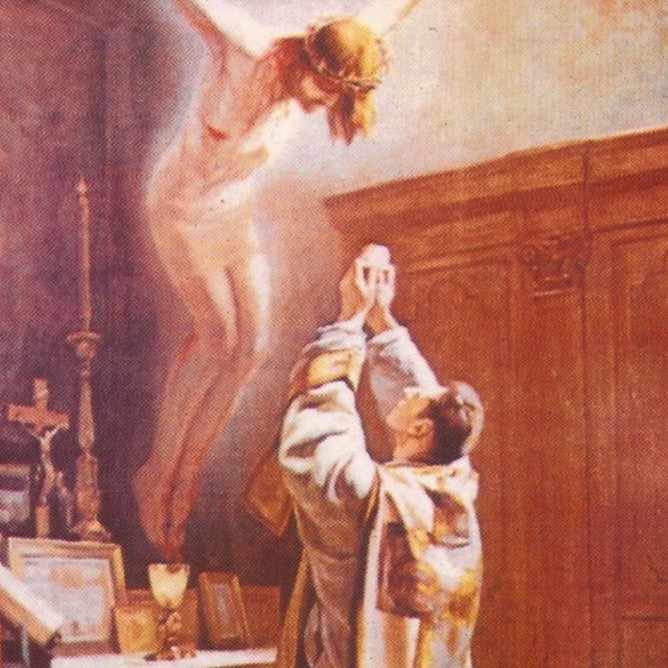
In the two images above we have a Mass being celebrated in the old rite, which was celebrated with the priest’s back to the people and facing God (which is also valid), unlike the new rite, which is facing the people and, consequently, with the back to God. In the first image is what we are able to see. In the second is what happens at the Mass, which many of us not only fail to see but also fail to believe. In either of these forms, the meaning and the sacrifice are the same, and it is always offered to God.
IT IS THE OFFERING OF THE SACRIFICE OF JESUS, THE LAMB OF GOD, FOR EACH ONE OF US, DIRECTED TO THE FATHER. THIS NOTION THAT THE SACRIFICE IS DIRECTED TO THE PEOPLE IS WRONG! IT IS LIKE WHAT HAPPENED IN THE OLD TESTAMENT, WHEN ANIMALS WERE SACRIFICED FOR THE SINS OF THE PEOPLE, OFFERED TO GOD. IN THE NEW TESTAMENT, JESUS IS THE LAMB OF GOD WHO IS SACRIFICED FOR OUR SINS.
The Mass begins when the ordained priest (who is called Persona Christi, for he is the person of Jesus) enters the church, which is the moment when Jesus began His journey toward Calvary carrying the cross. That is why we bow when the priest passes by — not for himself, but because of his dignity as a man consecrated to God. We must not forget that the priest entering is Jesus carrying the cross.
Then we have the greeting of the people, the penitential act, which is the moment to ask forgiveness and be reconciled with the Lord, for we cannot approach the Lord in sin. There are venial sins, and it is at this moment that we receive forgiveness and purification for them. For other, mortal sins (which we will explore) we need to go to confession before approaching Holy Communion, so as not to fall into the sorrow of sacrilege.
St Cyril of Jerusalem already taught: “When a person receives Communion in mortal sin, he communicates both Christ and Satan; Satan, to reign, and Christ, to be crucified within his own heart.” We cannot do this, crucifying and mistreating our Lord Jesus, who makes Himself small to be within us! It is the same thing St Paul said to the community of Corinth (cf. 1 Cor 11:28-29).
Then we sing the Gloria, and we have the proclamation of the readings, of the psalm and of the Gospel, in which the blood of Jesus Christ pours over each person, when we pay attention and listen with an open heart. This is very important, for besides washing and purifying us (cf. Jn 15:3), it enkindles and prepares our heart to enter into intimate communion with Christ (cf. Lk 24:32).
Then we have the moment of the offertory, in which we take part with material offerings, but above all we ought to offer our heart and our soul on the altar, where the sacrifice of the Lord will take place. At this moment our guardian angel goes up to the altar to offer something... We need to be attentive and to hand over our life, our worries and everything we need to give to God (cf. Phil 4:6).
See how important and wonderful it is to do this. St Peter Julian Eymard explains it to us: “In prayer we ask graces of God; at the Mass He is obliged to grant them to us.” Why? Because it is the sacrifice of Christ and not our own. It is the Lamb of God offered to God!
Next we enter into the Liturgy of the Eucharist and we have the SANCTUS, in which the Church, united to the angels of heaven who come down to earth, encamp and fill the house of God, sings the praise of the Lord, inspired by the book of the prophet Isaiah:
“In the year that King Uzziah died I saw the Lord sitting upon a throne, high and lifted up; and his train filled the temple. Above him stood the seraphim; each had six wings: with two he covered his face, and with two he covered his feet, and with two he flew. And one called to another and said: ‘Holy, holy, holy is the Lord God of hosts! The whole earth is full of his glory!’ And the foundations of the thresholds shook at the voice of him who called, and the house was filled with smoke.” (Is 6:1-4)
That is why, on the Church’s solemn feasts, the thurible is used (that sacred object in which the holy incense is burned — the only incense permitted by the Church for the adoration of God; any other incense is burned not for God but for the devil). And so the Church is filled with this holy smoke!
Next, we have the proper rites and prayers, which were formed over the course of the centuries, with contributions from the saints, men and women, and from the popes. These prayers are in a book called the Roman Missal. At last we reach the moment of the consecration.
AFTER PRONOUNCING THE WORDS OF THE LORD, THE PRIEST RAISES THE BREAD, AT THE MOST POWERFUL MOMENT OF THE MASS, SO THAT IT MAY BE CONSECRATED. AT THIS MOMENT THE HOLY SPIRIT COMES UPON THE BREAD AND THE TRANSFORMATION OF THE BREAD INTO THE BODY OF CHRIST TAKES PLACE. WE DO NOT SEE, WE DO NOT FEEL, WE DO NOT PERCEIVE IT, BUT IT IS THE MOMENT WHEN THE HANDS OF JESUS ARE NAILED TO THE CROSS.
Continuing, the priest raises the chalice with the wine (in which there is a tiny portion of water united to the wine — these are our sins and our miseries, diluted in the blood of Christ that is to be consecrated), and at the moment of the consecration the wine is transformed into the blood of Christ, by the action of the Holy Spirit, which, as in the consecration of the Body of the Lord, comes from the Cross. We do not see, we do not feel, we do not perceive it, but it is the moment when the feet of Jesus are nailed to the cross.
The Mass is Calvary made present, the sacrifice renewed, love brought to its fullness, the redeeming power of the cross, made present again through the blood, through the self-giving of Jesus. And what is our role before all of this? We must live, attend and take part with a heart burning and aflame with love for Christ. Once someone asked St Pio of Pietrelcina how we ought to take part in the Holy Mass, and he answered: “As the Most Blessed Virgin and the holy women assisted. As St John the Evangelist assisted at the Eucharistic Sacrifice and at the bloody Sacrifice of the cross.”
Ah, how Catholics need to hear and read this! How many today make of the Mass a place of partying, of disorder, of commotion, of doing and saying everything one can and cannot, but do not live the mystery of Christ. They profane the sacred mystery of the Holy Mass with inappropriate clothing, with gestures and ways of behaving inside the church more like pagans than like Christians. It is a disgrace and a shame, what the modern world does in our churches. It is at this moment that we see how few authentic Christians there are who understand and live these mysteries: they cannot even stay still before the sacrifice of Jesus!
When this moment of the consecration ends, the priest says: THE MYSTERY OF FAITH! We answer the question of who can enter into these mysteries: whoever prepares himself, whoever seeks, whoever truly desires it, whoever fasts for at least one hour (as the canonical code teaches; a fast that ought to be lengthened for our times because of the reality of so many abuses and disrespects toward the sacred liturgy). God offers us the opportunity of His merciful love. We must learn to make the most of it!
Then the liturgy continues with the seven petitions (or the principal ones) before Jesus crucified in the drama of Calvary at the Holy Mass — the universal prayer for the Church, for the faithful, for the bishops, for the pope, for the whole world. At a certain moment the prayer is directed in intercession for the souls in purgatory. At this moment we should pray for those we know and for all the souls in purgatory (a theme we will explore).
The following moment is the one that raises the sacrifice on the altar to its fullness, for when we pray “Lamb of God, who takes away the sin of the world” we are at the moment when the soldier Longinus pierces the heart of Jesus. At this moment of the Lamb, the mercy of Jesus is poured out upon us all. It is the last act before Communion! And so we need to make one more penitential act, examining our conscience and asking the mercy of the Lord, so that we may enter into communion with Him.
Communion is what we do at the end, receiving the body and blood of Christ. We do not receive Communion — we receive Jesus and enter into communion with Him. This needs to be clear in our heart, even though this moment is called Communion and Jesus is often called the Communion.
Here we need to be aware of what took place on the altar: the species of bread and wine were consecrated into the body, blood, soul and divinity of Jesus. Both in the Most Holy Body and in the Most Holy Blood, in every fragment, whether smaller or larger, Jesus is present in His entirety. If you receive a single drop from the chalice you are receiving the whole of Jesus. If you receive a tiny particle of the consecrated host you are receiving the whole of Jesus.
This is the most important moment of the Mass for everyone, for we enter into intimate and profound communion with Christ. He nourishes our soul, enters into our heart, dissolves within our body, and in a matter of seconds Jesus, with His body, blood, soul and divinity, is wholly within us.
THE APPROXIMATE TIME IT TAKES FOR THE BODY OF CHRIST TO DISSOLVE COMPLETELY WITHIN US IS FIFTEEN MINUTES; THIS IS WHY THE CHURCH RECOMMENDS MAKING AT LEAST FIFTEEN MINUTES OF THANKSGIVING.
See what St Louis Marie Grignion de Montfort used to say about this moment of the Holy Mass: “I would rather have half an hour of thanksgiving than an hour in heaven, because in heaven I will not be able to receive Communion.”
St John Mary Vianney used to say: “Every consecrated host is made to be consumed by love in a human heart.” And also: “When it receives Communion, the soul is steeped in the balm of love, as the bee in the perfume of flowers.”
In other posts we will insist on this idea, which is very important and essential for us to enter, in silence, into the intimacy of Christ. St Catherine of Siena used to say that this is the most fitting moment we have to converse, to ask, to present to Jesus our whole life, for He is wholly united to us.
At the end, the priest gives the final blessing, which is very important for us all, for it is the priestly blessing that the Lord gave to the apostles after the resurrection. We need to be attentive and to receive with great love and devotion this blessing, which is the sending and should carry the pure and holy meaning of every Holy Mass. We are sent to bear witness to this wonderful love of Jesus Christ with which we have been supplied, nourished and encouraged to live in our daily life.
St Augustine used to say: “The blessing you receive from the priest at the Holy Mass will be confirmed in Heaven.”
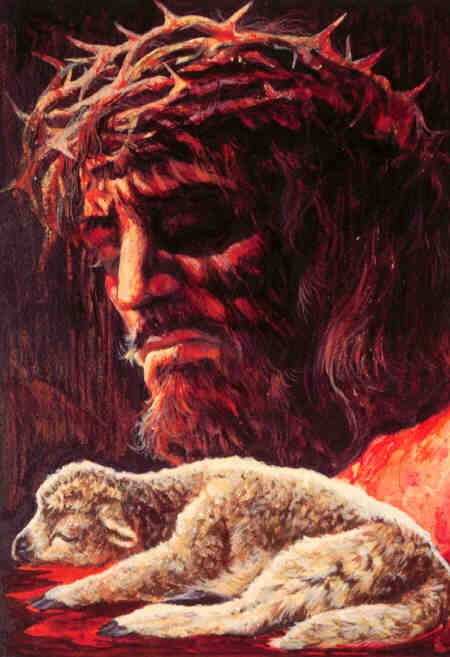
Before the Lamb of God, let us open our heart and ask Him for the grace to live the mystery of the Holy Mass with joy and holiness, for Jesus is the source of holiness for our life:
“Beloved Jesus, in light of what I have read in this post, I want to ask You for the grace of a firm resolution, to live the mystery of the Lord that takes place at every Holy Mass. I want to begin by asking forgiveness for everything I have done, without knowing what the Mass is, which is the making-present of the sacrifice of the Lord. I ask forgiveness for all the restlessness, for all the disharmony, for all the joking, for all the commotion that I have caused or led others to cause. I ask You for the grace to receive in Communion the mystery of the Lord with radicalness and love.
Help me, Holy Spirit of God, to dive headlong into the greatest mystery of the Lord Jesus Christ. You who glorify the Father in the Son, O glorious Holy Spirit, come to my aid and lead me to live and to be consumed as the Lord always does for me. Renew in my heart the love for Christ, Holy Spirit. Fill me with Your love and grant me the grace to melt with love, burned like incense, set aflame like the candle that is spent before the Lord; I want to spend myself and offer my life, to be united to the sacrifice of the Lord, as a pleasing offering of the King of Kings and the Lord of Lords.
Holy Father, take me and draw me to live the mystery that Your Son instituted and that the Lord blesses, welcomes, and through which He pours out graces and blessings upon the whole world. Give me a pure heart so that I may see what happens at every Holy Mass; give me pure eyes, pure ears, pure hands, a noble sentiment and an insatiable hunger for the Lord, so that I may never tire of seeking and of receiving the Lord in Communion at every Mass I have the opportunity to attend.
Glory and praise to the Lord my God and King. I adore You for having instituted Your mystery of love, the memorial of Your passion, the glorious renewal of Your sacrifice of the cross, Your goodness and mercy. I adore You, Holy Spirit, for touching me and giving me the grace to understand this wonderful mystery better. I magnify You, blessed Father, because all this is possible only because it is by Your will. Glory to You, Jesus, for giving me the opportunity to know You and to be able to enter into communion with You in this way. Thank You for Your Mother, whom the Lord gave to be my mother. Glory to the Father, and to the Son, and to the Holy Spirit. As it was in the beginning, is now, and ever shall be. Amen. Alleluia!”
“The celebration of the Holy Mass is worth as much as the death of Jesus on the cross.” (St Thomas Aquinas)
“Without the Holy Mass, what would become of us? Everything in this world would perish, for it alone can hold back the arm of God.” (St Teresa of Ávila)
“The humblest of Masses, celebrated in the poorest of churches, by the simplest of priests, strikes fear into the devil... And Heaven bows down to attend it.” (St John Mary Vianney)
In the face of the whole mystery of the Holy Mass, we of this blog have no better nor greater expression than this to speak of Heaven on Earth. The Holy Mass is the mystery set before our eyes, which — as in this last image, at the altar, in the making-present of the sacrifice of Christ, in the mystery of the cross renewed before our eyes — brings powerfully present the mystery of the Lord acting mightily and holily upon the face of the Earth in a silent way.
May God bless us and open our eyes so that we may live with love and intensity the mystery of the Holy Mass!

Comments