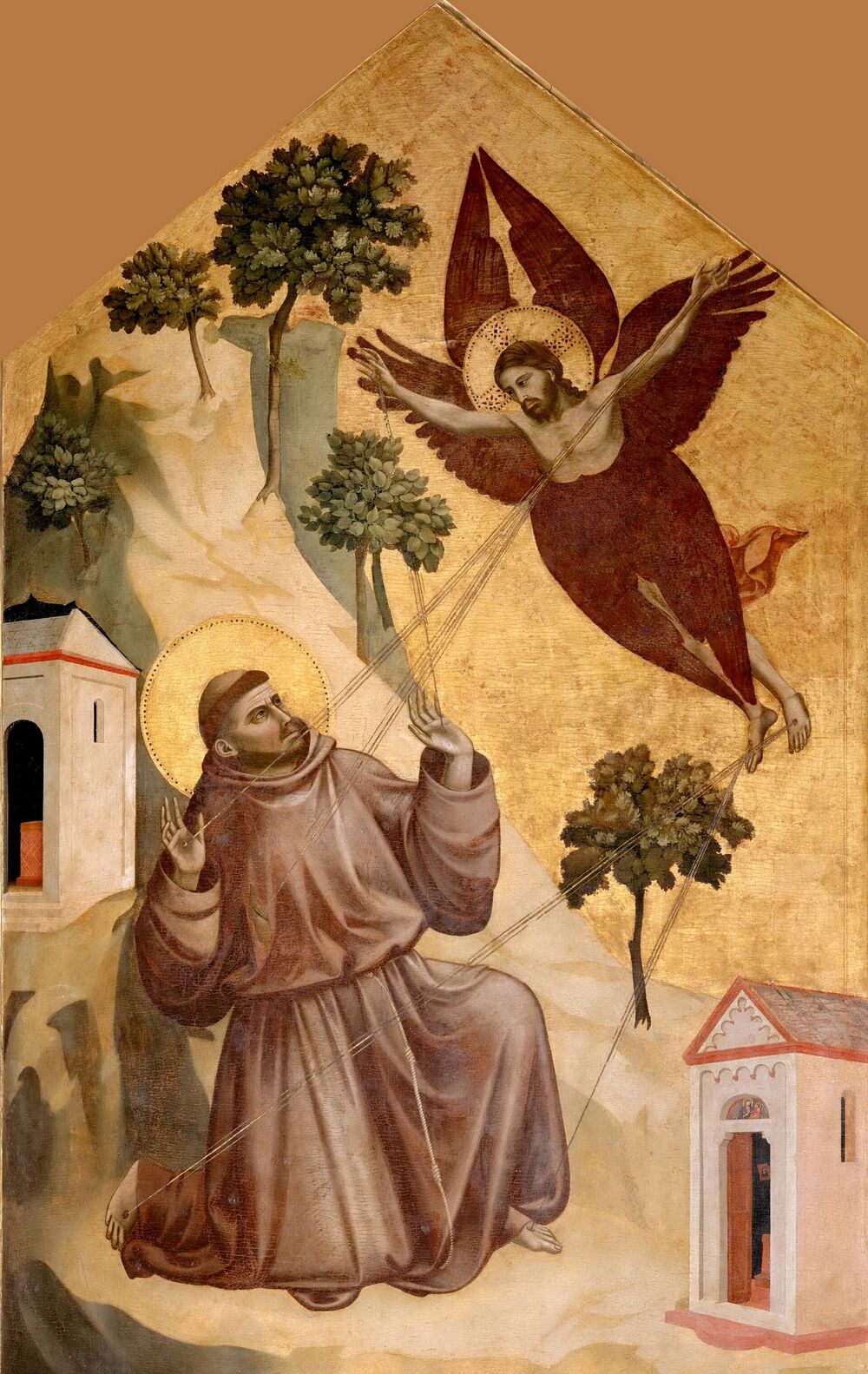
Today, 17 September, the Church keeps the memory of the Impression of the Stigmata of Saint Francis of Assisi. It is not a saint's birthday, nor the day he died: it is the memory of a morning in 1224, high on a Tuscan mountain, when a man went into prayer as on any other day and came down with the marks on his body.
A mountain, two friars and a Lent
The place is La Verna, in the Casentino woods of Tuscany. Francis went up with Brother Leo and Brother Rufino, and he did not go up to rest: he went up to fast. He was in the middle of a Lent in honour of Saint Michael the Archangel — the forty-day fast he kept between the Assumption of Our Lady and the feast of the Archangels.
The intention was his own, and the early biographies kept his words:
For the honour of God, of the Blessed Virgin Mary and of Saint Michael, prince of the angels and of souls, I wish to keep a Lent here.Saint Francis, in the Legend of Perugia, 93
Forty days of fasting and prayer, from 15 August to 29 September. Francis kept three such Lents each year, and all of them at La Verna.
The choice of the archangel is not decoration. The old devotion sees in Saint Michael the one whose office is to lead souls home — and Francis, who wanted every man saved, went to fast in the hands of the one who does that work.
This is the Lent that the front page of this site follows day by day between August and September. Today is day 29 of 40.
The vision of the seraph
The oldest and best known account is that of Saint Bonaventure. Francis was at prayer on the mountainside when he saw a winged figure come down from heaven which, on drawing near, turned out to be something else:
He saw what seemed a Seraph with six wings, shining and burning, coming down swiftly from heaven; and when it came to a halt beside him, it showed itself to be not only a Seraph but the Crucified himself.Saint Bonaventure, Minor Legend — De Stigmatibus sacris
Bonaventure describes what happened inside him as two things at once, not one: the joy of seeing Christ so familiarly near, and the pain of seeing him nailed. When the conversation ended — he calls it mysterious and intimate — the vision faded. The body did not.
What stayed in the body
- The hands. The marks of the nails, the heads standing out in the palms, the points coming through on the other side.
- The feet. The same marks, above and below — which cost him his walk for the rest of his life.
- The right side. An open wound, as though torn by a lance, which often bled.
It is Bonaventure again who gives the line Christian art never let go of: Francis came down from the mountain carrying the figure of the Crucified not carved in stone, nor painted on panel or canvas, but opened in his own flesh by the finger of the living God.
He hid the wounds for as long as he could. It was Brother Leo who told him that this was a gift, and that the brothers had to know.
14 or 17 September?
It is worth saying plainly: the early sources do not fix the day. Bonaventure places it "about the feast of the Exaltation of the Holy Cross" — that is, around 14 September, the feast the Church kept three days ago. Modern accounts, especially those written for the eighth centenary in 2024, give the date closed: Tuesday, 17 September 1224.
What is firm is the calendar of the Church: 17 September was granted by Benedict XI to the Order of Friars Minor, to keep the impression of the wounds every year. The feast belongs to the 17th; the event, the sources place between the Exaltation of the Cross and that day.
The proof that survived: Brother Leo's chartula
Of Francis's own hand one single parchment survives — the chartula he wrote for Brother Leo at La Verna, kept in Assisi to this day. It is the only autograph of his that scholarship recognises as authentic.
Decades after the saint's death, an old man by then, Leo added three lines in red ink to that parchment, telling what he had seen: the vision of the seraph, the wounds, and that Francis wrote the text for him straight afterwards. He asked Leo to carry it always. Leo carried it — for the rest of his life.
Francis is held to be the first person to receive the stigmata. Bonaventure says as much in thirteenth-century words: it was "by a singular privilege never before granted to anyone".
Recognition came quickly: canonised two years after his death, he came to be called alter Christus, and the wounded hands entered the coat of arms of the Order, crossed with those of Christ.
Summe, gloriose Deus, illumina tenebras cordis mei. Et da mihi fidem rectam, spem certam et caritatem perfectam, sensum et cognitionem, Domine, ut faciam tuum sanctum et verax mandatum.
Most High, glorious God, enlighten the darkness of my heart. Give me right faith, sure hope and perfect charity, sense and knowledge, Lord, that I may carry out your holy and true command.
Amen.
And, because the day asks for it, the invocation that runs through these forty days: Sancte Michael Archangele, defende nos in proelio. Saint Michael the Archangel, defend us in battle.
- The Exaltation of the Holy Cross — the feast of 14 September, beside which the sources place La Verna.
- Our Lady of Sorrows — the one who stood by the Cross, on the 15th.
- The Rosary of the Seven Sorrows — step by step.
- Novena to Saint Padre Pio — running now, 14 to 22 September: the wounds return to the body of a friar, seven centuries later.
- Prayer is the breathing of our soul — the video in which this Lent, and these wounds, come up.

Comments