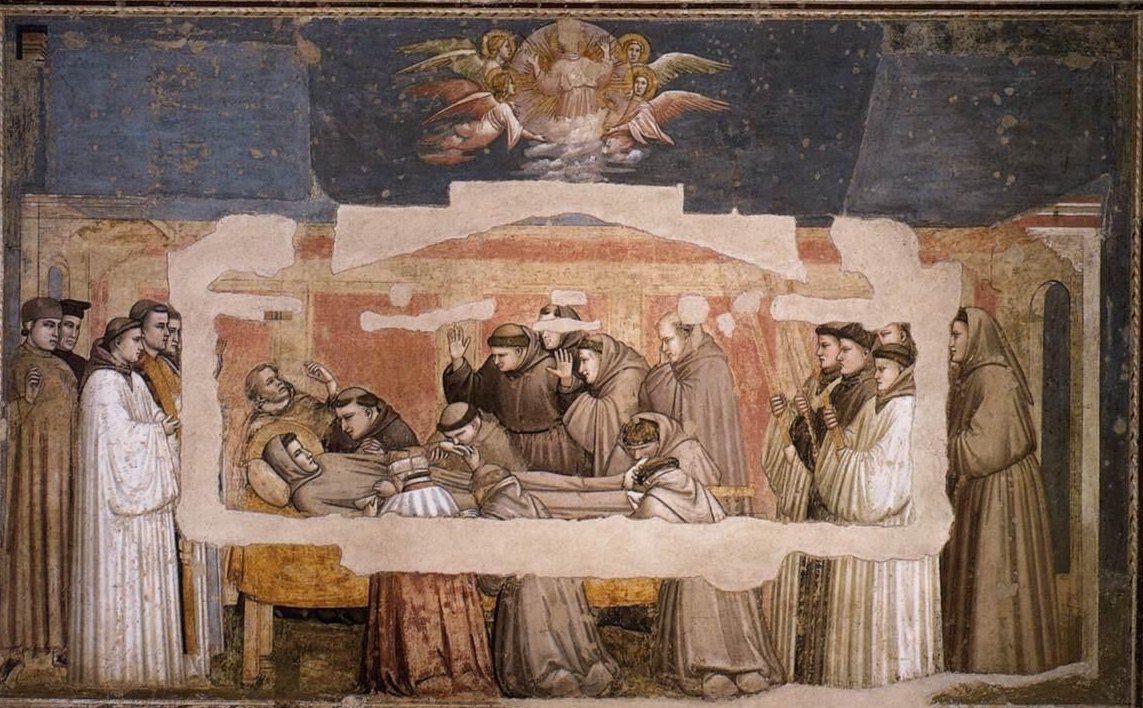
Today, 4 October, the Church remembers Saint Francis of Assisi. (In 2026 the date falls on a Sunday, which takes precedence in the Roman Calendar; the saint, of course, is the same.) On the evening before, Saturday 3 October 1226, he died on the bare ground of the Porziuncola. Celano says that “he received death singing”. And what he sang was a poem he had composed in his illness, almost blind, and from which Pope Francis took the title of his 2015 encyclical Laudato si’.
A poem in the language of the people
The Canticle of the Creatures, or Canticle of Brother Sun, was written in Umbrian, the speech of Assisi, and not in Latin. It is usually called the first work of Italian literature with a known author. The oldest manuscript, of the thirteenth century, is Codex 338 in the library of the Sacro Convento at Assisi, whose title reads: “Here begin the praises of the creatures, which blessed Francis made, in praise and honour of God, when he was sick at San Damiano.”
It was there, in a hut beside Saint Clare’s convent, with his eyesight almost gone, that he composed it. The sources differ on the date, between late 1224 and 1225. Celano records that, after a consolation received in his illness, Francis “composed some praises of the creatures” (2 Cel 213).
- Three stages. The praise of the creatures was born at San Damiano. The stanza on forgiveness came later, when Bishop Guido and the podestà Oportulo fell out and Francis had it sung before the two of them. The stanza on Sister Death was added a few days before the end.
- Brothers and sisters. Sun, Moon, Wind, Water, Fire, Earth: all kin, because all come from the same Father.
- Praising “for”. The per of the text can mean “because of”, “through” or “on behalf of”; scholars argue over it, and the English “for” keeps the same ambiguity.
The Transitus, 3 October 1226
Feeling death near, Francis asked to be taken to the Porziuncola, the little chapel of Saint Mary of the Angels, where everything had begun. There, Celano tells us, he had himself laid naked on the bare earth, to fight naked, in the last hour, against the enemy, and said to the friars: “I have done what was mine; may Christ teach you what is yours.” (2 Cel 214). He asked for the Gospel of Saint John to be read and intoned Psalm 141: Voce mea ad Dominum clamavi, “with my voice I cried to the Lord”. He died at nightfall, aged about forty-four (the year of his birth, 1181 or 1182, is uncertain).
In his last days, according to Celano, he would say: “Welcome, my sister Death”; and to the doctor: “Tell me boldly, brother doctor, that death is near, for it will be the door of life to me” (2 Cel 217). According to Franciscan tradition, he asked his companions Angelo and Leo to sing him the Canticle.
The image at the top of this page is by Giotto, in the Bardi Chapel of Santa Croce in Florence; the date is disputed, between 1317 and about 1333. Above, the soul rises to heaven among angels.
The patches of bare plaster in the middle of the scene are not a flaw in the photograph: the chapel was whitewashed in the eighteenth century, the fresco was only rediscovered in 1851, and the cleaning tore away passages that were lost for good.
On the 4th the body was carried in procession to Assisi and placed provisionally in the church of San Giorgio. It was there that, on 16 July 1228, Pope Gregory IX canonised him, less than two years after his death, and soon afterwards laid the foundation stone of the basilica of Saint Francis.
Two much-repeated sayings in his name are not his. The line “Preach the Gospel at all times and, if necessary, use words” is found neither in his writings nor in the early biographies; the nearest is the Earlier Rule: “let all the brothers preach by their deeds”. And the “Peace Prayer” (“Lord, make me an instrument of your peace”) appeared anonymously in a French magazine in 1912; only later was it attributed to him.
“Praised be you, my Lord, with all your creatures.”— Saint Francis, Canticle of the Creatures (Assisi Codex 338; translated from the Umbrian)
“Praised be you, my Lord, for those who forgive for your love.”— Saint Francis, Canticle of the Creatures (Assisi Codex 338; translated from the Umbrian)
“I have done what was mine; may Christ teach you what is yours.”— words of Saint Francis to the friars, according to Thomas of Celano, Memoriale (2 Cel 214)
The prayers
The Canticle is the prayer of this day: the Umbrian text of Codex 338 (codex spelling, modern punctuation), with an English translation. After it, a short prayer that tradition attributes to Francis before the crucifix of San Damiano, around 1205; it reached us through late witnesses (this Italian version is from a fifteenth-century codex) and editors differ on its authorship.
Altissimu onnipotente bon signore, tue so’ le laude, la gloria e l’honore et onne benedictione.
Ad te solo, altissimo, se konfano, et nullu homo ene dignu te mentovare.
Laudato sie, mi signore, cum tucte le tue creature, spetialmente messor lo frate sole, lo qual è iorno et allumini noi per loi. Et ellu è bellu e radiante cum grande splendore: de te, altissimo, porta significatione.
Laudato si’, mi signore, per sora luna e le stelle: in celu l’ai formate clarite et pretiose et belle.
Laudato si’, mi signore, per frate vento et per aere et nubilo et sereno et onne tempo, per lo quale a le tue creature dai sustentamento.
Laudato si’, mi signore, per sor aqua, la quale è multo utile et humile et pretiosa et casta.
Laudato si’, mi signore, per frate focu, per lo quale ennallumini la nocte, ed ello è bello et iocundo et robustoso et forte.
Laudato si’, mi signore, per sora nostra matre terra, la quale ne sustenta et governa, et produce diversi fructi con coloriti flori et herba.
Laudato si’, mi signore, per quelli ke perdonano per lo tuo amore, et sostengo infirmitate et tribulatione. Beati quelli ke l’sosterrano in pace, ka da te, altissimo, sirano incoronati.
Laudato si’, mi signore, per sora nostra morte corporale, da la quale nullu homo vivente po skappare. Guai acquelli ke morrano ne le peccata mortali, beati quelli ke trovarà ne le tue santissime voluntati, ka la morte secunda nol farrà male.
Laudate et benedicete mi signore, et rengratiate et serviate li cum grande humilitate.
Most High, all-powerful, good Lord, yours are the praise, the glory, the honour and every blessing.
To you alone, Most High, they belong, and no man is worthy to name you.
Praised be you, my Lord, with all your creatures, especially Sir Brother Sun, who is the day, and through whom you give us light. And he is beautiful and radiant with great splendour: of you, Most High, he bears the sign.
Praised be you, my Lord, for Sister Moon and the stars: in heaven you have formed them, clear and precious and beautiful.
Praised be you, my Lord, for Brother Wind, and for air and cloud and clear sky and every weather, through which you give your creatures sustenance.
Praised be you, my Lord, for Sister Water, who is very useful and humble and precious and chaste.
Praised be you, my Lord, for Brother Fire, through whom you light up the night; and he is beautiful and merry and robust and strong.
Praised be you, my Lord, for our sister Mother Earth, who sustains and governs us, and brings forth diverse fruits with coloured flowers and grass.
Praised be you, my Lord, for those who forgive for your love, and bear infirmity and tribulation. Blessed those who shall bear them in peace, for by you, Most High, they shall be crowned.
Praised be you, my Lord, for our Sister Bodily Death, from whom no living man can escape. Woe to those who die in mortal sins; blessed those whom she shall find in your most holy wills, for the second death shall do them no harm.
Praise and bless my Lord, and give thanks, and serve him with great humility.
…
O alto et glorioso dio, illumina el core mio. Damme fede dericta, speranza certa, carité perfecta, humilità profonda. Senno e cognoscemento che io servi li toi commandamenti.
O high and glorious God, enlighten my heart. Give me right faith, certain hope, perfect charity, deep humility. Sense and knowledge, that I may keep your commandments.
Amen.
Sancte Francisce, ora pro nobis. Saint Francis, pray for us — and teach us to praise even when the singing costs.
- The stigmata at La Verna — the September post on Saint Francis.
- Novena to Saint Francis — nine days of prayer.
- Saint Faustina Kowalska — tomorrow, the 5th.
- Words of the saints — a growing collection, in English and Portuguese.

Comments