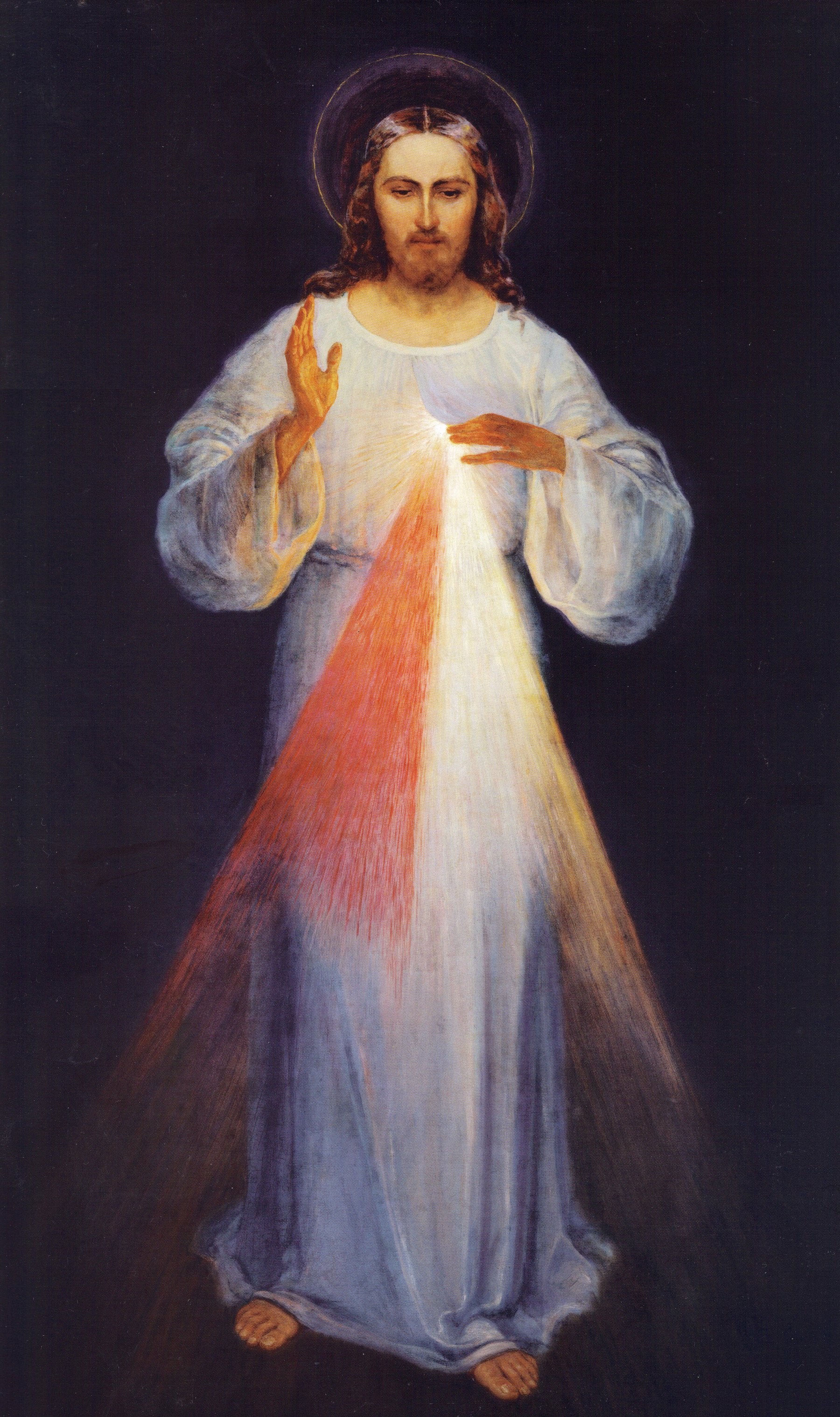
Today, 5 October, the Church keeps Saint Faustina Kowalska. When she first saw the painting she had asked to have made, she went to the chapel and wept. She wrote afterwards: “I said to the Lord: who is going to paint You as beautiful as You are?” The answer, she says, came at once: the greatness of that image would lie not in the beauty of the paint, but in grace.
Helena, of Głogowiec
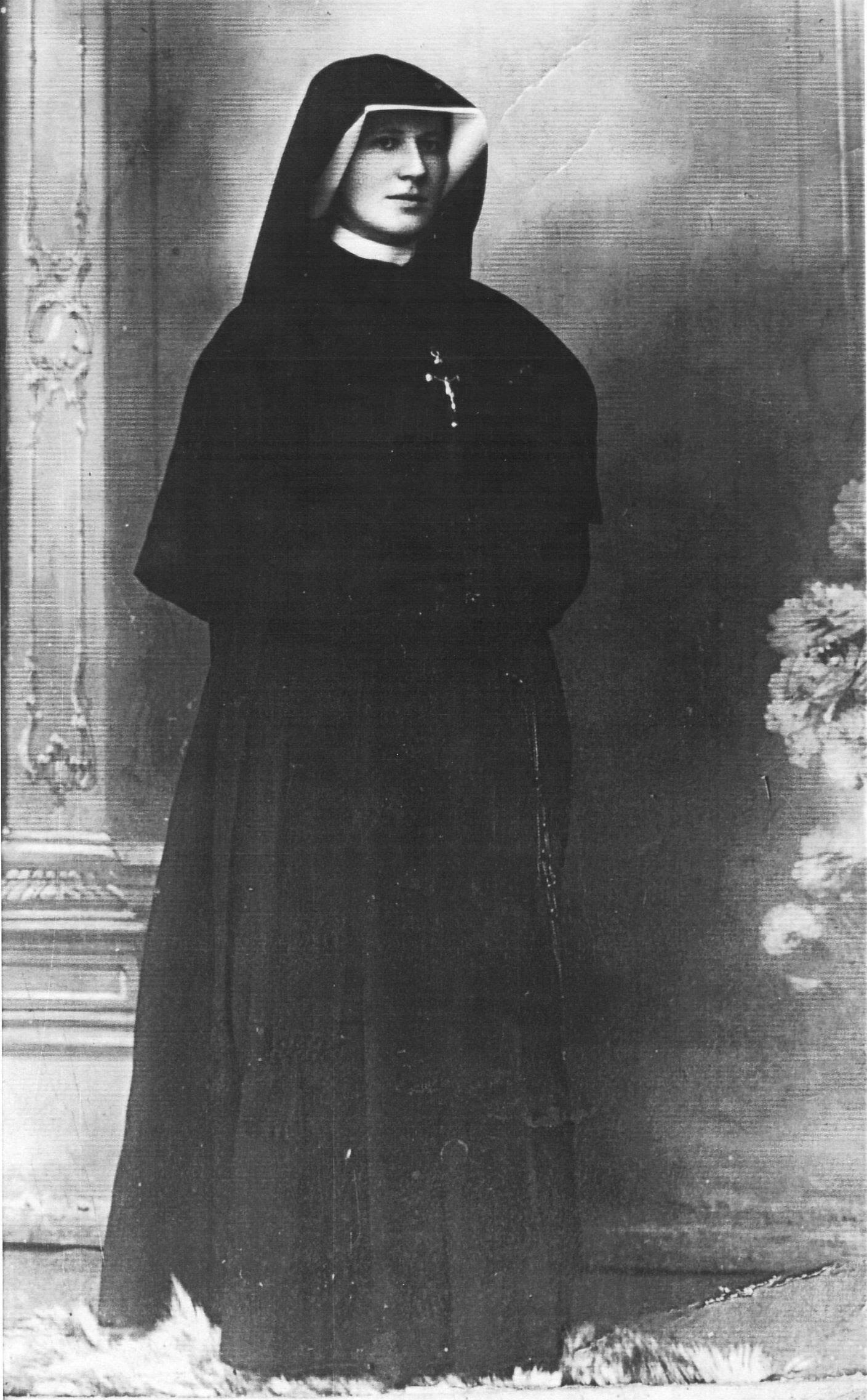
She was born Helena Kowalska on 25 August 1905 in the Polish village of Głogowiec, the third of ten children in a poor peasant family. She was baptised two days later. She went to school for less than three years, and at sixteen she left home to work as a domestic servant in Aleksandrów and Łódź, helping her parents.
Her parents would not hear of a convent. She knocked at many doors, and only on 1 August 1925 was she accepted by the Congregation of the Sisters of Our Lady of Mercy in Warsaw. She received the habit on 30 April 1926 and became Sister Maria Faustina; she made her perpetual vows in Kraków on 1 May 1933. She never held a post of distinction: she worked in the kitchen, the bakery, the garden and at the gate.
22 February 1931: Płock
It was one evening, in her cell at the convent in Płock. In her own account, she saw Jesus in a white garment, one hand raised in blessing and the other touching his robe at the breast; from the opening of the robe came two great rays, one red and one pale. After a moment she heard: “Paint an image after the design you see, with the inscription: Jesus, I trust in You” (Diary, 47).
She was also told what the rays meant: the pale one is the water that justifies souls; the red one is the blood, which is the life of souls (Diary, 299) — the same that flowed from the pierced side on the cross.
Vilnius: the painter and the painting
In May 1933 she was sent to Vilnius, where she worked as a gardener and met Father Michał Sopoćko, the sisters’ confessor. It was he who looked for a painter. On 2 January 1934 Faustina went for the first time to the studio of Eugeniusz Kazimirowski, and for months she kept going there to guide him. The painting was finished in June 1934.
That was when she wept. Not because of the painter’s work, but because no paint came near what she had seen. From 26 to 28 April 1935 the painting was shown to the public for the first time, at the Gate of Dawn (Ostra Brama) in Vilnius.
Eugeniusz Kazimirowski was born in 1873, studied at the academies of fine arts in Kraków and Munich, and in Vilnius taught in a seminary and painted theatre sets. He died on 23 September 1939 in Białystok, five years after finishing the work for which he is remembered.
The canvas above, the first one, is the Vilnius original. It hangs today in the city’s Sanctuary of Divine Mercy, the former church of the Holy Trinity. The painter died more than seventy years ago, which is why the image is in the public domain.
The Chaplet, 13 and 14 September 1935
On the evening of Friday 13 September 1935, again in Vilnius, Faustina records in her Diary that she saw an angel sent to carry out God’s wrath upon the earth. She began to plead and, caught up before the throne of God, heard inwardly the words of her plea: “Eternal Father, I offer You the Body and Blood, Soul and Divinity…” (Diary, 474–475). The next morning, in the chapel, she received the full form, to be said “on the ordinary rosary beads” (Diary, 476). The Polish text in use today was approved by Cardinal Franciszek Macharski in Kraków in 1980.
- The image (Diary, 47–48): “Jesus, I trust in You”, with the promise that the soul that venerates it will not perish.
- The feast (Diary, 49; 299): the first Sunday after Easter was to be the Feast of Mercy.
- The Chaplet (Diary, 476): five decades on ordinary rosary beads, with its own words on the beads.
- The Hour of Mercy (Diary, 1320): at three in the afternoon, to ask mercy for the world and dwell for a moment on the Passion.
The end, and the recognition
She returned to Kraków on 11 May 1936; her health kept failing, and she was twice admitted to the hospital at Prądnik. She died in the convent at Kraków-Łagiewniki on 5 October 1938, at 10.45 pm, aged thirty-three. She was buried on 7 October, the first Friday of the month and the feast of Our Lady of the Rosary.
The devotion did not have an easy road: on 6 March 1959 the Holy Office forbade the spread of the images and writings in the form she had received them, and the prohibition was declared no longer binding on 15 April 1978. On 30 April 2000, in St Peter’s Square, Saint John Paul II canonised her and, at the same Mass, ruled that the Second Sunday of Easter should be called, throughout the Church, Divine Mercy Sunday. In 2020 her optional memorial was inscribed in the General Roman Calendar.
“The greatness of this image lies not in the beauty of paint or brush, but in my grace.”— words ascribed to Jesus in Saint Faustina’s Diary, 313
“I hand people a vessel to bring with them when they come for graces to the source of mercy. That vessel is this image bearing the inscription: Jesus, I trust in You.”— Saint Faustina’s Diary, 327
“Silence is a sword in the spiritual fight; a garrulous soul will never arrive at holiness.”— Saint Faustina, Diary, 477
The prayers
The Chaplet of Divine Mercy, said on ordinary rosary beads, with the approved Polish text on the left and, beside it, the English text prayed throughout the world:
At the start: Ojcze nasz, Zdrowaś Maryjo, Wierzę w Boga.
On the large beads:
Ojcze Przedwieczny, ofiaruję Ci Ciało i Krew, Duszę i Bóstwo najmilszego Syna Twojego, a Pana naszego Jezusa Chrystusa, na przebłaganie za grzechy nasze i całego świata.
On the small beads (ten times):
Dla Jego bolesnej męki miej miłosierdzie dla nas i całego świata.
To close (three times):
Święty Boże, Święty Mocny, Święty Nieśmiertelny, zmiłuj się nad nami i nad całym światem.
At the start: Our Father, Hail Mary, the Apostles’ Creed.
On the large beads:
Eternal Father, I offer You the Body and Blood, Soul and Divinity of Your Dearly Beloved Son, Our Lord, Jesus Christ, in atonement for our sins and those of the whole world.
On the small beads (ten times):
For the sake of His sorrowful Passion, have mercy on us and on the whole world.
To close (three times):
Holy God, Holy Mighty One, Holy Immortal One, have mercy on us and on the whole world.
— Saint Faustina’s Diary, 476 · Polish text approved in Kraków, 1980 · English as given by the Marian Fathers
Deus, qui sanctæ Faustínæ múnus tribuísti imménsas tuæ infínitæ misericórdiæ divítias diffundéndi, ipsa intercedénte nobis concéde, ut eius exémplo de tua bonitáte plene confídere atque caritátis ópera generóse perfícere valeámus. Per Dóminum.
O God, who granted Saint Faustina the task of spreading the immense riches of your infinite mercy, grant us, through her intercession, that by her example we may trust fully in your goodness and generously carry out works of charity. Through our Lord.
Amen.
Sancta Faustina, ora pro nobis. Saint Faustina, pray for us. Jezu, ufam Tobie — Jesus, I trust in You.
- Saint Bruno — the silence that founded the Charterhouse, on the 6th.
- Our Lady of the Rosary — the day Saint Faustina was buried, 7 October.
- How to pray the Rosary, step by step — the ground on which the Chaplet is prayed.
- Words of the saints — a growing collection, in English and Portuguese.

Comments