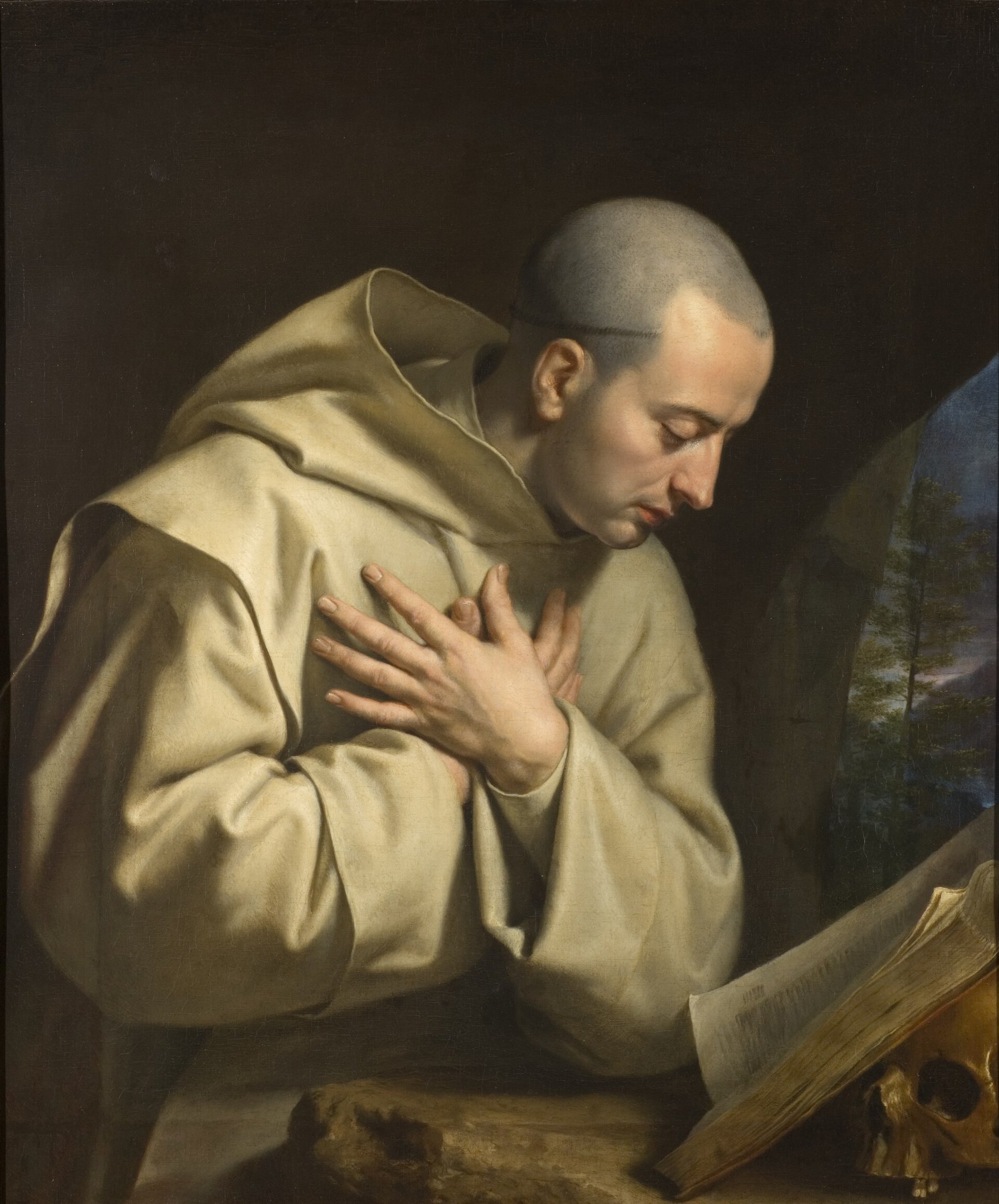
Today, 6 October, the Church keeps Saint Bruno. Writing from Calabria to a friend of his youth, he said: “A bow that is always kept drawn loses its strength and is less fit for its work.” The man who wrote that had spent nearly two decades directing the cathedral school of Reims, and then went to live, by choice, where hardly anyone would see or hear him.
From Cologne to Reims
He was born in Cologne around 1030, studied at Reims and returned there as a master. From 1057 he directed the cathedral school, and the sources show him as a respected philosopher and theologian; in 1075 he became chancellor of the archdiocese. One of his pupils was Odo of Châtillon, who would become Pope Urban II.
The career ended in troubled waters. Archbishop Manasses of Gournay was corrupt, and Bruno and two other canons denounced him; Manasses was suspended at the council of Autun in 1077 and answered by having the accusers’ houses pulled down and their goods confiscated. In 1080 he was finally driven out. By then Bruno was already leaving Reims.
We know of a promise Bruno made before leaving the world, and we know it from a letter of his own. Writing to his old friend Raoul le Verd, provost of Reims, he recalls: one day the two of them and a third, Fulcius the One-Eyed, were in a garden next to the house of a certain Adam, talking about the false pleasures of the world and the joys of eternal glory. There, “burning with divine love”, they promised the Holy Spirit that they would soon leave the world and take the monastic habit.
But Fulcius went off to Rome, they put the decision off until his return, and the fervour cooled. Bruno kept the promise; by the letter, Raoul had not yet. The letter, written from Calabria, is one long, affectionate and firm plea that his friend should do what he had sworn.
1084: the Chartreuse
Bruno set out with companions, stayed for a time with the community of Molesme, and reached Grenoble, where Bishop Hugh received him. In 1084, with six companions (Master Landuin, the two Stephens of Bourg and of Die, Hugh the chaplain, and the lay brothers Andrew and Guérin), he settled in a remote valley of the Alps, the Chartreuse. According to tradition the bishop had seen in a dream seven stars marking the place. They built an oratory and, around it, small separate cells.
Life there was one of silence and solitude, and that is the idea his name has left the Church: a place where one may live before God without anyone needing to look.
Urban II, Calabria and death
Around 1090 his former pupil became pope and called the master to Rome to help with the reform of the Church. Bruno obeyed, but he resisted when they wanted to make him archbishop of Reggio in Calabria: he refused and named a former disciple instead. In 1091 he withdrew with companions to a wild place in the diocese of Squillace, where Count Roger of Sicily gave them land and, in 1095, paid for the monastery of Saint Stephen.
Bruno died on 6 October 1101 at Serra San Bruno, surrounded by his brethren. There was never a formal canonisation process: Pope Leo X, in 1514, authorised his cult for the Order, and Gregory XV, on 17 February 1623, extended the feast to the whole Church.
- Silence and solitude. Each monk lives in his own cell, and common life is cut to the essential: the Office and a few moments together, such as the Sunday walk (the spatiamentum).
- Never reformed. The Order itself says that, having kept the spirit of its founder so well, it has never needed “reform”. There are now a little over twenty charterhouses in the world.
- The motto. Stat crux dum volvitur orbis: “The cross stands firm while the world turns.”
- A legend not to repeat. It is told that Bruno’s conversion came when a famous Paris doctor, at his own wake, spoke three times from the bier. It is a late legend: contemporaries and the first biographers do not mention it, and Bruno himself, in the letter to Raoul, never cites it.
“How beautiful, how useful, how sweet it is to remain in his school, under the discipline of the Holy Spirit, and to attain the divine philosophy, which alone gives true happiness: who could fail to see it?”— Saint Bruno, letter to Raoul le Verd (Migne, PL 152, col. 422); translated from the Latin
“Flee, my brother, flee all these troubles and miseries, and pass from the storm of this world into the safe and quiet mooring of the harbour.”— Saint Bruno, letter to Raoul le Verd (PL 152, col. 422); translated from the Latin
The prayers
The most famous passage of the letter, written from Calabria, is almost a definition of the Carthusian life. Here it is in Latin and in translation from the Latin:
Quid vero solitudo eremíque silentium amatóribus suis utilitátis iucunditátisque cónferat, norunt hi solum, qui experti sunt. Hic namque viris strenuis tam redire in se licet, quam libet; et habitare secum, virtutumque germina instanter excolere, atque de paradisi feliciter fructibus uti. Hic oculus ille conquiritur, cuius sereno intuitu vulneratur Sponsus amore, quo mundo et puro conspicitur Deus. Hic otium celebratur negotiosum, et in quieta pausatur actione. Hic pro certaminis labore repensat Deus athletis suis mercedem optatam, pacem videlicet, quam mundus ignorat, et gaudium in Spiritu Sancto.
What solitude and the silence of the wilderness bring of profit and sweetness to those who love them, only those who have tried them know. Here, indeed, men of strong spirit may withdraw into themselves as often as they wish, dwell with themselves, diligently cultivate the seeds of the virtues, and feed happily on the fruits of paradise. Here one seeks that eye whose serene gaze wounds the Bridegroom with love, and by which, clean and pure, God is seen. Here a busy leisure is kept and one rests in quiet action. Here, for the toil of the contest, God repays his athletes with the prize they longed for: the peace the world does not know, and joy in the Holy Spirit.
— Saint Bruno, letter to Raoul le Verd (Migne, PL 152, col. 421–422)
Deus, qui sanctum Brunónem ad serviéndum tibi in solitúdine vocásti, eius nobis intercessióne concéde, ut, per huius mundi varietátes, tibi iúgiter vacémus.
O God, who called Saint Bruno to serve you in solitude, grant us, by his intercession, that in the shifting fortunes of this world we may ever keep ourselves free for you.
Amen.
Sancte Bruno, ora pro nobis. Saint Bruno, pray for us, and teach us to be quiet enough to listen.
- Saint Faustina Kowalska — the saint who wrote that silence is a sword, on the 5th.
- Our Lady of the Rosary — the memorial of the 7th.
- Saint Francis of Assisi — another who exchanged the town for solitude, on the 4th.
- Words of the saints — a growing collection, in English and Portuguese.

Comments