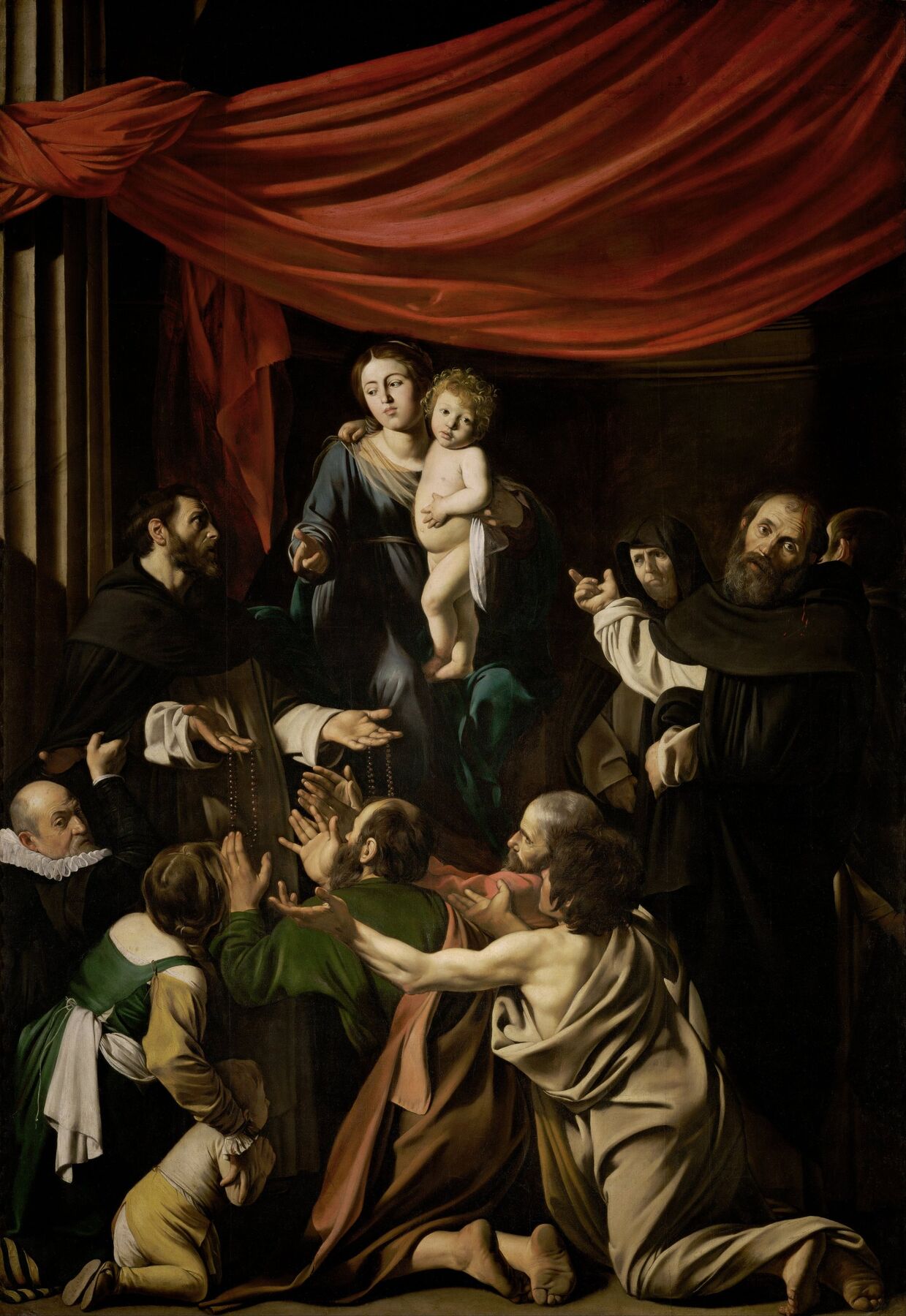
Today, 7 October, the Church keeps Our Lady of the Rosary. The date was not chosen by chance: it was on 7 October 1571 that the fleet of the Holy League defeated the Ottoman fleet at Lepanto, and the feast that now bears the name of the Rosary was born as thanksgiving for that victory.
Lepanto, 7 October 1571
The Holy League brought together Spain, Venice, the Papal States and other allies, under the overall command of Don John of Austria. The encounter took place in the Gulf of Patras, in the Ionian Sea, and ended with the Ottoman fleet almost destroyed. Pius V, who had built the coalition, called Christendom to pray the Rosary for that cause; tradition says he announced the victory in Rome before any messenger arrived, but that is a late account and undocumented.
In memory of the result, Pius V instituted in 1571 the feast of Our Lady of Victory. On 1 April 1573 Gregory XIII changed the title to the feast of the Holy Rosary, to be kept on the first Sunday of October. In 1716, after Prince Eugene’s victory at Petrovaradin, Clement XI extended it to the whole Church. And in 1913 Saint Pius X fixed it on 7 October. Today it is an obligatory memorial in the Roman Calendar.
The pope of the Rosary
Nobody did more for this devotion than Leo XIII. On 1 September 1883 he published the encyclical Supremi apostolatus officio, asking that the whole month of October be consecrated to the Queen of the Rosary, and he returned to the theme almost every year until 1898: the usual list counts twelve encyclicals on the Rosary. In that same year, 1883, he added to the Litany of Loreto the invocation Queen of the Most Holy Rosary. That is why October is still the month of the Rosary.
Caravaggio’s Madonna of the Rosary, painted around 1605–1607, is more than three and a half metres tall. Nobody knows for certain who commissioned it. It soon came up for sale and was bought by a consortium of Flemish painters, Rubens among them, for a Dominican church in Antwerp. Today it hangs in Vienna.
Look at the hands: the faithful, barefoot and with arms raised, reach for the rosaries that Saint Dominic, on the left, holds out to them. On the other side, with a wounded brow, stands Saint Peter Martyr.
Where the Rosary comes from
Dominican tradition says the Virgin herself handed the Rosary to Saint Dominic. Historians, however, find no trace of this account before the second half of the fifteenth century: most see a legend, not a documented fact. What the studies show is a devotion that took shape slowly over centuries, repeating Hail Marys on cords of beads and meditating on the life of Christ. The Dominican Alain de la Roche promoted it strongly around 1470, and the first confraternities appeared in Cologne in 1475. On 17 September 1569 Pius V, himself a Dominican, issued the bull Consueverunt Romani Pontifices, which describes the Rosary as vocal and mental prayer, with the angelic greeting repeated one hundred and fifty times and the Our Father at each decade.
On 16 October 2002 Saint John Paul II published the apostolic letter Rosarium Virginis Mariae, opened the Year of the Rosary (October 2002 to October 2003) and proposed the five luminous mysteries: the Baptism in the Jordan, the wedding at Cana, the proclamation of the Kingdom, the Transfiguration and the institution of the Eucharist.
- Each decade carries one mystery of the life of Christ, one Our Father, ten Hail Marys and a Glory Be.
- There are twenty mysteries, in four groups: joyful, luminous, sorrowful and glorious.
- The Hail Mary joins the greetings of the angel and of Elizabeth (Lk 1:28 and 1:42) to the Church’s closing petition.
- The Salve Regina usually closes the Rosary, handing to Our Lady what has been meditated.
“To recite the Rosary is nothing other than to contemplate with Mary the face of Christ.”— Saint John Paul II, Rosarium Virginis Mariae, 3 (2002)
“The Rosary is my favourite prayer. A marvellous prayer!”— Saint John Paul II, 29 October 1978, quoted in Rosarium Virginis Mariae, 2
The prayers
This day closes the novena to Our Lady of the Rosary, which began on 28 September. The essential prayer is the Hail Mary, repeated in every decade, and the Salve Regina usually closes the Rosary. The Collect of the memorial is just below.
Ave, María, grátia plena, Dóminus tecum. Benedícta tu in muliéribus, et benedíctus fructus ventris tui, Iesus.
Sancta María, Mater Dei, ora pro nobis peccatóribus, nunc et in hora mortis nostræ. Amen.
Hail Mary, full of grace, the Lord is with thee. Blessed art thou among women, and blessed is the fruit of thy womb, Jesus.
Holy Mary, Mother of God, pray for us sinners, now and at the hour of our death. Amen.
Amen.
Salve, Regína, Mater misericórdiæ, vita, dulcédo et spes nostra, salve. Ad te clamámus, éxsules fílii Evæ. Ad te suspirámus, geméntes et flentes in hac lacrimárum valle. Eia ergo, advocáta nostra, illos tuos misericórdes óculos ad nos convérte. Et Iesum, benedíctum fructum ventris tui, nobis post hoc exsílium osténde. O clemens, o pia, o dulcis Virgo María.
Hail, holy Queen, Mother of mercy, our life, our sweetness and our hope. To thee do we cry, poor banished children of Eve. To thee do we send up our sighs, mourning and weeping in this valley of tears. Turn then, most gracious advocate, thine eyes of mercy toward us; and after this our exile, show unto us the blessed fruit of thy womb, Jesus. O clement, O loving, O sweet Virgin Mary.
Amen.
Grátiam tuam, quaesumus, Dómine, méntibus nostris infúnde, ut, qui, Angelo nuntiánte, Christi Fílii tui incarnatiónem cognóvimus, beáta María Vírgine intercedénte, per passiónem eius et crucem ad resurrectiónis glóriam perducámur. Per Dóminum.
Lord, we ask that you pour your grace into our hearts: we who learned of the Incarnation of Christ your Son from the message of the Angel, may be led, through the intercession of the Blessed Virgin Mary, by his Passion and Cross to the glory of the Resurrection. Through our Lord.
Amen.
Sancta Maria, Regina sacratissimi Rosarii, ora pro nobis. Holy Mary, Queen of the Most Holy Rosary, pray for us.
- Novena to Our Lady of the Rosary — nine days, from 28 September to 6 October.
- How to pray the Rosary, step by step — the beads, the mysteries and the order of the prayers.
- Saint Bartolo Longo — the apostle of the Rosary of Pompeii, on the 29th.
- Words of the saints — a growing collection, in English and Portuguese.

Comments