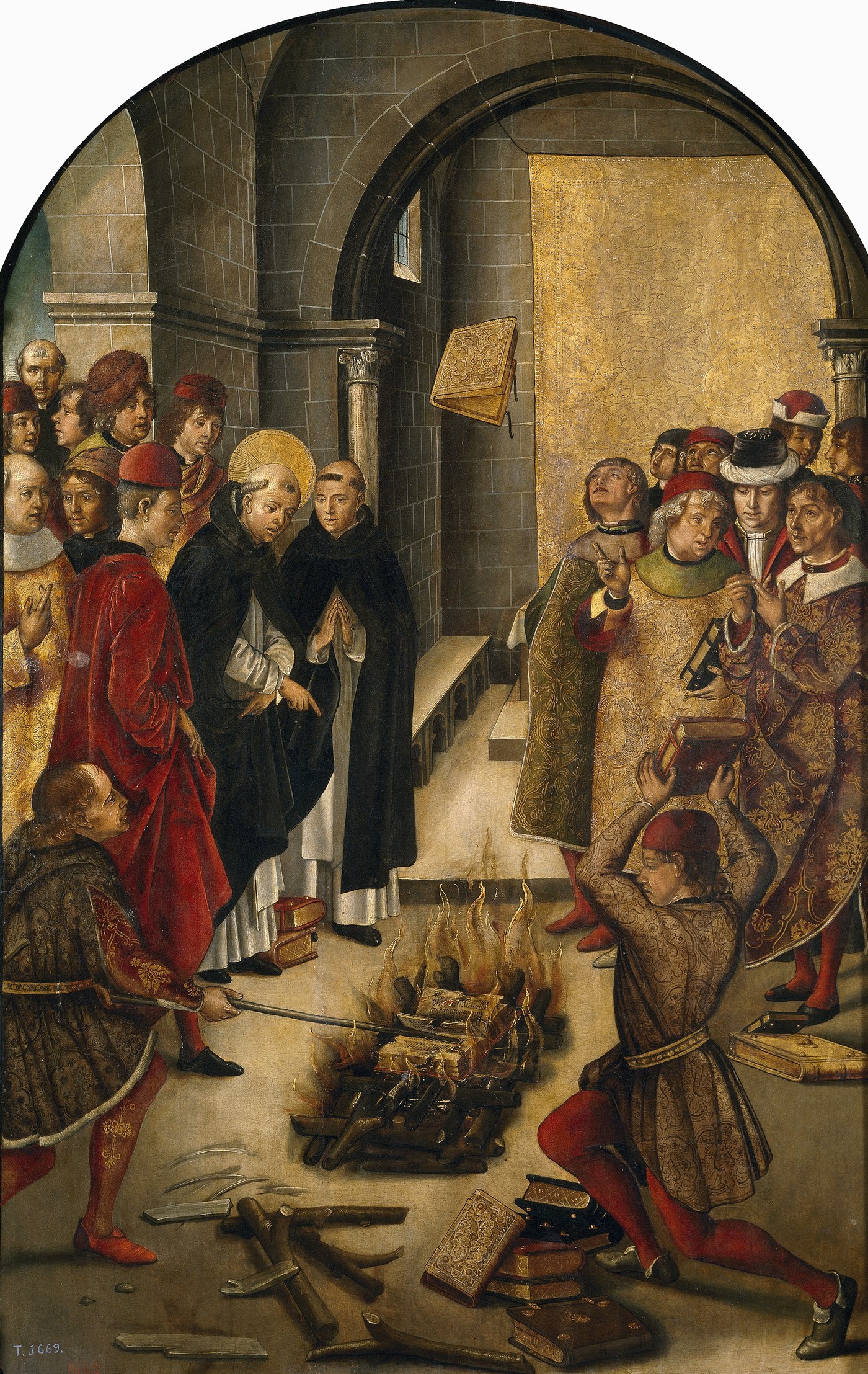
At Fanjeaux, in the heart of the Languedoc, they settled the argument by throwing the books on the fire: the true text would not burn. They say Dominic’s leapt out of the flames three times — that is the scene above, with half the painting staring upward. It was the only time anyone saw him win a debate by spectacle. The rest of his life was the exact opposite: a man on foot, with no money, convincing one person at a time. And here is the detail almost nobody notices: the founder of the Order of Preachers left not one written sermon.
The student who sold his books
He was born at Caleruega, in Old Castile, around 1170. He studied at Palencia, and while still a student came the episode that contains everything that followed: famine fell on the region, and Dominic sold the parchments he had copied out by hand — the most expensive thing a twelfth-century student could own, the equivalent of selling your degree. To those who were baffled he answered that he would not study off dead skins while men were dying of hunger.
Hold that scene beside the painting at the top of this page. Dominic’s life begins with books sold to buy bread and passes through books thrown on a bonfire. He never had a collector’s relationship with a book: a book was a tool — and a tool is used, worn out, and traded for food when someone is starving.
He became a canon regular of the cathedral of Osma, under Bishop Diego de Acebo. He kept the ordered, silent life of a canon, and would have kept it to the end had it not been for a diplomatic journey.
The night at Toulouse
In 1203, travelling with Bishop Diego on an embassy for the King of Castile, he crossed the Languedoc — country then held by the Cathars, also called Albigensians. They stopped at an inn in Toulouse, and the innkeeper was a heretic.
Dominic stayed up the whole night talking with him. By morning the man had come back to the Catholic faith. One conversation, one night, one man. That is literally the method he would use for the next eighteen years, and the whole Order is that night turned into an institution.
On that road he also grasped the other half of the problem, and that half stung:
The papal legates rode through the Languedoc with escorts and baggage. The Cathars went on foot and fasted. Dominic concluded, without softening it, that the problem was not the argument — it was the witness. Nobody believes a man who preaches poverty and arrives with a retinue.
He and Diego sent the horses back and went barefoot, begging their bread. They preached for ten years in the south of France, with modest results and a high personal cost.
Prouille: the Order began with women
In 1206, before there was an Order, a friar or a habit, Dominic founded a house at Prouille — and not for preachers. It was for women converted out of Catharism who had nowhere to go back to: daughters of noble houses who, on leaving the sect, were left without home, dowry or reputation.
It is worth saying plainly, because it usually slips past: the first Dominican monastery is a women’s house, and it is ten years older than the Order of Preachers. Dominic’s preaching was founded on a community of nuns praying for it — that is how he built the thing from day one, and that is how the Order still works.
The method
In 1215 he gathered a small group of companions at Toulouse. The next year, 1216, Honorius III confirmed the Order of Preachers. Dominic took the Rule of St Augustine and added what would make it unlike anything then in existence.
- Real poverty, not decorative. The friars begged. No property, no rents, none of the security that blunts a man’s speech.
- Study as an obligation, not a luxury. Dominic was the first to excuse friars from manual work so that they could study. The Order he founded produced Albert the Great and Thomas Aquinas within a single generation.
- Preaching as the end, not an accessory. The official name is literally the Order of Preachers. Everything — prayer, study, common life — exists so that someone preaches better.
- Government by vote. Priors were elected, chapters decided, and the master of the Order answered to them. In feudal Europe, where authority came down from above, this bordered on scandalous — and jurists would be studying those constitutions centuries later.
- Deliberate dispersal. In 1217 he sent the few friars he had to Paris, Bologna, Rome and Spain. He was told it was far too soon. He answered that hoarded grain rots, and scattered grain bears fruit.
He refused a bishopric three times. That is not decorative humility: a bishop has a diocese, and a diocese has a boundary. He did not want a territory. He wanted the road.
The nine ways of prayer
Here is the strangest and most moving thing in the story. He wrote nothing — but the friars watched him through the gap in the door, because he prayed alone at night in the church, and what they saw was too astonishing not to write down. Decades after his death someone set out the nine ways of prayer, with illustrations. It is a document without parallel: not a saint’s teaching about prayer, but eyewitness testimony about what his body did while he prayed.
- Bowing before the altar in humility — the body saying it before the mouth does.
- Prostrate on the ground, face down, repeating the publican: “Lord, be merciful to me, a sinner.”
- Under discipline, taking on himself the penance he asked of others.
- Kneeling, over and over, eyes fixed on the crucifix.
- Standing before the cross, reading the face of Christ the way one reads a text.
- Arms outstretched in the form of a cross — and it was so, they said, that he prayed when he was asking for a miracle.
- Stretched upward, hands joined above his head, like an arrow loosed.
- Seated, reading, alone, the book open: for him, study was already prayer.
- Praying on the road, between one town and the next — because most of his life was spent walking.
Notice what the list does not contain: no interior method, no technique of concentration, no ladder of degrees. Nine bodily positions. Dominic prayed with his bones.
“Lord, what will become of sinners?”
What he said on those nights the friars also overheard. It was not a petition for himself, nor for the Order, nor for vocations. It was always the same question, out loud and sometimes shouted, so often that it became his portrait:
“Lord, what will become of sinners?”
Domine, quid fiet de peccatoribus?
What the friars heard him repeat at night in the churchA man who spends the night weeping over people he never met, and the whole day walking barefoot to reach them. His first companions said a thing about him that sums him up better than any biography: he spoke only with God or about God — loquebatur cum Deo aut de Deo. There was no third kind of conversation.
The Rosary
The best-loved tradition about Saint Dominic holds that at Prouille, worn out because the preaching was not working and the heresy was spreading, he received the Rosary from Our Lady, with the promise that it would be the weapon to win that country back.
It is fair to add what historians say: the Rosary in the form we pray it only settled two centuries later, and it was a fifteenth-century Dominican, Blessed Alan de la Roche, who spread the attribution to Dominic. The Church has never set the tradition aside — Leo XIII repeats it in several of the twelve encyclicals he wrote on the Rosary.
And there is a fact neither reading disputes, which is the one that matters: if the Rosary reached the hands of people who could not read, it is because Dominic’s sons carried it there. They preached it from square to square, founded the Rosary confraternities, and taught farmhands and spinners to walk through the mysteries of Christ’s life in memory while their fingers counted the beads. The prayer that no argument of the learned could ever replace is, historically, Dominican work. Which is why, in art, Dominic is nearly always shown receiving the beads from the Virgin’s hands: the picture tells a truth the chronology cannot tell on its own.
Facing the Turkish fleet, Pope Saint Pius V — himself a Dominican — ordered all Christendom to pray the Rosary for victory.
The battle was won that day, and the Pope credited Our Lady rather than the guns. From it came the feast of Our Lady of the Rosary, which the Church keeps on 7 October.
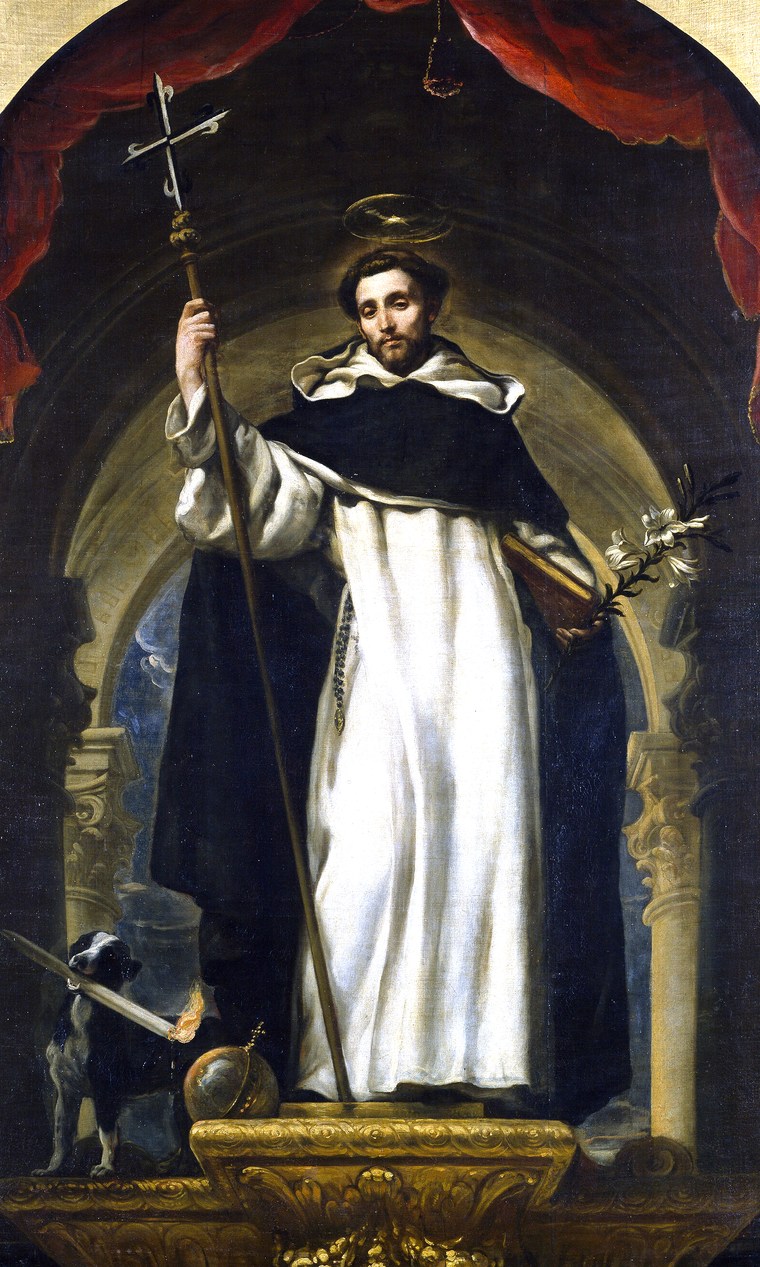
In art, Saint Dominic nearly always has at his feet a black-and-white dog with a lit torch in its mouth.
The image comes from a medieval pun: Dominicanes sounds like Domini canes, “the hounds of the Lord” — the ones who guard the flock and carry fire through the world. The colours are the habit’s: white tunic, black cappa.
Bologna, and the end
He spent his last years crossing Italy, France and Spain on foot, nearly always preaching and nearly always hungry. He fell ill at Bologna in the summer of 1221. He had no bed of his own: they laid him on a friar’s habit.
He called the brothers and left them a testament of three lines, without a word about structure, mission or strategy:
“Have charity among you, guard humility, possess voluntary poverty.”
Habete caritatem, humilitatem servate, paupertatem voluntariam possidete.
Saint Dominic to the friars — Bologna, August 1221The friars were weeping. He told them to stop: he would be more use to them dead than he had been alive. And he asked to be buried under the feet of his brothers — not in a chapel, not in a tomb of honour: in the floor they would walk across. He died on 6 August 1221, a little past fifty. Gregory IX canonised him thirteen years later.
He left no writings. He left an Order — and what the Order wrote after him, the Summa Theologiae included, is the book he never wrote.
What they still sing every night
One thing of his survives outside the books. Every night, at the end of Compline, Dominicans the world over process singing the Salve Regina and stop before the image of their founder to sing seven praises in seven words. They have done it for eight hundred years without a break:
“O light of the Church, teacher of truth, rose of patience, ivory of chastity: freely you gave the water of wisdom to drink. Preacher of grace, join us to the blessed.”
O lumen Ecclesiae, Doctor veritatis, rosa patientiae, ebur castitatis, aquam sapientiae propinasti gratis: praedicator gratiae, nos iunge beatis.
Antiphon O lumen Ecclesiae — sung by Dominicans after ComplineThe man left not a line. But every night, in every house of the Order, somebody sings those seven words to him — and it is fair to call that his sermon, preached by other people, without a break, since 1221.
“A man who governs his passions is master of the world. We must either rule them, or be ruled by them.”— Saint Dominic de Guzmán
“Do not weep: I shall be more use to you after my death, and I shall help you then more effectively than during my life.”— Saint Dominic to the friars, on his deathbed
“Have charity among you, guard humility, possess voluntary poverty.”— Saint Dominic, his testament
“Grain hoarded in the barn rots; scattered, it bears fruit.”— Saint Dominic, on dispersing the first friars
Sancte Dominice, ora pro nobis. Saint Dominic, pray for us — and win us the courage to tell the truth with nothing to defend.
- Saint Clare of Assisi — the mendicant of the same generation who wrote the first Rule composed by a woman.
- Saint Alphonsus Liguori — the Doctor of prayer and the Glories of Mary.
- Saint Ignatius of Loyola — another order born of a radical conversion.
- Words of the saints — a growing collection, in English and Portuguese.

Comments