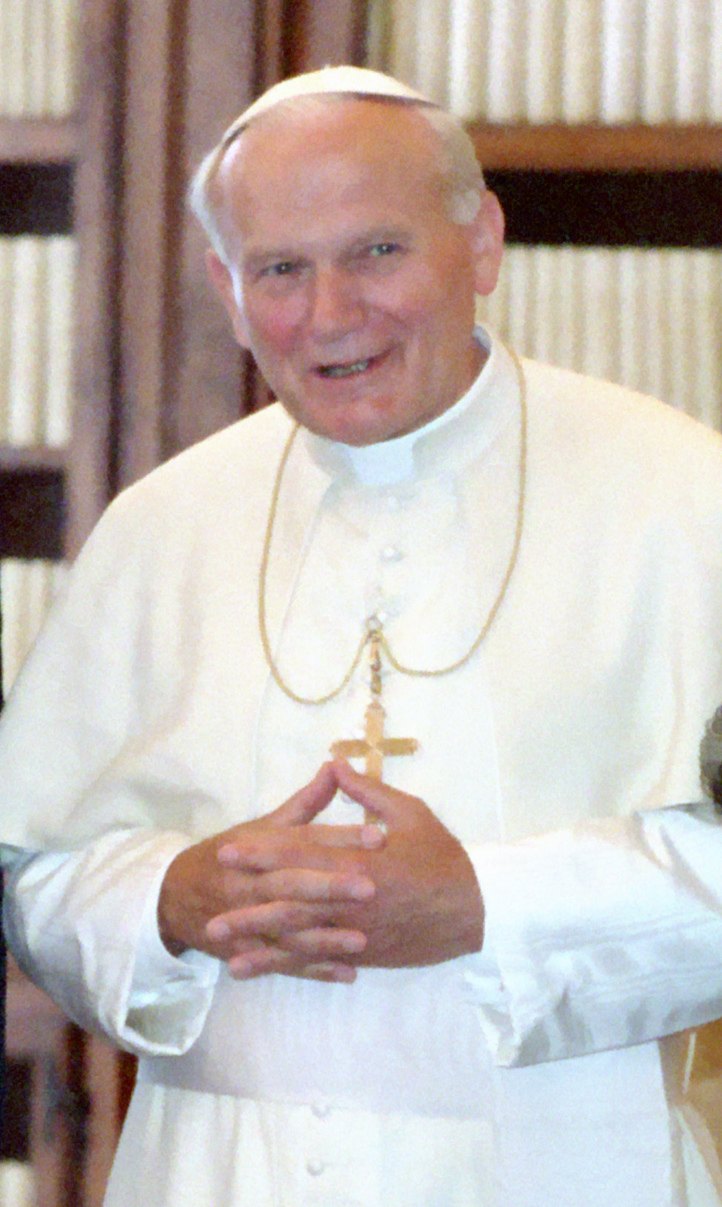
Today, 22 October, the Church keeps Saint John Paul II (optional memorial), and the date has a precise address: it was on this day in 1978, in Saint Peter’s Square, that he solemnly began his ministry as pope. Six days earlier the conclave had elected a fifty-eight-year-old Polish cardinal, the first non-Italian pope since the sixteenth century. In the homily of that Mass he spoke the sentence that became his signature: “Do not be afraid! Open, rather, fling wide the doors to Christ!”
From Wadowice to Kraków
Karol Józef Wojtyła was born on 18 May 1920 in Wadowice, Poland, the third child of Karol Wojtyła and Emilia Kaczorowska. His mother died in 1929, his elder brother Edmund, a physician, in 1932, his father in 1941. At twenty-one he had already buried his mother, his brother and his father.
During the Nazi occupation he worked in a quarry and then in the Solvay chemical factory, to earn a living and to avoid deportation to Germany. In 1942 he entered the clandestine seminary of Kraków, directed by Archbishop Adam Stefan Sapieha, and was at the same time one of the organisers of the “Rhapsodic Theatre”, also clandestine. He was ordained on 1 November 1946; in Rome he took his doctorate in 1948 with a thesis on faith in the works of Saint John of the Cross. In 1958 he was named auxiliary bishop of Kraków, in 1964 archbishop, in 1967 cardinal. He took part in the Second Vatican Council and helped draft the constitution Gaudium et Spes.
22 October 1978
Elected on 16 October, he began his ministry on the following Sunday, the 22nd. The homily opens with Peter’s confession (“You are the Christ, the Son of the living God”, Mt 16:16) and comes to a personal prayer, a rare thing in a text of that kind:
“O Christ! Let me become, and be, the servant of your one power! The servant of your gentle power! The servant of your power that knows no evening! Let me be a servant! Indeed, the servant of your servants.”
Soon afterwards comes the paragraph that stayed. It gives the reason for the “do not be afraid”: it is not textbook courage; it is that Christ knows man from within, and man so often does not know what he carries inside himself.
“Do not be afraid! Open, rather, fling wide the doors to Christ! […] Christ knows ‘what is in man’. He alone knows it! […] Allow Christ to speak to man! He alone has words of life, yes, of eternal life.”
It was also World Mission Day, as the homily itself points out. And today’s Liturgy of the Hours gives, as its second reading, an extract from that same text.
Totus tuus
The motto he took on becoming a bishop in 1958, and kept as pope, was Totus tuus, “all yours”, said to Mary. He himself explained that the motto is inspired by the teaching of Saint Louis Marie Grignion de Montfort (Rosarium Virginis Mariae, 15). The Latin formula is in the Treatise on True Devotion, and Montfort himself translates it: “I am all yours, and all that I have is yours, O my loving Jesus, through Mary, your holy Mother” (n. 233).
On 13 May 1981, as he entered Saint Peter’s Square for the general audience, he was shot by Mehmet Ali Ağca. It was the day of the first apparition at Fátima. The Vatican’s official biographical profile says he was “saved by the maternal hand of the Mother of God” and that, after a long stay in hospital, he forgave the man who shot him.
In May 1982, a year after the attack, the pope went to Fátima to give thanks. The bullet that had struck him was handed to the bishop of Leiria-Fátima, Dom Alberto Cosme do Amaral; as the account has it, the pope said: “This is a gift for Our Lady.”
At the bishop’s request, the bullet was set in the crown of the statue of Our Lady of Fátima: an object made to kill became an ornament in Mary’s crown.
The Rosary, the young and the road
- The Rosary. On 16 October 2002, at the start of the twenty-fifth year of his pontificate, he published the apostolic letter Rosarium Virginis Mariae, proclaimed the Year of the Rosary (October 2002 to October 2003) and proposed the five “luminous mysteries”: the Baptism in the Jordan, the wedding at Cana, the proclamation of the Kingdom, the Transfiguration and the institution of the Eucharist.
- The young. On 20 December 1985 he announced the founding of World Youth Day; the first, in 1986, was kept in the dioceses on Palm Sunday.
- The road. He made one hundred and four international apostolic journeys. He was in Brazil in 1980, 1991 and 1997; on 4 July 1980 he consecrated the Basilica of Our Lady of Aparecida.
- Mercy. He died on 2 April 2005, at 21:37, on the eve of Divine Mercy Sunday. He was beatified on that Sunday, 1 May 2011, by Benedict XVI, and canonised, again on Divine Mercy Sunday, on 27 April 2014, by Francis, together with Saint John XXIII.
“Do not be afraid! Open, rather, fling wide the doors to Christ!”— Saint John Paul II, homily at the Mass inaugurating his pontificate, 22 October 1978
“Allow Christ to speak to man! He alone has words of life, yes, of eternal life.”— Saint John Paul II, same homily
“Reciting the Rosary is, after all, nothing else than gazing with Mary upon the face of Christ.”— Saint John Paul II, Rosarium Virginis Mariae, 3 (2002)
The prayers
Totus tuus was not his invention: it is the formula with which Montfort renews the consecration to Jesus through Mary. John Paul II made it his own and set it in his coat of arms.
Tuus totus ego sum, et omnia mea tua sunt. Accípio te in mea ómnia. Praébe mihi cor tuum, o María.
I am all yours, and all that is mine is yours. I receive you into all that is mine. Give me your heart, O Mary.
— Saint Louis Marie Grignion de Montfort, Treatise on True Devotion, nn. 233 and 266
And this is the Collect of today’s Mass, which asks for what the homily of 1978 asked for:
Deus, dives in misericórdia, qui beátum Ioánnem Paulum, papam, univérsae Ecclésiae tuae praeésse voluísti, praesta, quǽsumus, ut, eius institútis edócti, corda nostra salutíferae grátiae Christi, uníus redemptóris hóminis, fidénter aperiámus.
O God, rich in mercy, who willed that Saint John Paul, pope, should preside over your universal Church, grant, we pray, that, instructed by his teaching, we may confidently open our hearts to the saving grace of Christ, the one Redeemer of man.
Amen.
Sancte Ioannes Paule, ora pro nobis. Saint John Paul, pray for us.
- Saint John XXIII — canonised at the same Mass, on 27 April 2014.
- Our Lady of Aparecida — the basilica he consecrated in 1980.
- How to pray the Rosary, step by step — with the luminous mysteries.
- Words of the saints — a growing collection, in English and Portuguese.

Comments