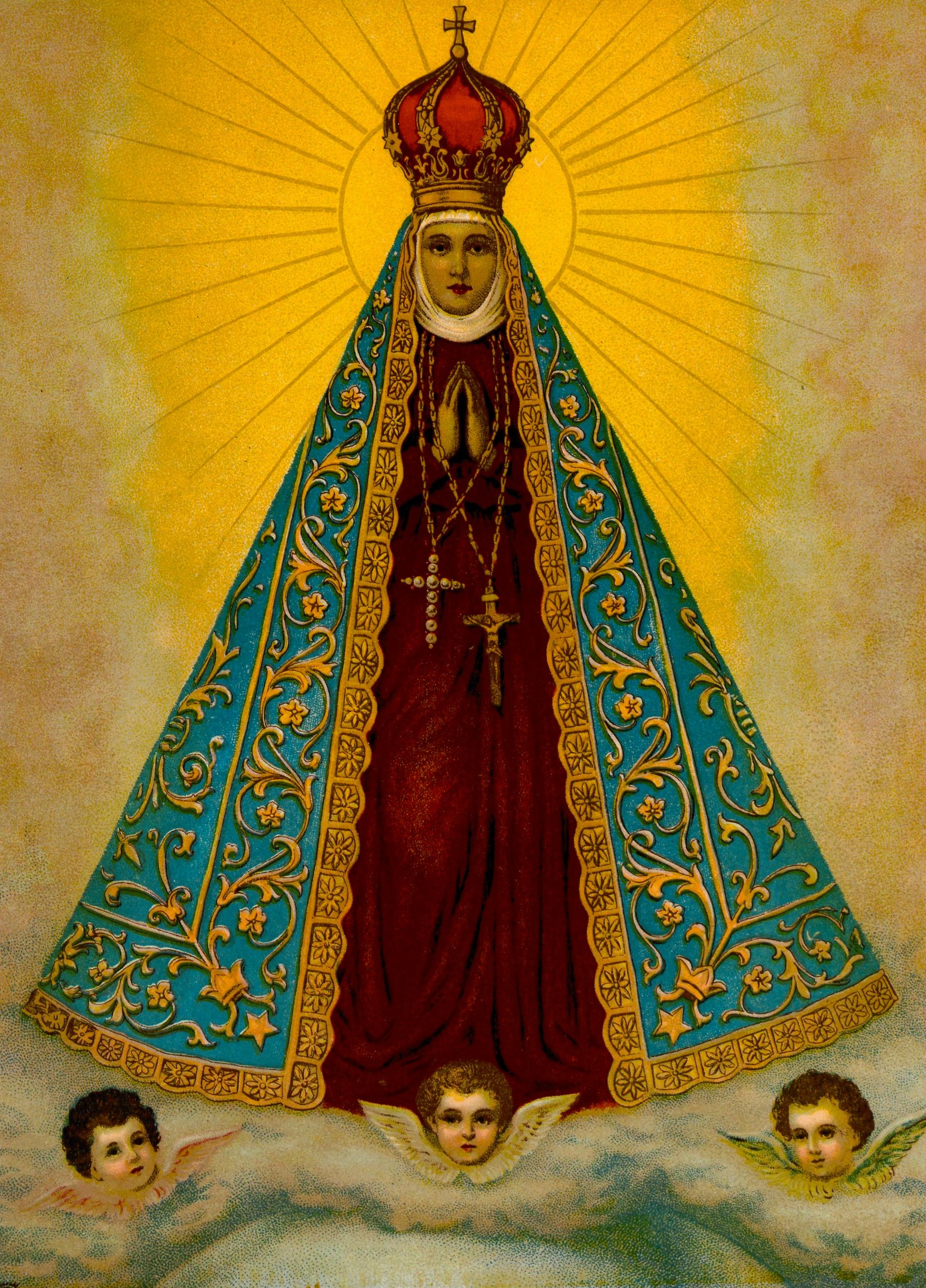
Today, 12 October, Brazil keeps the solemnity of Our Lady of the Conception Aparecida, patroness of the country. It all began with an order for fish for a banquet: in October 1717 three fishermen went down the Paraíba do Sul river and caught nothing, and the first thing their net brought up was the body of a statue of Our Lady without its head.
Fish for the governor
In mid-October 1717 word reached Guaratinguetá that the governor of the captaincy of São Paulo and Minas, Dom Pedro de Almeida e Portugal, the future Count of Assumar, would pass through the town on his way to Vila Rica, today Ouro Preto. According to the National Shrine, he was in the region from 17 to 30 October. The town council summoned the river fishermen to provide fish for the banquet, even though it was not the good season for fishing. Many gave up along the way; three persisted: Domingos Garcia, Filipe Pedroso and João Alves.
They went down the river with nothing. At the port of Itaguaçu, João Alves cast his net and drew up the body of a statue of Our Lady of the Conception, without the head; he cast it again, further down, and the head came, fitting the statue. After that the catch was so abundant that the three, afraid of capsizing their canoes, went home. Before taking the fish to the banquet they handed the pieces to Silvana da Rocha, Domingos’s wife, Filipe’s sister and João’s mother, who joined them with wax and set the statue on a small altar in the family home.
Documents from the time are scarce: the parish priest of Guaratinguetá wrote a report of the find eight years later, and the text tradition preserves is that of the parish Livro Tombo (record book), written in 1757 by the vicar João de Morais e Aguiar. It was the fishermen, tradition says, who began to call the statue Our Lady of the Conception “Aparecida” — “she who appeared” — of the waters of the Paraíba.
The statue
It is a small terracotta image, thirty-nine centimetres high counting the pedestal, in seventeenth-century style, made of clay from the region of Santana de Parnaíba in Greater São Paulo. It represents the Immaculate Conception. When it came out of the river it had lost its original colours, and its dark tone today is explained, according to the Shrine, by the years in the silt and then by candle smoke. Its maker is not known: some scholars attribute it, on grounds of style, to the Benedictine monk Friar Agostinho de Jesus (c. 1600–1661), who worked at Santana de Parnaíba, but no document proves it.
The statue was found in two pieces and joined with wax in Silvana da Rocha’s house. On 16 May 1978 it was the target of an attack and was reduced to one hundred and sixty-five fragments. It was reconstructed by the restorer Maria Helena Chartuni, then at the São Paulo Museum of Art, and returned to its niche.
Twice the statue was put back together, and twice it went back to being venerated.
From oratory to National Shrine
Filipe Pedroso kept the statue at home for almost fifteen years, and the neighbours gathered to pray the rosary and the litany. In 1732 his son Atanásio built an oratory open to the public. In 1743 the vicar of Guaratinguetá, Father José Alves Vilela, asked the Bishop of Rio de Janeiro to approve the devotion, and the first church, on the Morro dos Coqueiros, was opened on 26 July 1745: the shrine and the settlement were born there. The Old Basilica was handed over to the faithful on 24 June 1888. On 8 September 1904 the statue was crowned, with the gold crown and blue mantle given by Princess Isabel.
On 16 July 1930 Pius XI, at the request of the Brazilian bishops made after the Marian Congress of 1929, signed the decree declaring her principal patroness of Brazil. The solemn proclamation was in Rio de Janeiro on 31 May 1931, before about a million people. The New Basilica, on a Greek-cross plan, began to be built in 1955; John Paul II consecrated it on 4 July 1980, on his first visit to Brazil, and in 1984 the Brazilian bishops’ conference declared it a National Shrine. Since the law of 30 June 1980, 12 October has been a national holiday.
Aparecida today
- The largest Marian shrine in the world, as the Shrine describes itself: the basilica holds up to forty-five thousand pilgrims, and millions visit each year.
- A solemnity in Brazil. As the country’s principal patroness, the day is a solemnity and a holiday; the Brazilian bishops’ conference invites the faithful to take part in the Eucharist.
- The Room of Promises. As early as 1745 the church had a room for objects of promise: the ex-votos of simple people who came to give thanks.
- The Aparecida Document. The Fifth General Conference of the Latin American and Caribbean Bishops met at the Shrine from 13 to 31 May 2007, opened by Benedict XVI, on the theme “Disciples and missionaries of Jesus Christ, so that in him our peoples may have life”.
“João Alves, casting the drag-net, drew up the body of the Lady without a head; and casting the net again further down, drew up the head of the same Lady, it never being known who had thrown her there.”— Livro Tombo of the parish of Santo Antônio de Guaratinguetá, 1757, as transcribed by the National Shrine (translated from the Portuguese)
“Lady of Aparecida, Brazil is yours! Queen of Brazil, bless our people. Peace to our people! Salvation for our Fatherland!”— Dom Sebastião Leme, at the consecration of Brazil to Our Lady of Aparecida, Rio de Janeiro, 31 May 1931 (according to the National Shrine; translated from the Portuguese)
“Because he hath regarded the humility of his handmaid; for behold from henceforth all generations shall call me blessed.”— Luke 1:48 (Magnificat, Douay-Rheims)
The prayers
Mary’s song, the Magnificat, is the prayer of someone else who received what she did not expect, and the Hail, Holy Queen is the one Brazilians say at the end of the rosary.
Magnificat anima mea Dominum, et exsultavit spiritus meus in Deo salutari meo. Quia respexit humilitatem ancillae suae: ecce enim ex hoc beatam me dicent omnes generationes, quia fecit mihi magna qui potens est, et sanctum nomen eius, et misericordia eius a progenie in progenies timentibus eum. Fecit potentiam in brachio suo, dispersit superbos mente cordis sui. Deposuit potentes de sede, et exaltavit humiles. Esurientes implevit bonis, et divites dimisit inanes. Suscepit Israel puerum suum, recordatus misericordiae suae, sicut locutus est ad patres nostros, Abraham et semini eius in saecula.
My soul doth magnify the Lord. And my spirit hath rejoiced in God my Saviour. Because he hath regarded the humility of his handmaid; for behold from henceforth all generations shall call me blessed. Because he that is mighty, hath done great things to me; and holy is his name. And his mercy is from generation unto generations, to them that fear him. He hath shewed might in his arm: he hath scattered the proud in the conceit of their heart. He hath put down the mighty from their seat, and hath exalted the humble. He hath filled the hungry with good things; and the rich he hath sent empty away. He hath received Israel his servant, being mindful of his mercy: As he spoke to our fathers, to Abraham and to his seed for ever.
Glory be to the Father, and to the Son, and to the Holy Spirit. — Vulgate; English: Douay-Rheims
Salve, Regina, mater misericordiae; vita, dulcedo et spes nostra, salve. Ad te clamamus, exsules filii Hevae. Ad te suspiramus, gementes et flentes in hac lacrimarum valle. Eia ergo, advocata nostra, illos tuos misericordes oculos ad nos converte. Et Iesum, benedictum fructum ventris tui, nobis post hoc exsilium ostende. O clemens, O pia, O dulcis Virgo Maria.
Hail, holy Queen, Mother of mercy, our life, our sweetness and our hope. To thee do we cry, poor banished children of Eve; to thee do we send up our sighs, mourning and weeping in this valley of tears. Turn then, most gracious advocate, thine eyes of mercy toward us; and after this our exile, show unto us the blessed fruit of thy womb, Jesus. O clement, O loving, O sweet Virgin Mary.
Amen.
Sancta Maria, mater Dei, ora pro nobis. Our Lady of Aparecida, pray for us — and for this people who cast the net without knowing what will come up.
- Our Lady of the Rosary — Lepanto and the Hail Marys, on the 7th.
- Novena to Our Lady of the Rosary — nine days with the rosary.
- Our Lady of Fátima — the miracle of the sun, on the 13th.
- Words of the saints — a growing collection, in English and Portuguese.

Comments