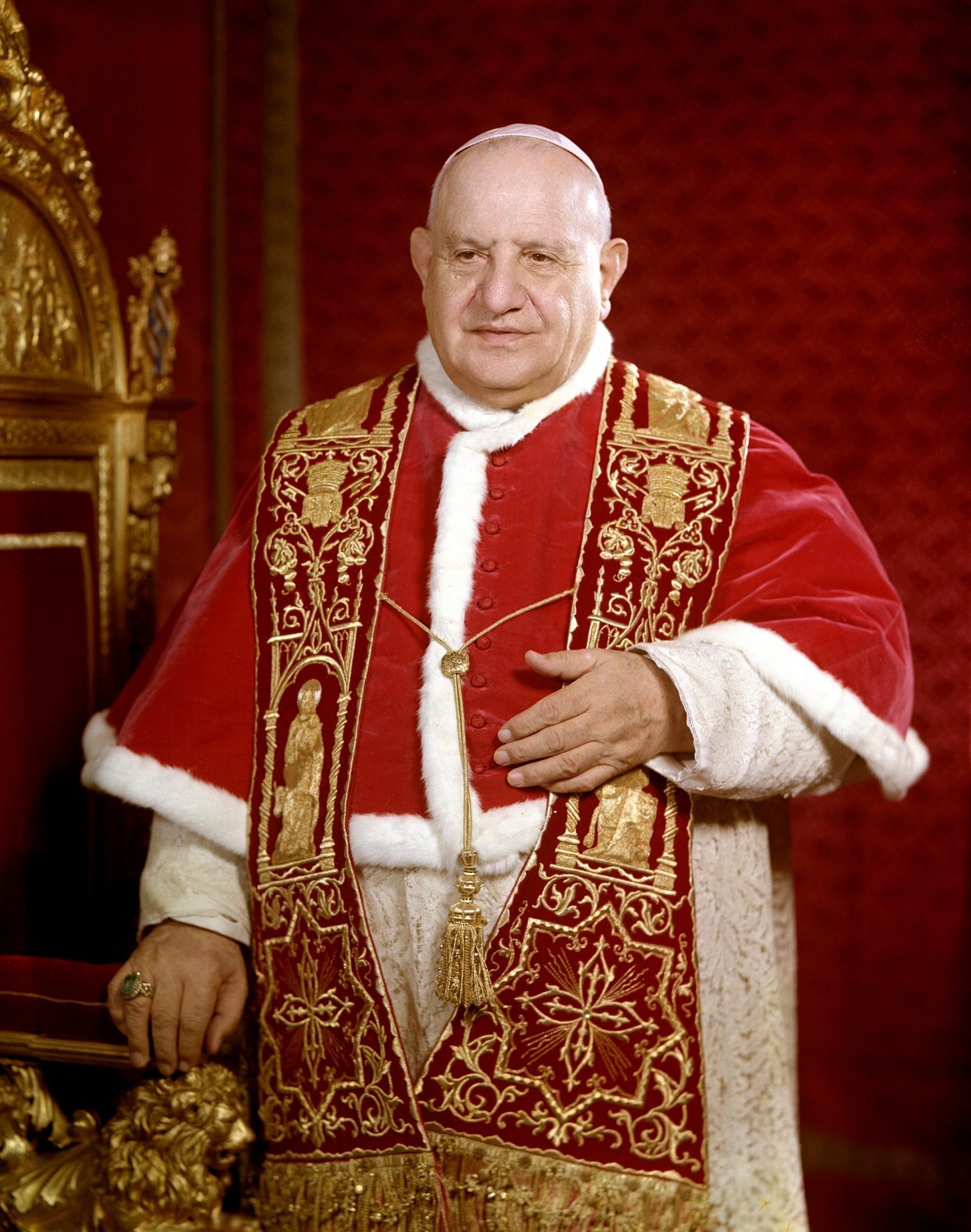
Today, 11 October, the Church remembers Saint John XXIII — it is the date of his optional memorial, which this year falls on a Sunday — and the day on which, in 1962, he opened the Second Vatican Council. That night, before the faithful gathered for a torchlight procession, the Pope improvised: “It seems that even the moon hurried, this evening — look up there! — to gaze upon this spectacle.”
Angelo Roncalli, of Sotto il Monte
He was born on 25 November 1881 at Sotto il Monte, in the province of Bergamo, into a family of peasant farmers. He entered the diocesan seminary at eleven and was ordained a priest in 1904. He served as secretary to the Bishop of Bergamo and then in the diplomacy of the Holy See: in 1921 at the Society for the Propagation of the Faith, in 1925 in Bulgaria, in 1935 in Turkey and Greece, in 1944 as nuncio in France. In 1953 he was made a cardinal and Patriarch of Venice.
On 28 October 1958, aged seventy-six, he was elected Pope and took the name John. A little under two months later, on 26 December, he went to visit the prisoners of Rome’s Regina Coeli jail.
The announcement and the Council
On 25 January 1959, in the basilica of Saint Paul Outside the Walls, he announced that he would call an ecumenical council. He convoked it formally on 25 December 1961 with the apostolic constitution Humanae salutis, and a letter of 2 February 1962 set the opening for 11 October. On that day about two thousand four hundred bishops processed into Saint Peter’s Basilica.
The opening address, Gaudet Mater Ecclesia (“Mother Church rejoices”), begins by recalling that the day belongs to Our Lady: the Council opens “under the auspices of the Virgin Mother of God, whose maternal dignity is celebrated today with joy”. From there the Pope turns away from the “prophets of doom, who always announce the worst, as if the end of the world were at hand”, and explains what he wants from the Council: not a list of condemnations but the proclamation of the same faith in a way that people today can hear.
That night of 11 October the Pope spoke without a script. He reminded them that the day was Our Lady’s, and that someone there had mentioned Ephesus and the lamps lit around the basilica, which he had seen himself — “not in those days, of course, but recently” — and which recall the proclamation of Mary’s divine motherhood. Then he chose to send them home with an image, not a doctrine: “When you go home, you will find the children; give your children a caress and say: ‘This is the Pope’s caress.’ You will find some tears to dry. Do something, say a kind word. The Pope is with us, especially in the hours of sadness and bitterness.”
The text is on the Vatican website, with the marks of speech improvised, and it is why 11 October is, in popular memory, the day of the moon and the caress.
The good pope, and what remained
John XXIII did not see the Council end. He died on 3 June 1963, between the first and second sessions; it was Paul VI who closed it on 8 December 1965. He was beatified by John Paul II on 3 September 2000 and canonised by Pope Francis on 27 April 2014, in the same ceremony as Saint John Paul II. In the canonisation homily Francis said that in convening the Council John XXIII “showed an exquisite openness to the Holy Spirit”, and that he liked to think of him “as the pope of openness to the Holy Spirit”.
- The Second Vatican Council. Opened on 11 October 1962 and closed on 8 December 1965, it left four constitutions: on the liturgy, the Church, Revelation and the Church in the modern world.
- Mater et Magistra (15 May 1961). An encyclical on “Christianity and social progress”: the Church as mother and teacher of the peoples.
- Pacem in Terris (11 April 1963). Signed on Holy Thursday, less than two months before his death, it is addressed not only to Catholics but “to all men of good will”.
- The prayer for a new Pentecost. The last lines of Humanae salutis, given below, ask the Holy Spirit to renew the wonders of the Church “as though for a new Pentecost”.
“When you go home, give your children a caress and say: ‘This is the Pope’s caress.’”— Saint John XXIII, greeting to the torchlight procession, 11 October 1962
“In the present time, the Bride of Christ prefers to use the medicine of mercy rather than take up the arms of severity.”— Saint John XXIII, Gaudet Mater Ecclesia, opening address of the Council, 11 October 1962
“The deposit of the faith, that is, the truths contained in our venerable teaching, is one thing; the way in which they are announced is another — always, however, in the same sense and with the same meaning.”— Saint John XXIII, Gaudet Mater Ecclesia, 11 October 1962
The prayers
The Pope’s prayer stands at the end of Humanae salutis, the bull that called the Council: in Latin, it is the petition that, in his words, rose daily to the Holy Spirit from every corner of the earth. The Collect of his memorial, also in Latin, is that of the Mass of the 11th.
Renova aetate hac nostra per novam veluti Pentecosten mirabilia tua, atque Ecclesiae Sanctae concede, ut cum Maria, Matre Iesu, unanimiter et instanter in oratione perseverans, itemque a Beato Petro ducta, divini Salvatoris regnum amplificet, regnum veritatis et iustitiae, regnum amoris et pacis. Amen.
Renew, in our time, your wonders, as though by a new Pentecost, and grant to the Holy Church that, persevering with one mind and steadfastly in prayer with Mary, the Mother of Jesus, and guided by Saint Peter, she may extend the kingdom of the divine Saviour, a kingdom of truth and justice, a kingdom of love and peace.
Amen. — Latin text: Humanae salutis, no. 23 (vatican.va); English translation ours
Omnípotens sempitérne Deus, qui per orbem terrárum in beáto Ioánne, papa, Christi boni pastóris vivum effulgére fecísti exémplum, concéde nobis, quæsumus, ut, eius intercessióne, abundántiam christiánæ caritátis lætánter effúndere valeámus.
Almighty and eternal God, who caused the living example of Christ the good shepherd to shine throughout the earth in blessed Pope John: grant us, through his intercession, to pour out joyfully the abundance of Christian charity.
Per Dominum. — Official Latin text (Congregation for Divine Worship, 2014); English translation ours
Sancte Ioánnes, ora pro nobis. Saint John XXIII, pray for us — and win for us the grace to carry the Pope’s caress to someone at home, in tears.
- Saint John Henry Newman — the Doctor of the Church of the 9th.
- Words of the saints — a growing collection, in English and Portuguese.

Comments