Today, 13 October, the Church recalls the sixth and last apparition at Fátima, in 1917. Three months earlier, on 13 July, the Lady had promised the children: “In October I will tell who I am, what I want, and I will work a miracle that all shall see, so that they may believe.” When the day came it poured with rain — and the people came all the same.
A sign fixed three months ahead
The apparitions at the Cova da Iria, near Fátima in Portugal, began on 13 May 1917. The seers were three children from Aljustrel: Lúcia dos Santos, ten, and her cousins Francisco, nine, and Jacinta Marto, seven. Of the six apparitions, five took place at the same spot, beside a small holm oak; the August one happened at Valinhos, on 19 August, because on the 13th the children were being held at Ourém by the district administrator.
In July Lúcia asked the Lady to say who she was and to work a miracle so that everyone would believe. The answer was the promise of October. The news travelled, and the crowd grew from month to month.
13 October 1917
The rain was torrential. Lúcia recalls that her mother insisted on going with her, afraid that it would be the last day of her daughter’s life, and that on reaching the Cova da Iria she herself asked the people to close their umbrellas so that they could pray the rosary. Soon after, she writes, she saw the flash of light and then the Lady above the tree.
In her account, the Lady said she wanted “a chapel in my honour, that I am the Lady of the Rosary, that they continue always to pray the rosary every day”, and that the war was going to end. Lúcia presented the many petitions she had been given: some would be granted, others not, and sinners had to amend their lives. With a sadder look, the Lady added: “Do not offend the Lord our God any more, for He is already much offended.”
- A chapel. In honour of Our Lady of the Rosary, on the place of the apparition.
- The rosary every day. The request went back to the first apparition, in May, and is renewed in the last: that they keep on always.
- Amendment of life. To ask pardon for sins and to offend God no more.
- Peace. The war would end — and the soldiers would go home. Lúcia herself admits in her Memoirs that she was mistaken in understanding that this would happen that very day; the war ended on 11 November 1918.
As she rose, Lúcia says, the Lady opened her hands and made their reflection fall on the sun. That is why she cried out to the people to look at the sun: “my purpose was not to draw the people’s attention there,” she writes. Beside the sun the three children saw Saint Joseph with the Child and Our Lady dressed in white with a blue mantle; then Lúcia saw Our Lord and Our Lady under the aspect of Our Lady of Sorrows, and a further figure resembling Our Lady of Mount Carmel.
What the crowd said it saw
The best-known report is that of the Lisbon newspaper O Século, dated 15 October 1917, signed by its special correspondent Avelino de Almeida under the headline “How the sun danced at midday in Fátima”. He describes the rain from ten in the morning, Lúcia’s request to close the umbrellas, the sky suddenly clearing, and a crowd which, by “dispassionate estimates of educated people”, came to thirty or forty thousand. Other documents of the time and of the following years speak of fifty thousand and of about seventy thousand: the figures vary, and the safest statement is that it was a crowd of tens of thousands.
Almeida writes that the sun looked like “a plate of dull silver” which could be gazed at without pain, that it “trembled” and that it “danced”, an expression he attributes to the country people. Asking one another what they had seen, some said the sun spun like a firework wheel, that it dropped almost to the point of burning the earth, that it changed colour. He himself passes no verdict: he ends by leaving it to the “competent” to explain the “dance of the sun”.
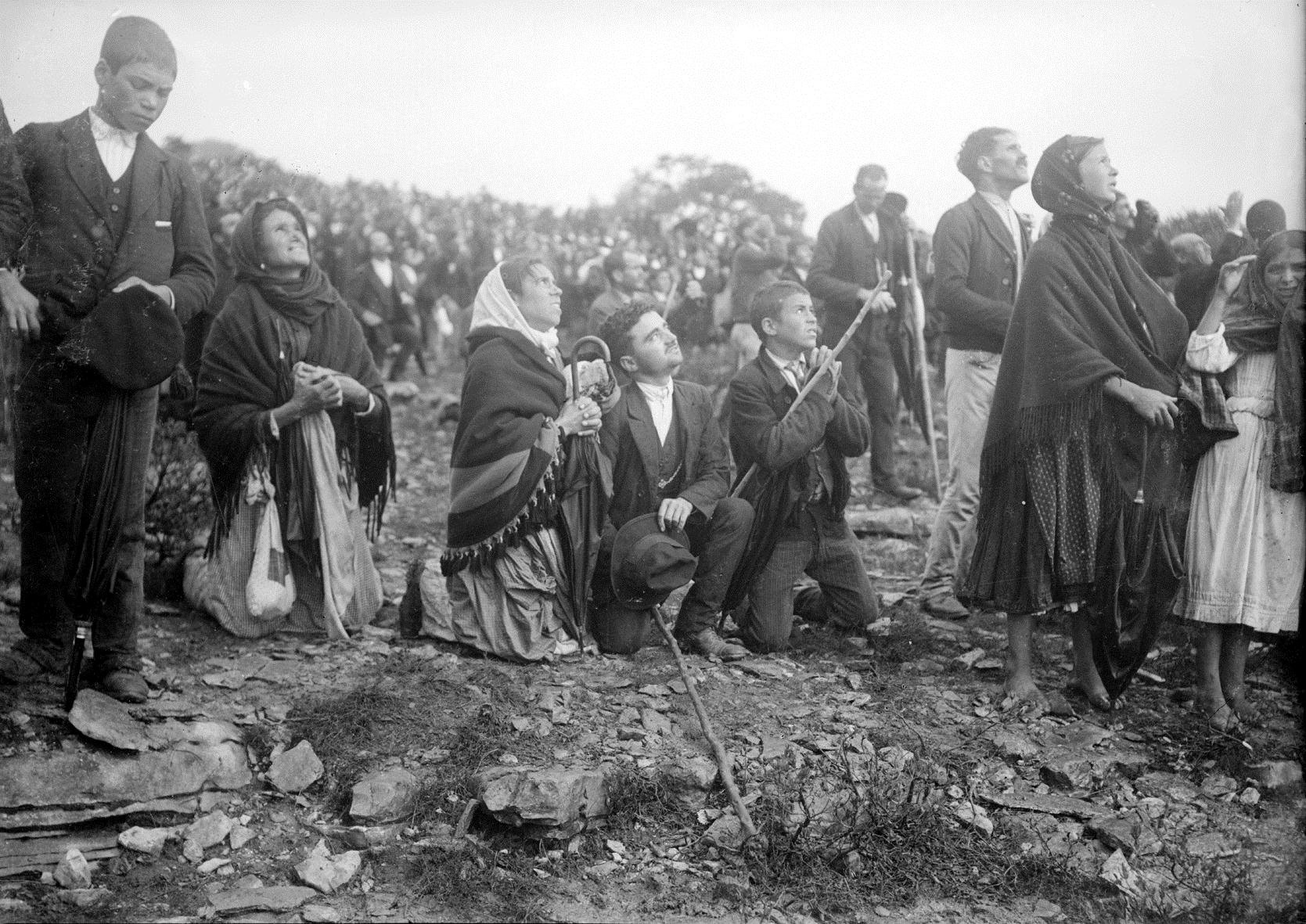
It is by Judah Bento Ruah (1892–1958), the photographer who travelled to Fátima with Avelino de Almeida and whose photograph appeared in the magazine Illustração Portugueza on 29 October 1917. It shows the people with their faces raised to the sky, some kneeling, others with umbrellas in hand.
What it kept was the crowd, not the sun: as far as is known, no photograph recorded what those present said they saw.
What the Church says — and what it leaves open
On 13 October 1930, by pastoral letter, the Bishop of Leiria, Dom José Alves Correia da Silva, declared the children’s visions “worthy of credence” and officially permitted the cult of Our Lady of Fátima. It is a judgement about a private revelation, and Cardinal Joseph Ratzinger’s theological commentary on The Message of Fatima (2000) explains its scope: private revelation “is a help to this faith and shows its credibility precisely by leading me back to the definitive public Revelation”. No one has to believe in Fátima to be a Catholic; what is asked is that the yardstick always be Christ.
The first request was fulfilled by the people: the little Chapel of the Apparitions was raised between 28 April and 15 June 1919, dynamited in the early hours of 6 March 1922 and reopened on 13 January 1923. Francisco died on 4 April 1919, aged ten, and Jacinta on 20 February 1920, aged nine; both were canonised by Pope Francis at Fátima on 13 May 2017. Lúcia, who entered the Carmel of Coimbra, died on 13 February 2005; her heroic virtues were recognised on 22 June 2023, and she is Venerable.
“Do not offend the Lord our God any more, for He is already much offended.”— Our Lady, as reported by Sister Lúcia, Memoirs (Fourth Memoir), on 13 October 1917
“The sun trembled, the sun made sudden movements never seen before, against all cosmic laws — the sun ‘danced’, in the typical expression of the country people.”— Avelino de Almeida, O Século, 15 October 1917
“I so love to tell Jesus that I love Him!”— Saint Jacinta Marto, as reported by Sister Lúcia, Memoirs (First Memoir)
The prayers
The first two are those of the Angel of Peace, taught to the children in 1916, a year before the Lady; Lúcia places the Angel’s first appearance in the spring of that year, without certainty about the dates. The third is the one the Lady asked for on 13 July 1917, to be said after each mystery of the rosary.
Meu Deus, eu creio, adoro, espero e amo-Vos. Peço-Vos perdão para os que não creem, não adoram, não esperam e não Vos amam.
Santíssima Trindade, Pai, Filho, Espírito Santo, adoro-Vos profundamente e ofereço-Vos o preciosíssimo Corpo, Sangue, Alma e Divindade de Jesus Cristo, presente em todos os sacrários da terra, em reparação dos ultrajes, sacrilégios e indiferenças com que Ele mesmo é ofendido. E pelos méritos infinitos do Seu Santíssimo Coração e do Coração Imaculado de Maria, peço-Vos a conversão dos pobres pecadores.
My God, I believe, I adore, I hope and I love You. I ask pardon for those who do not believe, do not adore, do not hope and do not love You.
Most Holy Trinity, Father, Son and Holy Spirit, I adore You profoundly and I offer You the most precious Body, Blood, Soul and Divinity of Jesus Christ, present in all the tabernacles of the world, in reparation for the outrages, sacrileges and indifference by which He Himself is offended. And through the infinite merits of His Most Sacred Heart and of the Immaculate Heart of Mary, I beg of You the conversion of poor sinners.
— Taught by the Angel to the shepherd children (Sister Lúcia, Memoirs)
Ó meu Jesus, perdoai-nos, livrai-nos do fogo do inferno, levai as alminhas todas para o Céu, principalmente aquelas que mais precisarem.
O my Jesus, forgive us, save us from the fire of hell, lead all souls to Heaven, especially those most in need.
— Taught by the Lady on 13 July 1917 (Sister Lúcia, Memoirs)
Regina sacratissimi Rosarii, ora pro nobis. Queen of the most holy Rosary, pray for us — and win us the grace to pray the rosary every day, without hurry.
- Our Lady of the Rosary — Lepanto and the Hail Marys, on the 7th; and the Rosary novena.
- How to pray the rosary step by step — where the Fátima prayer comes in.
- The Immaculate Heart of Mary — where the devotion comes from.
- Words of the saints — a growing collection, in English and Portuguese.

Comments