Last Saturday, 13 June 2026, the day after the Solemnity of the Sacred Heart of Jesus, the Church kept the Memorial of the Immaculate Heart of Mary. The two feasts stand side by side on purpose: first the Heart of the Son, the source; then, the very next day, the Heart of the Mother — the human heart that answered God’s love most perfectly. It is one of the loveliest sequences in the calendar, and it is worth pausing on it even a few days late.
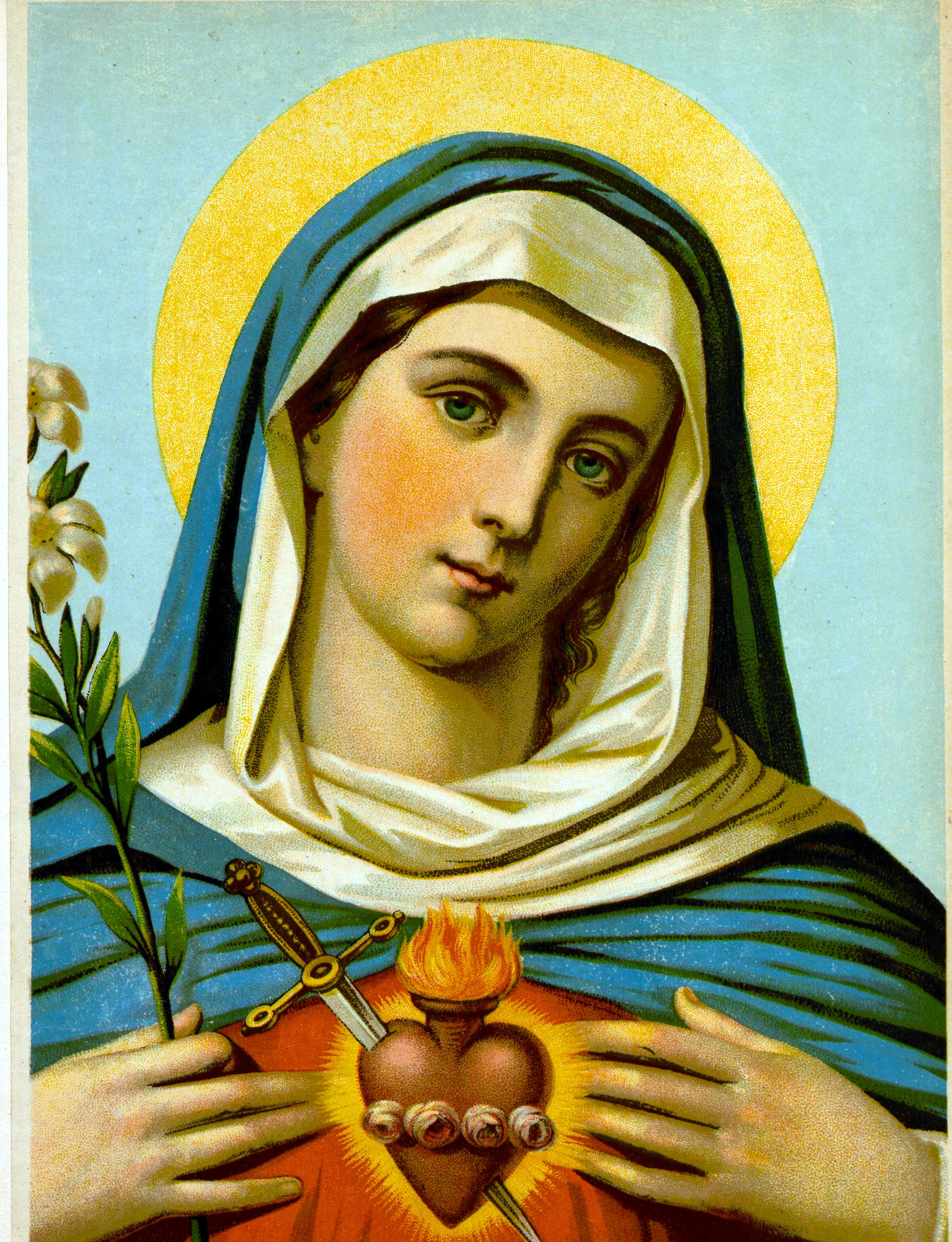
What we mean by her Heart
To honour the Heart of Mary is not to honour a mere organ, any more than to honour the Sacred Heart is to honour muscle and blood. The heart, in the language of Scripture, is the centre of the person — where one loves, decides, treasures and suffers. Twice St Luke tells us that Mary “kept all these things, pondering them in her heart” (Lk 2:19, 51). And the old Simeon had warned her, with the Child in his arms, that “a sword will pierce through your own soul also” (Lk 2:35). That is the heart we venerate: the interior life of the woman who believed, who treasured the Word, and who let herself be wounded alongside her Son. The sword and the flame in every image of the Immaculate Heart say exactly this — a love that costs, and a love that burns.
Where the devotion comes from
Love for the Heart of Mary is ancient — you find it already in St Bernard, St Bonaventure, St Bridget. But the devotion took liturgical form through a French priest, St John Eudes (1601–1680), whom Pope St Pius X called “the father, doctor and apostle” of the liturgical cult of the Hearts of Jesus and Mary. He composed a Mass and Office, and obtained the first feast of the Holy Heart of Mary as early as 1648. From the start, he never separated the two Hearts: where one is honoured, the other is near.
Fatima, 1917
What carried the devotion to the whole world, however, was Fatima. In 1917 Our Lady told the three shepherd children that God wished to establish in the world devotion to her Immaculate Heart, and she showed it to them encircled with thorns. “My Immaculate Heart,” she said, “will be your refuge and the way that will lead you to God.” She asked for prayer, for the Rosary, and for reparation; and she left a promise that has echoed through a century of turmoil:
“In the end, my Immaculate Heart will triumph.”
In 1925, at Pontevedra, Our Lady returned to Sister Lúcia and asked specifically for the devotion of the Five First Saturdays — an act of reparation to her Heart for the offences it receives. It is simple, and anyone can keep it:
- Go to Confession (within roughly eight days before or after).
- Receive Holy Communion on the first Saturday of the month.
- Pray five decades of the Rosary.
- Keep her company for fifteen minutes, meditating on the mysteries.
- Do all of this for five consecutive first Saturdays, with the intention of making reparation to her Immaculate Heart.
The Popes and the consecrations
The twentieth century answered Fatima. In 1942 Pope Pius XII consecrated the whole world to the Immaculate Heart of Mary, and in 1944 he extended her feast to the universal Church. St John Paul II — whose life was spared on 13 May 1981, a Fatima anniversary — renewed that consecration in union with the world’s bishops in 1984. After the reform of the calendar, the memorial found its present and most fitting place: the Saturday immediately after the Solemnity of the Sacred Heart.
Why the Saturday
The choice is not accidental. Saturday has belonged to Our Lady since the early Middle Ages — the day she alone kept faith while the Apostles scattered, between the Cross and the Resurrection. To set her Heart on the day after her Son’s is to draw, in the calendar itself, the icon the whole devotion proclaims: the Heart of God, and beside it the one creature whose heart answered his without reserve.
How to live it
The devotion fits into ordinary life. Begin, or renew, an entrustment of yourself to her Immaculate Heart. Keep the First Saturdays. Pray the daily Rosary, even a single decade. And imitate the interior life the devotion honours: to ponder rather than merely react, to treasure the Word, to say her fiat — “let it be done to me” — when God asks something hard. Tomorrow the Church’s gaze turns to a third heart, that of the man who guarded both Jesus and Mary; but it begins here, in the quiet refuge of the Mother’s Heart.


Comments Comentários