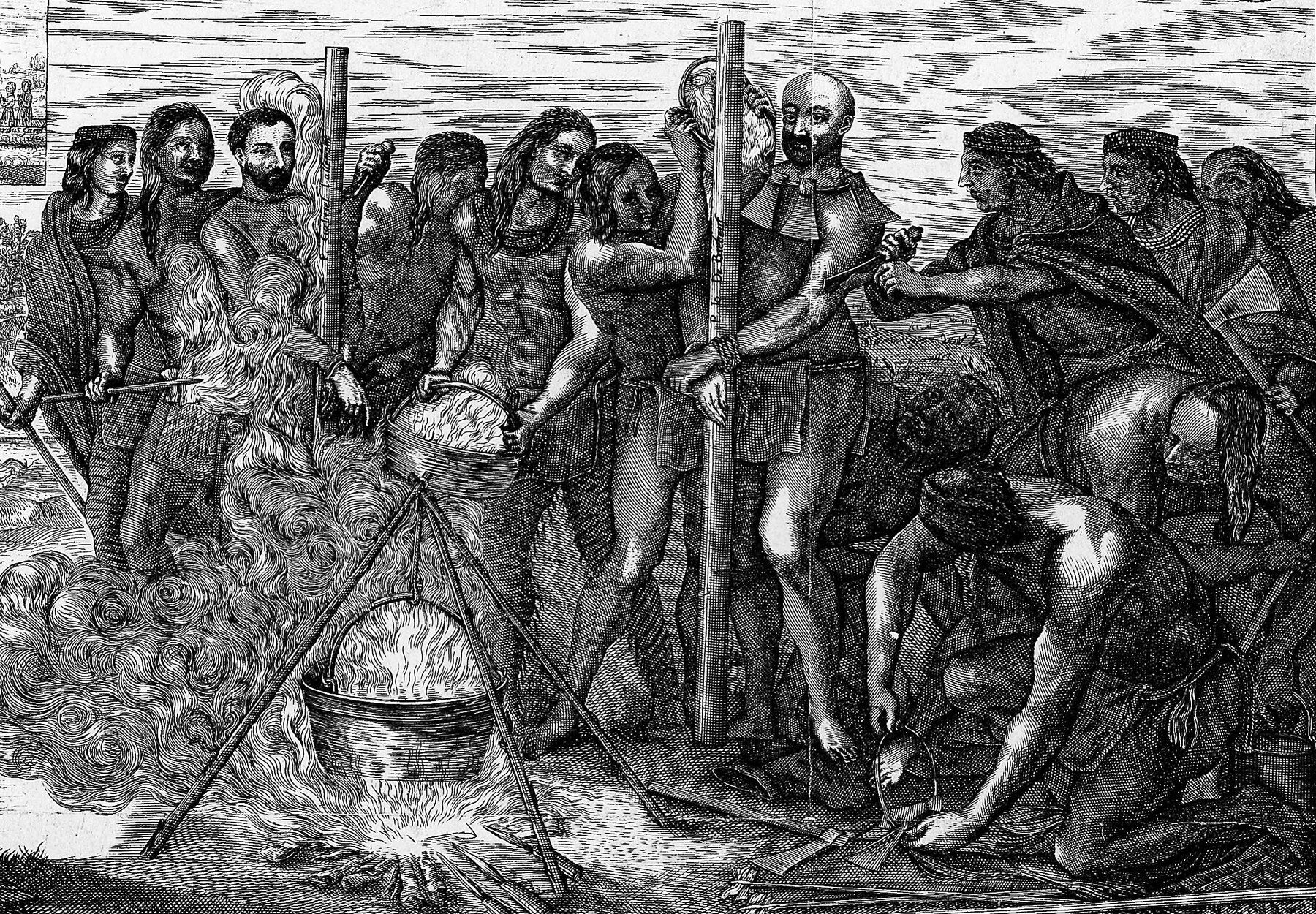
Today, 19 October, the Church remembers, in an optional memorial, Saint John de Brébeuf, Saint Isaac Jogues and their companions, eight martyrs killed between 1642 and 1649 in what is now Canada and northern New York State. Yesterday, the 18th, was exactly 380 years since Jogues was killed by a hatchet blow in a Mohawk village — where he had gone back on purpose, after already surviving it once with his hands mutilated.
Eight names, three places
They are six Jesuit priests — Isaac Jogues, Jean de Brébeuf, Gabriel Lalemant, Antoine Daniel, Charles Garnier and Noël Chabanel — and two lay helpers: René Goupil, a surgeon who became a Jesuit brother shortly before he died, and Jean de Lalande, a young man from Dieppe who had offered himself to serve the mission. They were canonized by Pius XI on 29 June 1930, and Pius XII proclaimed them patrons of Canada in 1940.
- Ossernenon, in Mohawk country (now near Auriesville, New York). René Goupil, on 29 September 1642; Isaac Jogues, on 18 October 1646; Jean de Lalande, probably the next day.
- Huronia, around Georgian Bay (Ontario). Antoine Daniel, on 4 July 1648; Jean de Brébeuf, on 16 March 1649, and Gabriel Lalemant, the day after, both at Saint-Ignace.
- The land of the Petun, to the south. Charles Garnier, on 7 December 1649, and Noël Chabanel, the day after.
Brébeuf, the “Echon”
Jean de Brébeuf was born at Condé-sur-Vire in Normandy on 25 March 1593. He reached Quebec in 1625 and the following year went to the Wendat (Hurons), with whom he would spend nearly all his life, except the years 1629 to 1633, when the English took Quebec and the missionaries returned to France. He learned the language, wrote a grammar and a dictionary, and was given by them the name Echon. It was not a life of success: after the smallpox epidemics many Wendat took the Jesuits for sorcerers, and Father Ragueneau would report that the name of Echon became so dreaded that it was used to frighten children.
Probably in 1642 he wrote in Wendat a Christmas song, Jesous Ahatonhia (“Jesus, he is born”), held to be the oldest in Canada, set to the tune of a French folk song. The famous English words, “’Twas in the moon of wintertime”, date from 1926 and are by another author: a free paraphrase, not a translation.
Isaac Jogues, the “living martyr”
Isaac Jogues was born at Orléans on 10 January 1607. On 3 August 1642, returning from Quebec with René Goupil and a party of Christian Wendat, he was captured by the Mohawks. He could have escaped, hidden in the reeds; he wrote afterwards: “Could I, indeed, abandon our French and leave those good neophytes and those poor catechumens without the help which the Church of my God has entrusted to me?” His nails were torn out, his fingers were gnawed to the bone, and Goupil was killed with a hatchet after teaching a boy the sign of the cross.
Jogues escaped in 1643 with the help of the Dutch and reached Brittany on Christmas Day. His hands were so maimed that Pope Urban VIII granted him leave to celebrate Mass: it is said he called it “unworthy that a martyr of Christ should not drink the blood of Christ” (Indignum esset Christi martyrem Christi non bibere sanguinem). He returned to Canada in 1644. In 1646 he went as an ambassador of peace to the Mohawks and, on the way, was the first European to see the lake he named Lac du Saint-Sacrement, today Lake George. On that first journey he had left a box in the village; when he returned in September, the Mohawks, who blamed it for the sickness, drought and famine that followed, seized him. He was killed on 18 October; Lalande, probably the next day.
The picture above is a detail from a cartouche of the map Novae Franciae Accurata Delineatio (1657) by the Italian Jesuit Francesco Bressani, who knew the subject from inside: captured by the Mohawks in 1644, he was tortured — nine of his fingers were cut off —, ransomed by the Dutch and sent back to France; he returned to the mission and retired to Italy only in 1650. In the lower right of the map, made for the edification of the faithful, is the scene of the death of Brébeuf and Lalemant.
Saint-Ignace, 16 March 1649
More than a thousand Iroquois attacked the village of Saint-Ignace and then Saint-Louis, where Brébeuf and Gabriel Lalemant were working. Taken prisoner to Saint-Ignace, they were stripped and beaten. Brébeuf, says the Relation of 1649, “overwhelmed under the burden of the blows”, still cared for his flock: he told the Christians imprisoned with him to lift their eyes to Heaven and remember that God was witness of their sufferings. A renegade Wendat, whom he himself had taught and baptized, mocked baptism by pouring boiling water over him; a collar of red-hot hatchets was put around his neck. He died the same day, about four in the afternoon; Lalemant, the next day.
The account comes from Father Ragueneau and from the donné Christophe Regnaut, who did not witness the scene but heard it from Christian Wendat who escaped captivity; Regnaut examined the bodies the next day. The two priests were buried at Sainte-Marie, the Jesuit mission in Huronia. With them suffered and died Christian Wendat whose names almost no one kept.
Noël Chabanel felt a strong repugnance for life among the Wendat and, fearing he would give up, made a vow never to leave the mission except under obedience. He kept it until his death on 8 December 1649. And Kateri Tekakwitha, the first Native American saint, was born in 1656 in the Mohawk village of Ossernenon, in present-day New York State; she was canonized on 21 October 2012.
“My children, let us lift our eyes to Heaven in the height of our afflictions; let us remember that God is witness of our sufferings and will soon be our great reward.”— Saint Jean de Brébeuf to his fellow captives, 16 March 1649 (Relation of 1649)
“From this day I gladly offer you my blood, my body and my spirit, that I may die for you, if you so grant, you who deigned to die for me.”— Saint Jean de Brébeuf, vow of martyrdom
“Could I abandon our French and leave those good neophytes and poor catechumens without the help which the Church of my God has entrusted to me?”— Saint Isaac Jogues, on his capture in 1642
The prayers
Brébeuf left written, in Latin, the vow never to fail the grace of martyrdom, made between 1637 and 1639 and transcribed by Father Ragueneau in the Relation of 1649. Here are its opening and its final offering (the omitted part names the witnesses of the vow: the Trinity, Our Lady, Saint Joseph, the angels and the saints). Then the Collect of the memorial.
Quid retribuam tibi, Domine mi Iesu, pro omnibus quæ retribuisti mihi? Calicem tuum accipiam, et nomen tuum invocabo. […] Tibi ergo, Domine mi Iesu, et sanguinem et corpus et spiritum meum iam ab hac die gaudenter offero, ut pro te, si ita dones, moriar, qui pro me mori dignatus es. Fac ut sic vivam, ut ita mori tandem me veles. Ita, Domine, calicem tuum accipiam, et nomen tuum invocabo: Iesu, Iesu, Iesu.
What shall I render to you, my Lord Jesus, for all that you have rendered to me? I will take your chalice and call upon your name. […] Therefore, my Lord Jesus, from this day I gladly offer you my blood, my body and my spirit, that I may die for you, if you so grant, you who deigned to die for me. Grant that I may live in such a way that, at the last, you may will me to die thus. Yes, Lord, I will take your chalice and call upon your name: Jesus, Jesus, Jesus.
— Saint Jean de Brébeuf, Relation of 1649
Deus, qui spem beatam regni aeterni sanctorum Ioannis et Isaac eorumque sociorum opere et sanguinis effusione manifestare voluisti, concede propitius, ut, eorum intercessione, fides christianorum in dies firmetur. Per Dominum.
O God, you were pleased to show forth the blessed hope of the everlasting kingdom in the labours and the spilt blood of John and Isaac and their companions: in your kindness grant that, through their prayers, the faith of Christians may grow firmer with each passing day. Through our Lord Jesus Christ.
Amen.
Sancti martyres Canadenses, orate pro nobis. Holy martyrs of North America, pray for us.
- Saint Luke — the evangelist of Acts, yesterday, on World Mission Sunday.
- Saint Ignatius of Loyola — the founder of the Jesuits.
- Words of the saints — a growing collection, in English and Portuguese.

Comments