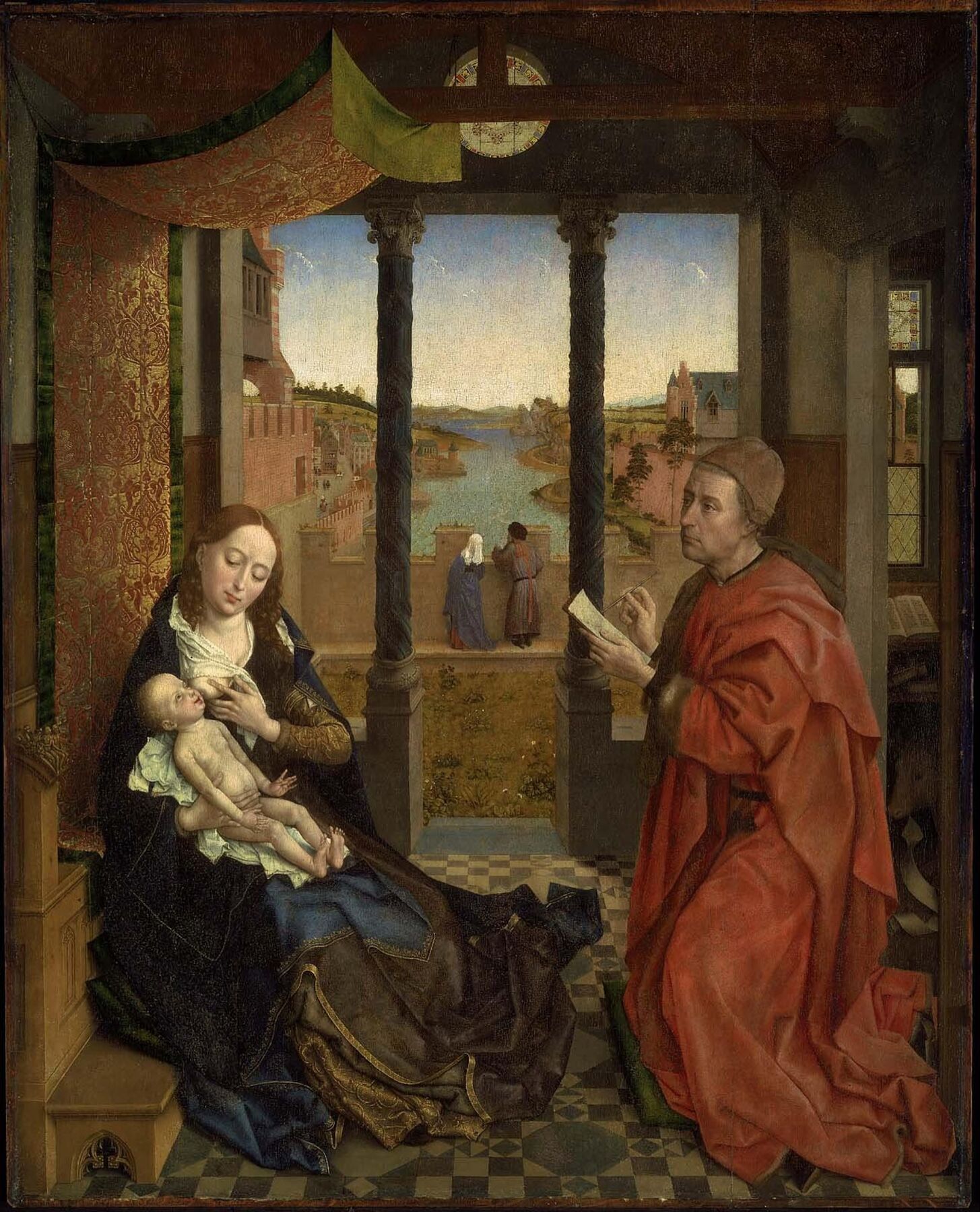
Today, 18 October, is the day of Saint Luke, evangelist, the “most dear physician” of whom Saint Paul speaks (Col 4:14). It was he who gave us the scene of the Annunciation and the Magnificat, and tradition says he also painted the face of Mary — a lovely tradition that no one can prove. In 2026 the date falls on a Sunday, the 29th of Ordinary Time and World Mission Sunday; since the calendar norms rank Sundays in Ordinary Time above the feasts of saints, today’s liturgy is that of the Lord’s Day, and Luke’s feast remains, this year, in devotion and in this page.
The physician of Antioch
Luke never names himself in his two books. His name comes from three letters of Paul: “Luke, the most dear physician, saluteth you” (Col 4:14); “Mark, Aristarchus, Demas, and Luke my fellow labourers” (Phlm 24); and, with Paul imprisoned and abandoned, “Only Luke is with me” (2 Tim 4:11). Saint Irenaeus, around AD 180, and the Bodmer papyrus XIV-XV (P75), of about AD 200, already ascribe the third Gospel to him.
Eusebius of Caesarea describes him as a man “of Antiochian parentage and a physician by profession”, who left us, in his two books, “proofs of that spiritual healing art” he learned from the apostles (Ecclesiastical History III, 4). He was probably not a Jew: in Colossians Paul sets him apart from “those of the circumcision”. And there is a discreet sign that he was present: in Acts the narrative suddenly shifts from “they” to “we”, at Troas: “immediately we sought to go into Macedonia, being assured that God had called us to preach the gospel to them” (Acts 16:10).
The Gospel opens like a historian’s work: “It seemed good to me also, having diligently attained to all things from the beginning, to write to thee in order, most excellent Theophilus” (Lk 1:3). Of the end of his life there are only traditions: he is said to have died in Boeotia, aged eighty-four (seventy-four, in some versions), and Jerome says he was buried at Constantinople, to which city his bones were carried, with those of the apostle Andrew.
The Gospel of mercy, the Gospel of Mary
- Only he tells the childhood of Jesus. The Annunciation, the Visitation, the Magnificat, the Benedictus of Zechariah, the birth at Bethlehem and the shepherds, Simeon and the Nunc dimittis, the twelve-year-old Boy in the Temple. Without Luke the crib would have no shepherds.
- Half of the Hail Mary is his. “Hail, full of grace, the Lord is with thee: blessed art thou among women” (Lk 1:28) is the angel’s greeting, and “Blessed art thou among women, and blessed is the fruit of thy womb” (Lk 1:42), Elizabeth’s.
- The parables of compassion. The Good Samaritan, who “was moved with compassion” and bound up the wounds “pouring in oil and wine” (Lk 10:33-34), and the father of the prodigal son, who “ran to him” (Lk 15:20), are found only in Luke. A physician notices the dressings.
- The ones nobody expected. Zacchaeus, the good thief (“This day thou shalt be with me in paradise”, Lk 23:43), the disciples at Emmaus. The Collect of the feast sums it up: God chose him to reveal “the mystery of his love for the poor”.
- Mary kept it all in her heart. “Mary kept all these words, pondering them in her heart” (Lk 2:19; also 2:51). Many readers see here a clue to the source of the infancy stories; the text does not say, it is a hypothesis.
The picture above, Saint Luke Drawing the Virgin, by Rogier van der Weyden (Boston, about 1435–1440), is oil and tempera on oak panel, about four and a half feet tall. Our Lady is shown nursing the Child, in the type of the Maria lactans; Luke, in a red robe, is before her, almost on his knees, and draws her face in silverpoint, a medium that forgives no error. In the little study behind him are the ox and the open book of his Gospel.
Luke’s face is widely considered a self-portrait of Van der Weyden himself: the painter placed himself beside the saint and the “founder” of painting. There are three near-contemporary versions (Saint Petersburg, Munich, Bruges); the Boston panel is held to be the original, almost certainly painted for the chapel of the painters’ guild in Brussels.
Did Luke paint Our Lady?
Tradition says he did. Theodorus Lector, in the sixth century, speaks of a portrait of the Mother of God sent from Jerusalem to Constantinople; Nicephorus Callistus, in the fourteenth century, and the Menology of Basil II, around AD 980, call Luke a painter. Rome still keeps, in Santa Maria Maggiore, the icon Salus Populi Romani, which legend attributes to him. It is a tradition without proof. Art historians see in the Roman icon a thirteenth-century surface painted over an older one whose date has been placed in almost every century between the fifth and the thirteenth. What Luke certainly left us is another portrait of Mary, made of words.
That is why painters made him their patron, and physicians count him as theirs too. His symbol is the ox, the sacrificial animal, because the Gospel begins in the Temple, with the priest Zechariah.
The evangelist of the missions
Luke is also the author of the Acts of the Apostles, the first history of the spread of the Church: from Jerusalem to Rome, with the “we” of a man who was in the boat. It is fitting that his day coincides, this year, with World Mission Sunday, the hundredth: Pius XI established it in 1926, on the penultimate Sunday of October, and the theme for 2026 is “One in Christ, united in mission”.
Tomorrow, the 19th, the Church remembers the martyrs of Canada and their companions, who carried the Gospel across the Atlantic.
“Behold the handmaid of the Lord; be it done to me according to thy word.”— Luke 1:38
“Mary kept all these words, pondering them in her heart.”— Luke 2:19
“Was not our heart burning within us, whilst he spoke in this way, and opened to us the scriptures?”— Luke 24:32
The prayers
The Magnificat, Mary’s song in Elizabeth’s house (Lk 1:46-55), exists only in Luke. It is here in Latin, in the Vulgate form the Church sings at Vespers, and in English. Then the Collect of the feast.
Magnificat anima mea Dominum, et exsultavit spiritus meus in Deo salutari meo, quia respexit humilitatem ancillae suae. Ecce enim ex hoc beatam me dicent omnes generationes, quia fecit mihi magna qui potens est, et sanctum nomen eius, et misericordia eius a progenie in progenies timentibus eum. Fecit potentiam in bracchio suo, dispersit superbos mente cordis sui. Deposuit potentes de sede, et exaltavit humiles. Esurientes implevit bonis, et divites dimisit inanes. Suscepit Israel puerum suum, recordatus misericordiae suae, sicut locutus est ad patres nostros, Abraham et semini eius in saecula.
My soul doth magnify the Lord, and my spirit hath rejoiced in God my Saviour, because he hath regarded the humility of his handmaid. For behold, from henceforth all generations shall call me blessed, because he that is mighty hath done great things to me, and holy is his name, and his mercy is from generation unto generations, to them that fear him. He hath shewed might in his arm; he hath scattered the proud in the conceit of their heart; he hath put down the mighty from their seat, and hath exalted the humble; he hath filled the hungry with good things, and the rich he hath sent empty away. He hath received Israel his servant, being mindful of his mercy, as he spoke to our fathers, to Abraham and to his seed for ever.
— The Song of Our Lady, Gospel of Saint Luke 1:46-55 (Douay-Rheims)
Domine Deus, qui beatum Lucam elegisti, ut praedicatione et scriptis mysterium tuae in pauperes dilectionis revelaret, concede, ut, qui tuo iam nomine gloriantur, cor unum et anima una esse perseverent, et omnes gentes tuam mereantur videre salutem. Per Dominum.
Lord God, you chose blessed Luke to make known, in his preaching and in his writing, the mystery of your love toward the poor: grant that those who already take pride in your name may go on being of one heart and one soul, and that every people may be counted worthy to behold your salvation. Through our Lord Jesus Christ.
Amen.
Sancte Luca, ora pro nobis. Saint Luke, pray for us.
- The Magnificat: meaning and how to pray it daily — Mary’s song, verse by verse.
- Saint Matthew — the evangelist of September.
- Words of the saints — a growing collection, in English and Portuguese.

Comments