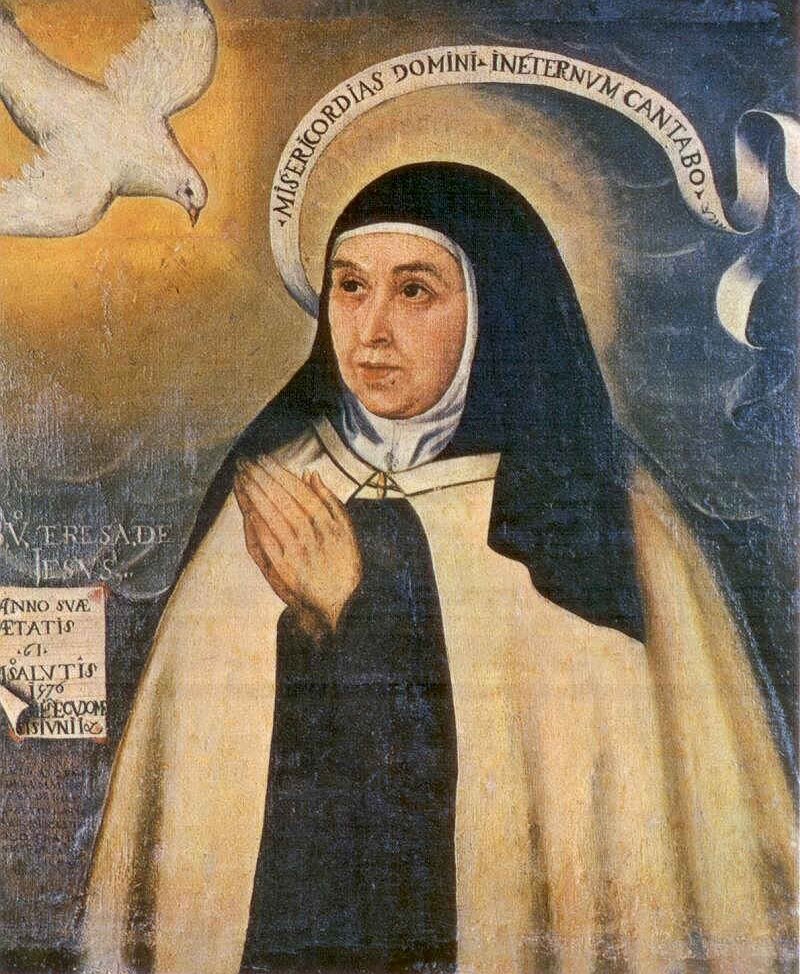
Today, 15 October, the Church keeps Saint Teresa of Jesus, Teresa of Ávila, virgin and Doctor of the Church. The date has a curiosity: she died on a night in 1582 when the day after 4 October was the 15th. Ten whole days were struck from the calendar, and her feast landed on the first one left.
The little girl who wanted to see God
She was born Teresa de Cepeda y Ahumada on 28 March 1515 at Ávila in Castile (the nearby village of Gotarrendura is also named as her birthplace). Hers was a large family, with three sisters and nine brothers. Before she was nine, reading lives of the martyrs, she ran away from home for a short while, to die for the faith and reach Heaven at once. “I want to see God”, she told her parents. She lost her mother at about twelve and asked the Virgin to be her mother instead.
At twenty she entered the Carmelite monastery of the Incarnation at Ávila and took the name Teresa of Jesus. Three years later she fell so gravely ill that she lay four days in a coma, looking dead. For years her life of prayer was a struggle; the turning point, as she tells it in the Life, came in Lent 1554, at thirty-nine, before the image of a most grievously wounded Christ.
The reform, and a friendship
In 1562 she founded in Ávila the first reformed Carmel, that of Saint Joseph, with the support of the bishop, Don Álvaro de Mendoza. The poverty of the new convent scandalised the city, which very nearly had it closed; later, suspicion turned to approval. In the following years she travelled across Spain founding convents — seventeen in all, Benedict XVI says. In 1568, with Saint John of the Cross, she opened at Duruelo the first friary of Discalced Carmelites. In 1580 Rome recognised the reformed Carmels as a separate province, the starting point of the Order of Discalced Carmelites.
She wrote because she was told to, and produced four works that have lasted the centuries:
- The Book of Her Life (1565). The autobiography, which she called the Book of the Mercies of the Lord.
- The Way of Perfection (1566). Written for the twelve novices of Saint Joseph’s; it contains her commentary on the Our Father.
- The Interior Castle (1577). The soul as a castle of seven dwelling places, leading to the meeting with God at the centre.
- The Book of Foundations (1573–1582). The story of the convents, told to show God’s action in them.
Teresa died at Alba de Tormes, on the way back from Burgos to Ávila, in 1582. That year Catholic Europe was exchanging the Julian calendar for the Gregorian, and the days 5 to 14 were removed from October: 4 October was followed by the 15th.
She died at the turn, and the sources differ: some say before midnight on the 4th; Benedict XVI, in a catechesis of 2011, writes “on the night of 15 October”. That is why the feast falls on the 15th. Her last words, according to the same Pope: “After all, I die a child of the Church.”
Doctor of the Church
She was beatified in 1614 and canonised in 1622 by Gregory XV. On 27 September 1970 Paul VI proclaimed her a Doctor of the Church, the first woman to receive the title; Saint Catherine of Siena received it a week later, on 4 October. Benedict XVI sums up her teaching in a line: for Teresa, to pray is to live in a relationship of friendship with God, and time given to prayer is “not time wasted”.
The portrait at the top of this page was painted in Seville, at the request of Father Jerónimo Gracián, by the Carmelite fray Juan de la Miseria; the inscription says she was sixty-one and bears the date 2 June 1576. Gracián recalled afterwards that he made her sit for it out of obedience, as a mortification. Tradition has it that, on seeing the result, she remarked with humour that he had painted her ugly and bleary-eyed.
In the Life (29,13) she describes the experience tradition calls the transverberation: an angel with a golden spear who pierces her heart. Bernini carved it in Rome, between 1647 and 1652, in the church of Santa Maria della Vittoria.
“Mental prayer, in my opinion, is nothing other than an exchange of friendship, being often alone with Him who we know loves us.”— Saint Teresa of Jesus, Book of Her Life 8,5
“…understand that if it is in the kitchen, the Lord walks among the pots and pans, helping you within and without.”— Saint Teresa of Jesus, Book of Foundations 5,8
“…It seemed to me he thrust it several times through my heart and that it reached my entrails; when he drew it out, it seemed to take them with it and left me all on fire with a great love of God.”— Saint Teresa of Jesus, Book of Her Life 29,13
The prayers
The Nada te turbe is Teresa’s best-known poem. According to Carmelite tradition she kept it on a leaf inside the breviary with which she prayed the Divine Office; the critical edition by Father Silverio de Santa Teresa (Burgos, 1919) carries a note by Father Gracián attesting that the breviary was hers, and the Catechism of the Catholic Church (no. 227) quotes the lines as Saint Teresa’s. Below, the Spanish text and a translation, and then the Collect of the memorial, in Latin.
Nada te turbe,
nada te espante;
todo se pasa,
Dios no se muda;
la paciencia
todo lo alcanza;
quien a Dios tiene
nada le falta:
sólo Dios basta.
Let nothing disturb you,
let nothing frighten you;
all things pass,
God does not change;
patience
obtains all things;
whoever has God
lacks nothing:
God alone is enough.
— Saint Teresa of Jesus, Poesías
Deus, qui per Spiritum tuum beatam Teresiam suscitasti, ut requirendae perfectionis semitam Ecclesiae manifestaret, da nobis et caelestis eius doctrinae pabulo semper nutriri, et verae sanctitatis desiderio accendi.
O God, who by your Spirit stirred up blessed Teresa to reveal to the Church the path of perfection that is to be sought, grant that we may always be fed on the nourishment of her heavenly teaching and be kindled with desire for true holiness.
Amen.
Sancta Teresia a Iesu, ora pro nobis. Saint Teresa of Jesus, pray for us — and win us the friendship of being alone with Him whom we know loves us.
- Saint Thérèse of Lisieux — another Carmelite and Doctor of the Church, on the 1st; and the Saint Thérèse novena.
- Prayers of Carmel — the Flos Carmeli and the songs of Our Lady of Mount Carmel.
- Words of the saints — a growing collection, in English and Portuguese.

Comments