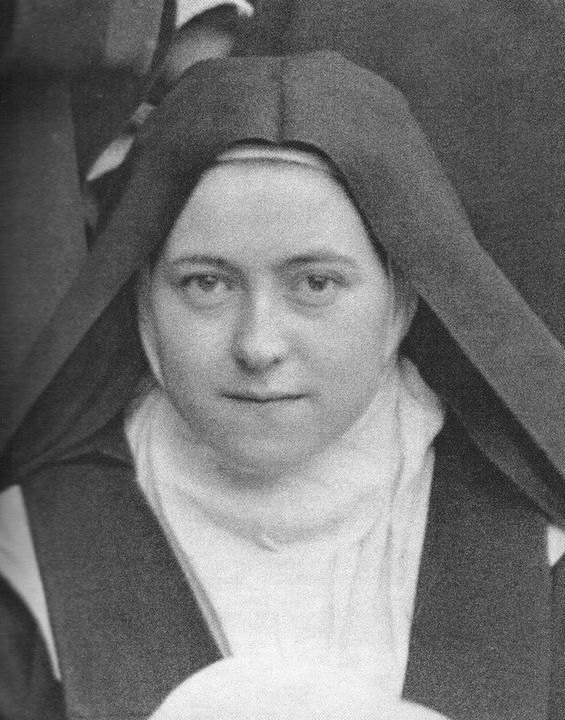
Today, 1 October, the Church keeps Saint Thérèse of the Child Jesus, virgin and Doctor of the Church. She died on 30 September 1897, aged twenty-four, in a convent at Lisieux that almost nobody had heard of — and a hundred years later a pope declared her a Doctor of the universal Church. Anyone who reads what she wrote understands why: instead of a system she left the sentence of a little girl, “my vocation is love”.
A short, hidden life
She was born at Alençon in Normandy on 2 January 1873 and entered the Carmel of Lisieux on 9 April 1888, at fifteen. She never left it. From outside, nothing stood out: a young Carmelite among the others.
What remained is what she wrote in obedience: three manuscripts, addressed to her sister Pauline (Mother Agnes of Jesus), to her sister Marie, and to the prioress. Gathered together, they appeared in 1898 as Story of a Soul. Pius XI canonised her on 17 May 1925 and, on 14 December 1927, named her patron of the missions alongside Saint Francis Xavier — she who spent her whole adult life behind the enclosure. Saint John Paul II proclaimed her a Doctor of the Church on 19 October 1997.
The little way
The heart of her teaching lies in the last manuscript, written in the summer of 1897. She felt too small for “the rough stairway of perfection” and, since she could not grow, went looking in Scripture for another road. She found two sentences: “Whoever is a little one, let him come to me” (Prov 9:4, in the Vulgate) and Isaiah’s promise that God comforts like a mother carrying her child (Is 66:12-13). Hence a conclusion so simple that it disarms:
“The lift that must raise me to Heaven is your arms, O Jesus! For that I have no need to grow; on the contrary, I must remain little, and become more and more so.” (Manuscript C, folio 3 recto)
Saint John Paul II, in the apostolic letter proclaiming her a Doctor, called this way “the Gospel way of holiness for all”.
- Accepting that one is small. “To grow is impossible; I must bear with myself as I am, with all my imperfections,” she writes. Holiness does not begin with the effort to be somebody else.
- Trusting instead of counting merits. In the Act of Offering she says she will appear before God “with empty hands”.
- Making love the vocation. In September 1896 she wrote that in the heart of the Church she would be Love — and so she would be everything.
- Going on after death. Her sisters noted that she had promised to spend her heaven doing good on earth. Hence the image of the roses, which popular devotion attaches to her.
9 June 1895: the Act of Offering
It was Trinity Sunday. Thérèse wrote afterwards: “I received the grace to understand more than ever how much Jesus desires to be loved”. She had been thinking of souls who offer themselves as victims to God’s Justice, and asked the Lord whether only Justice would receive such offerings: “does not your Merciful Love need them too?” After Mass, according to her sister Céline, she took Céline to the prioress, who was then Mother Agnes, and asked leave for the two of them to offer themselves as victims to Merciful Love. Leave was granted, although the prioress did not quite grasp what it was about.
Within two days she had put the text on paper. On Tuesday 11 June the two sisters knelt before the statue of the Virgin of the Smile, next to Thérèse’s cell, and she read the prayer aloud.
The heart of the text is the request to be consumed by Love. And she took it seriously: she wrote to Mother Agnes that since that day “Love penetrates and surrounds me, at every instant this Merciful Love renews me and purifies my soul” (Manuscript A, folio 84 verso).
The image at the top of this page is a detail from a group photograph taken in the courtyard of the Carmel on Easter Monday, 15 April 1895, by Céline, Thérèse’s sister, who had entered the Carmel in 1894 and brought a camera with her.
It is to her that we owe the authentic photographs of Thérèse, down to the last one, of 30 August 1897, a month before her death.
“At last I have found my vocation: my vocation is Love!… In the heart of the Church, my Mother, I shall be Love.”— Saint Thérèse, Manuscript B, folio 3 verso (September 1896)
“The lift that must raise me to Heaven is your arms, O Jesus!”— Saint Thérèse, Manuscript C, folio 3 recto (1897)
“I want to spend my heaven doing good on earth.”— Saint Thérèse, as noted by her sisters (17 July 1897) — a saying recorded by witnesses, not written by her
The prayers
The Act of Offering is the prayer that cannot be missing on this day. Below, two extracts from the French text of 1895, with an English translation; the whole Act is in any edition of Story of a Soul.
O mon Dieu ! Trinité bienheureuse, je désire vous aimer et vous faire aimer, travailler à la glorification de la sainte Église, en sauvant les âmes qui sont sur la terre et en délivrant celles qui souffrent dans le purgatoire. Je désire accomplir parfaitement votre volonté et arriver au degré de gloire que vous m’avez préparé dans votre royaume ; en un mot, je désire être sainte, mais je sens mon impuissance et je vous demande, ô mon Dieu, d’être vous-même ma sainteté.
[…]
Au soir de cette vie, je paraîtrai devant vous les mains vides, car je ne vous demande pas, Seigneur, de compter mes œuvres. Toutes nos justices ont des taches à vos yeux. Je veux donc me revêtir de votre propre Justice et recevoir de votre Amour la possession éternelle de Vous-même. Je ne veux point d’autre Trône et d’autre Couronne que Vous, ô mon Bien-Aimé !
O my God, blessed Trinity, I long to love you and to make you loved, to work for the glory of holy Church by saving the souls on earth and setting free those who suffer in purgatory. I long to fulfil your will perfectly and to reach the degree of glory you have prepared for me in your kingdom; in a word, I long to be a saint, but I feel my helplessness, and I ask you, O my God, to be yourself my holiness.
[…]
At the evening of this life I shall appear before you with empty hands, for I do not ask you, Lord, to count my works. All our righteousness is stained in your eyes. I wish, then, to clothe myself in your own Righteousness and to receive from your Love the everlasting possession of Yourself. I want no other Throne and no other Crown than You, O my Beloved!
…
Afin de vivre dans un acte de parfait Amour, je m’offre comme victime d’holocauste à votre Amour miséricordieux, vous suppliant de me consumer sans cesse, laissant déborder en mon âme les flots de tendresse infinie qui sont renfermés en vous, et qu’ainsi je devienne martyre de votre Amour, ô mon Dieu !
[…]
Je veux, ô mon Bien-Aimé, à chaque battement de mon cœur, vous renouveler cette offrande un nombre infini de fois, jusqu’à ce que, les ombres s’étant évanouies, je puisse vous redire mon Amour dans un Face à Face éternel !
In order to live in an act of perfect Love, I offer myself as a victim of holocaust to your merciful Love, begging you to consume me without ceasing, letting the floods of infinite tenderness that are shut up in you overflow into my soul, and so let me become a martyr of your Love, O my God!
[…]
I wish, O my Beloved, at every beat of my heart, to renew this offering to you an infinite number of times, until the shadows having faded away, I can tell you of my Love in an eternal Face to Face!
— Marie Françoise Thérèse of the Child Jesus and the Holy Face, unworthy Carmelite religious. Feast of the Most Holy Trinity, 9 June 1895.
Sancta Teresia a Iesu Infante, ora pro nobis. Saint Thérèse, pray for us — and teach us to be little.
- Novena to Saint Thérèse — nine days with the saint of the roses.
- Holy Guardian Angels — tomorrow, the 2nd.
- Saint Francis of Assisi — the Canticle of the Creatures, on the 4th.
- Words of the saints — a growing collection, in English and Portuguese.

Comments