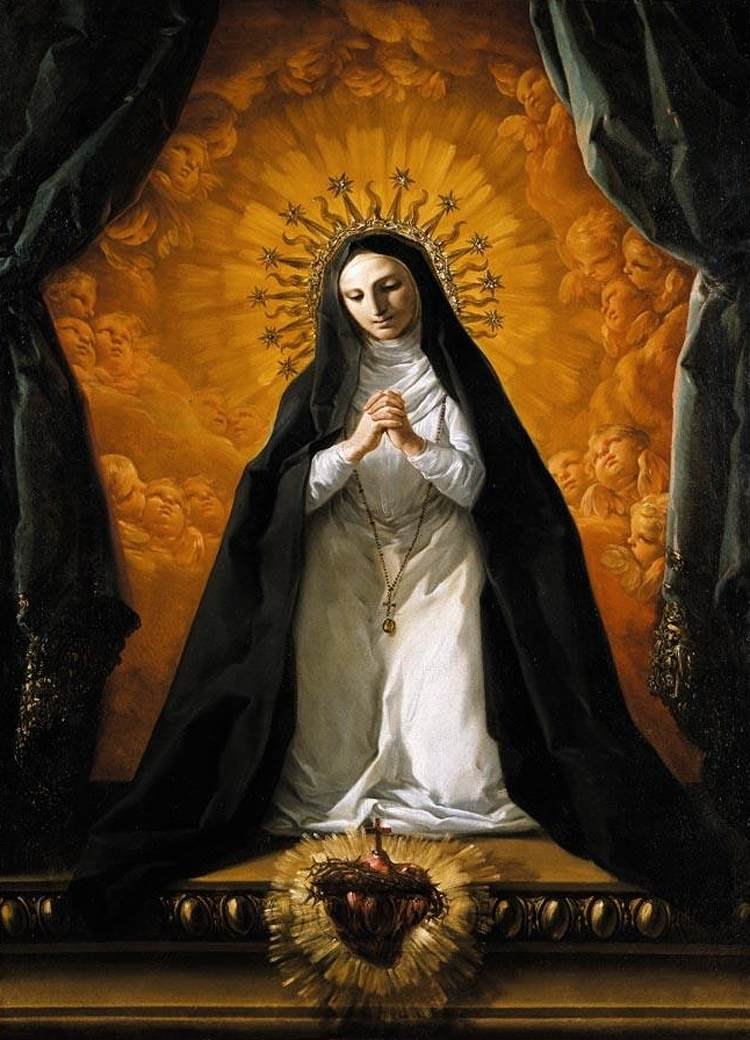
Today, 16 October, the Church remembers Saint Margaret Mary Alacoque, a Visitation nun of Paray-le-Monial in Burgundy. For years her own community treated her as an over-excited woman, and it was to her that it fell to hear, before the Blessed Sacrament: “Behold this Heart which has so loved men.”
A girl from Burgundy
Margaret was born on 22 July 1647 at L’Hautecour, the daughter of Claude Alacoque, a well-to-do notary, and Philiberte Lamyn. Her father died when she was eight, and the family fell into poverty. She was schooled by the Poor Clares of Charolles, made her first Communion at nine, and a long illness kept her in bed for four years. She promised the Virgin that she would be a religious if she recovered, and she recovered; that, it is said, is why she added Mary to her baptismal name.
Then came adolescence, with dances and her mother’s hope of seeing her married. One Carnival night, returning from a party, she had a vision of Christ scourged, who reproached her for her forgetfulness. She resolved to keep her promise and, in 1671, at twenty-three, entered the Visitation at Paray-le-Monial. She received the habit on 25 August; her profession was delayed and came only on 6 November 1672.
Paray-le-Monial, 1673–1675
On 27 December 1673, the feast of Saint John the Evangelist, she says the Lord let her rest her head on his breast, like the beloved disciple at the Supper, and opened his Heart to her. In the apparitions that followed came the image of the Heart ringed with thorns and surmounted by a cross, the complaint of men’s ingratitude, and the request for the Holy Hour on Thursday nights.
The best known is the so-called great apparition, in June 1675, within the octave of Corpus Christi (the sources differ on the exact day, between 13 and 20 June). She was asked that the Friday after the octave be set aside for a feast in honour of the Heart of Jesus, with Communion and reparation. From that feast comes the solemnity of the Sacred Heart, extended to the Latin Church by Pius IX in 1856.
- Consecration. For her, the essence of the devotion: a total giving of oneself, of all one’s actions.
- Reparation. To answer ingratitude with love, above all before the Blessed Sacrament.
- The Holy Hour. An hour of watching on Thursday night, in union with Jesus’s agony in Gethsemane.
- The Friday. Communion on the day of the pierced Heart, in a spirit of reparation.
The promises linked to this devotion have a text of their own on this site; here the concern is the life and the gesture.
Misunderstood, then recognised
The community did not believe her: it took her for sick or mad, and the superior, when she asked to make the Holy Hour, rejected the request as an “invention”. Support came from a Jesuit, Saint Claude de la Colombière, who arrived in Paray in February 1675 as superior of the Society’s house and began to hear the sisters’ confessions. He defended the authenticity of what she reported and, on 21 June 1675, the Friday after the octave, consecrated himself to the Heart of Christ. In 1683, with the election of a new superior, the opposition ended; Margaret became her assistant and later novice mistress, and the community began to keep the feast privately from 1686.
She wrote down what she had lived, out of obedience, in her Autobiography. She died on 17 October 1690, aged forty-three, with one word on her lips: “Jesus”. She was beatified by Pius IX on 18 September 1864 and canonised by Benedict XV on 13 May 1920. Pope Francis, in the encyclical Dilexit nos (2024), reminds us that no one is obliged to accept every detail of her experience, but that the underlying message, the love of Christ that calls for an answer, remains.
She died on 17 October, and that was the day on which the Church entered her memorial in the General Roman Calendar, in 1929. In the reform of 1969 the 17th went to Saint Ignatius of Antioch, a saint of the first centuries, and Margaret Mary’s memorial moved to the day before.
Today it is an optional memorial, sharing the 16th with Saint Hedwig.
“Behold this Heart which has so loved men that it has spared nothing, even to exhausting and consuming itself, to show them its love.”— Words of Christ, as reported by Saint Margaret Mary, Autobiography, account of the great apparition (June 1675)
“My divine Heart is so passionate with love for men, and for you in particular, that, no longer able to contain within itself the flames of its ardent charity, it must pour them out through you.”— Words of Christ, as reported by Saint Margaret Mary, Autobiography, no. 53 (27 December 1673)
“This is my irrevocable will: to be wholly His, and to do everything for love of Him.”— Saint Margaret Mary, Consecration to the Sacred Heart
The prayers
The principal one is the Consecration to the Sacred Heart. The French edition of 1920 of her writings (Vie et révélations) carries a note that she composed it, by inspiration of Our Lord, and asked Father Croiset to include it in the book he was preparing: “it comes from Him, and He would not approve of its being omitted”. Variants circulate, and another act of consecration is attributed to her in older editions; the text below is that of the 1920 edition, in French, with a translation of our own.
Je, N., me donne et consacre au sacré Cœur de Notre-Seigneur Jésus-Christ, ma personne et ma vie, mes actions, peines et souffrances, pour ne plus vouloir me servir d’aucune partie de mon être que pour l’honorer, aimer et glorifier. C’est ici ma volonté irrévocable que d’être tout à lui, et faire tout pour son amour, en renonçant de tout mon cœur à tout ce qui lui pourrait déplaire.
Je vous prends donc, ô sacré Cœur, pour l’unique objet de mon amour, le protecteur de ma vie, l’assurance de mon salut, le remède de ma fragilité et de mon inconstance, le réparateur de tous les défauts de ma vie, et mon asile assuré à l’heure de ma mort. Soyez donc, ô Cœur de bonté, ma justification envers Dieu le Père, et détournez de moi les traits de sa juste colère. Ô Dieu d’amour, je mets toute ma confiance en vous, car je crains tout de ma malice et de ma faiblesse, mais j’espère tout de votre bonté.
Consumez donc en moi tout ce qui vous peut déplaire ou résister. Que votre pur amour vous imprime si avant dans mon cœur que jamais je ne vous puisse oublier, ni être séparé de vous, que je conjure, par toutes vos bontés, que mon nom soit écrit en vous, puisque je veux faire consister tout mon bonheur et toute ma gloire à vivre et mourir en qualité de votre esclave.
I, N., give myself and consecrate myself to the Sacred Heart of our Lord Jesus Christ — my person and my life, my actions, pains and sufferings — no longer wishing to use any part of my being except to honour, love and glorify Him. This is my irrevocable will: to be wholly His, and to do everything for love of Him, renouncing with all my heart whatever might displease Him.
I take you, then, O Sacred Heart, as the sole object of my love, the protector of my life, the assurance of my salvation, the remedy of my frailty and inconstancy, the repairer of all the faults of my life, and my sure refuge at the hour of my death. Be, then, O Heart of goodness, my justification before God the Father, and turn away from me the arrows of His just anger. O God of love, I put all my trust in You, for I fear everything from my own malice and weakness, but I hope for everything from Your goodness.
Consume in me, then, all that can displease You or resist You. May Your pure love imprint You so deeply on my heart that I may never be able to forget You, nor be separated from You; I entreat You, by all Your goodness, that my name be written in You, since I wish to make all my happiness and all my glory consist in living and dying as Your slave.
— Saint Margaret Mary Alacoque; Paray-le-Monial, 17th century
Effunde super nos, quaesumus, Domine, spiritum, quo beatam Margaritam Mariam singulariter ditasti, ut scire valeamus supereminentem scientiae caritatem Christi, et impleamur in omnem plenitudinem tuam.
Pour out upon us, we pray, O Lord, the spirit with which you enriched blessed Margaret Mary in a singular way, that we may be able to know the charity of Christ that surpasses all knowledge, and be filled with all your fullness.
Amen.
Sancta Margarita Maria, ora pro nobis. Saint Margaret Mary, pray for us — and win us the grace to give the whole heart, and not only what is left over from the day.
- The Sacred Heart to St Margaret Mary — the apparitions and the twelve promises.
- The Sacred Heart of Jesus — the devotion and its meaning.
- Saint Teresa of Ávila — the reformer of Carmel, on the 15th.
- Words of the saints — a growing collection, in English and Portuguese.

Comments