Today, Friday 12 June 2026, the Church keeps the Solemnity of the Sacred Heart of Jesus — a feast born, a little over three centuries ago, inside a convent cell in Burgundy, from the eyes of a nun no one took seriously. The story of how the Heart of Christ asked to be loved, and of the twelve promises bound to that request, is among the most concrete and startling in Catholic spirituality. It is worth telling in full.
A nun no one expected
Margaret Mary Alacoque was born in 1647 in Verosvres, in Burgundy, France. She lost her father early, was ill through much of her youth, and at twenty-four entered the monastery of the Order of the Visitation at Paray-le-Monial. She was not brilliant, not learned, with nothing to set her apart from the others — and it was precisely her that Christ chose to entrust with one of the most widespread devotions in the history of the Church. “I have chosen you,” he would tell her, “as an abyss of unworthiness and ignorance, so that everything may be done by me.”
The great apparitions (1673–1675)
Between 1673 and 1675, at Paray-le-Monial, Margaret Mary received a series of apparitions of Christ himself. They were not vague visions: they were precise encounters, with words, gestures and concrete requests.
27 December 1673. Before the Blessed Sacrament, Jesus invited her to rest her head upon his breast, as the apostle John had done at the Last Supper. And there he revealed to her “the wonders of his love and the inexplicable secrets of his Sacred Heart,” which he had until then kept hidden. He told her that his Heart burned so for mankind that it could no longer contain the flames of that charity.
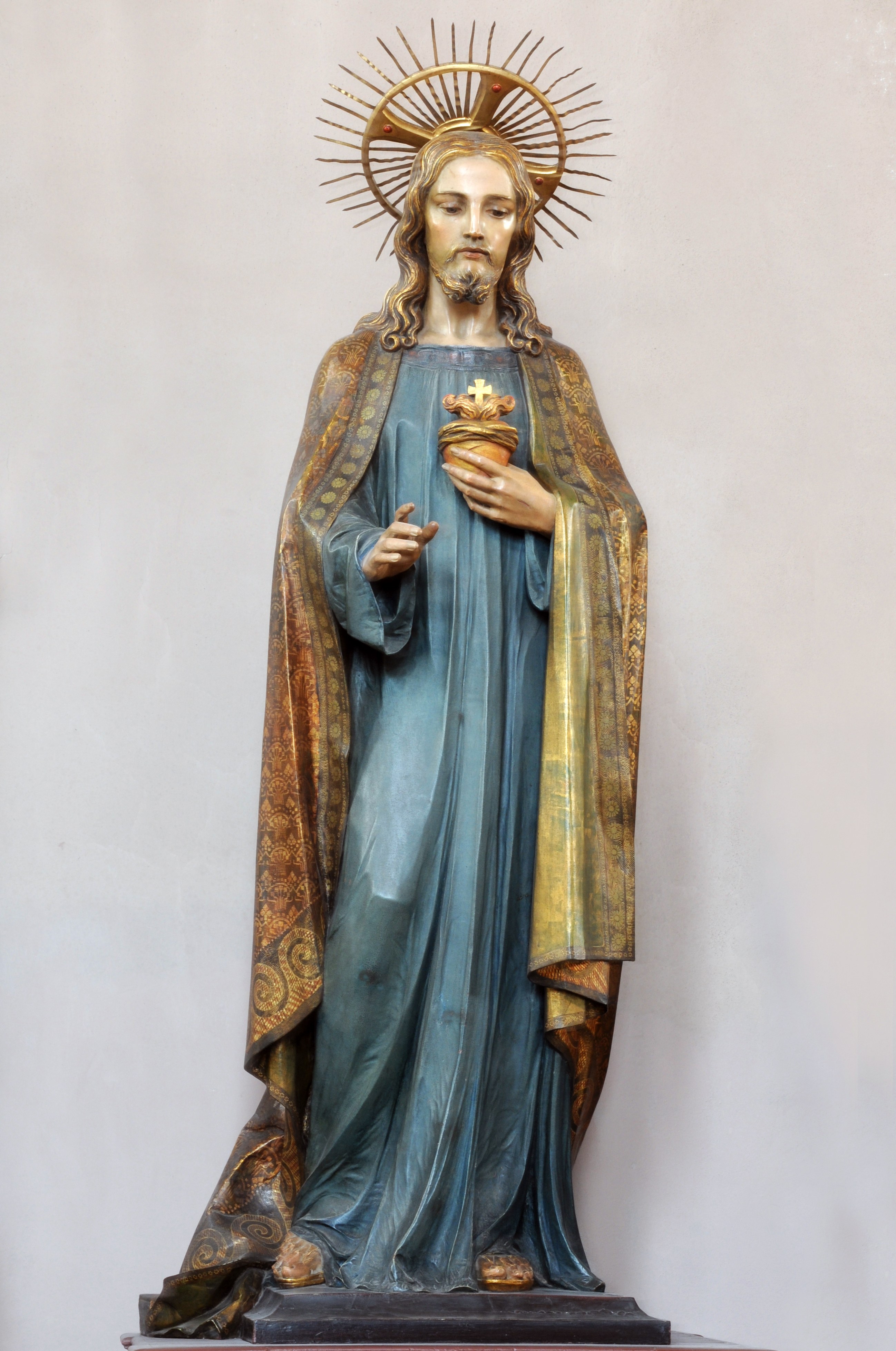
The apparitions that followed. In one of them, Christ showed her his Heart upon a throne of fire, brighter than the sun, transparent as crystal, with the living wound it had received on the cross. Around it, a crown of thorns — the sins of men; surmounted by a cross — the price paid for that love. The flames were the love; the thorns, the ingratitude.
The Great Apparition, June 1675. This was the most famous. During the octave of Corpus Christi, showing his Heart, Christ spoke the words that sum up the whole devotion:
“Behold this Heart which has so loved men that it has spared nothing, even to exhausting and consuming itself, in order to testify to them its love. And in return I receive from the greater part only ingratitude, by their irreverence and sacrilege, and by the coldness and contempt they show me in this sacrament of love.”
And he made three concrete requests, which are the practical heart of the devotion: a feast dedicated to his Heart on the Friday after the octave of Corpus Christi (which is why we keep it today); Communion of reparation, especially on the first Friday of each month; and the Holy Hour, a vigil on the night of Thursday to Friday, in memory of his agony in Gethsemane. He did not ask for feelings: he asked for reparation — love offered in exchange for indifference.
The man who believed: St Claude de la Colombière
Like so many mystics, Margaret Mary was met with suspicion. The sisters doubted; the superiors hesitated. The turning point was the arrival at Paray of a Jesuit, Father Claude de la Colombière, who became her spiritual director. A solid, prudent man, little given to enthusiasm, he examined everything — and believed. He declared the revelations authentic and devoted himself to spreading the devotion. Without him, the message would likely have died in that cell. Claude was canonised in 1992; Margaret Mary, in 1920.
From a cell to the whole world
Margaret Mary died in 1690, at forty-three, without seeing the feast established. But the seed was sown. The devotion spread through France and Europe, above all through the preaching of the Jesuits. In 1856, Pope Pius IX extended the Feast of the Sacred Heart to the whole Church. In 1899, Leo XIII consecrated the entire human race to the Heart of Christ. In 1956, Pius XII devoted to it the encyclical Haurietis Aquas, the great theological exposition of the devotion. What began in the silence of a convent became the patrimony of the whole Church.
The 12 promises of the Sacred Heart
Across the apparitions and Margaret Mary’s correspondence, Christ attached to the devotion to his Heart a series of promises for those who would practise it with faith. Tradition gathered them into twelve. They are not an amulet or a magic guarantee: they presuppose a life of faith, of sacraments and of love. They are, rather, Christ’s own word about what he does for those who draw near to his Heart.
- I will give them all the graces necessary for their state of life.
- I will give peace in their families.
- I will console them in all their afflictions.
- I will be their secure refuge during life, and above all at the hour of death.
- I will pour abundant blessings upon all their undertakings.
- Sinners shall find in my Heart the source and the infinite ocean of mercy.
- Lukewarm souls shall become fervent.
- Fervent souls shall rise speedily to great perfection.
- I will bless the homes where an image of my Heart shall be exposed and honoured.
- I will give to priests the power to touch the most hardened hearts.
- Those who promote this devotion shall have their name written in my Heart, never to be effaced.
- The Great PromiseI promise you, in the excessive mercy of my Heart, that its all-powerful love will grant to all those who receive Holy Communion on the first Friday of nine consecutive months the grace of final repentance: they shall not die under my displeasure, nor without receiving their sacraments, and my Heart shall be their secure refuge in that last hour.
The Great Promise and the First Fridays
The twelfth is called the Great Promise, and it deserves a word. It is bound to the devotion of the nine First Fridays: to receive Communion, in a state of grace and with the intention of reparation, on the first Friday of nine consecutive months. The promise does not dispense with conversion nor licence presumption — it supposes precisely a soul that, in seeking the Heart of Christ over nine months, opens itself to the grace of not dying separated from him. It is, at bottom, mercy taking the initiative: God promising to come to the aid, at the last instant, of those who in life turned towards his Heart.
How to live this today
The devotion has not aged. It remains within anyone’s reach, and fits into simple acts: Communion on the First Fridays; a Holy Hour before the Blessed Sacrament, however brief; the enthronement of an image of the Sacred Heart at home, entrusting one’s family to it (promise no. 2); the consecration to the Heart of Jesus; and, above all, the attitude beneath all of it — reparation: to offer love where there is indifference, beginning with our own.
In the end, the message of Paray-le-Monial fits in a single line: the Heart of God is not a distant metaphor. It is a Heart that truly loves, that truly grieves at not being loved, and that makes true promises to those who draw near. Today, on his feast, it is enough to turn to him and tell him that we love him — that was all he asked.

Comments