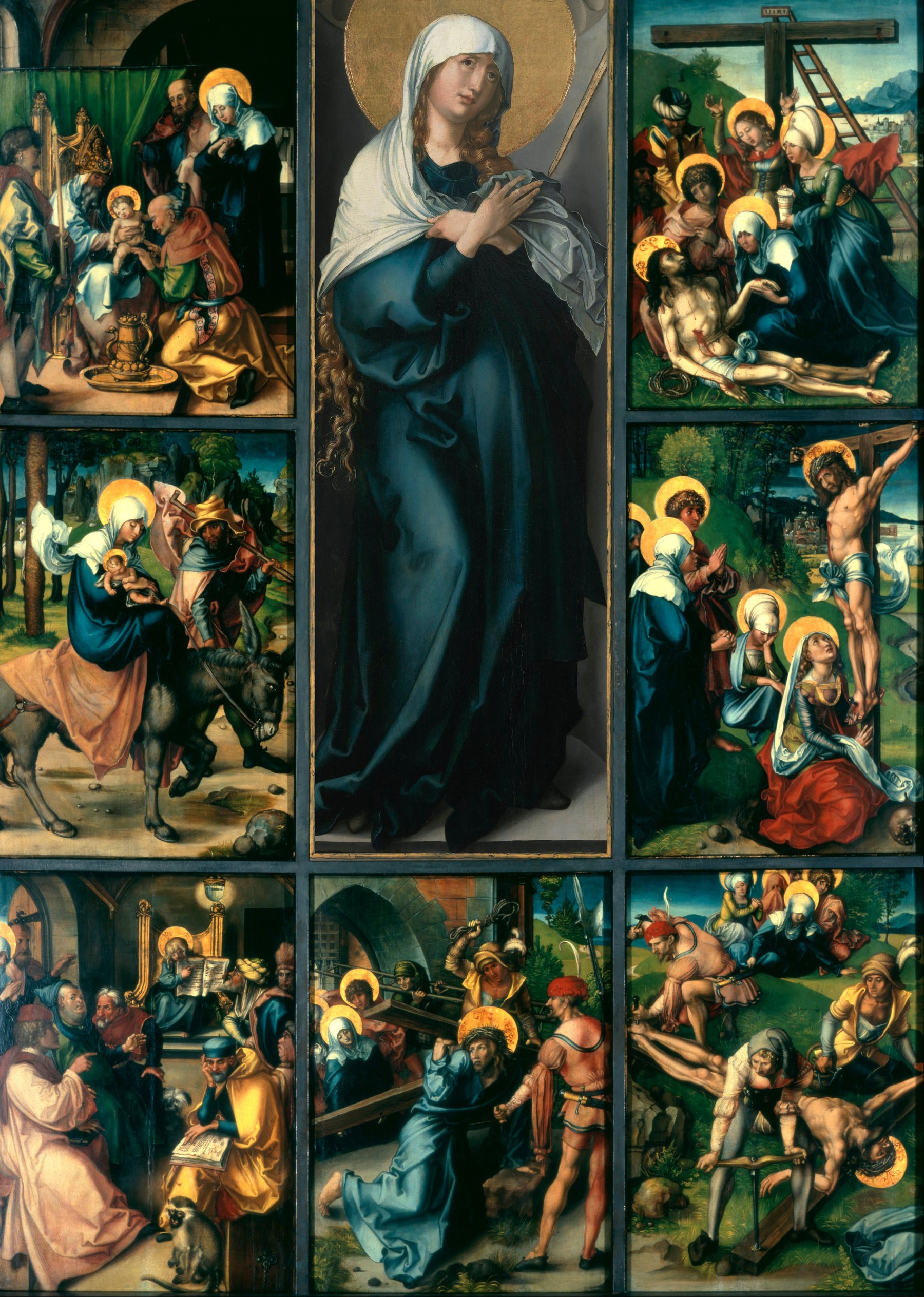
On 15 September the Church keeps Our Lady of Sorrows, and there is a rosary made to measure for the day. It is called the Seven Sorrows Rosary (also the Servite Rosary, or the Chaplet of the Seven Sorrows); it takes about twenty minutes, and it asks for nothing you do not already have. Here it is in full, from the sign of the cross to the amen.
It is not the Sorrowful Mysteries
The confusion is common, and worth clearing up at once. The Sorrowful Mysteries of the Rosary contemplate the Passion of Christ: the agony in the garden, the scourging, the crowning with thorns, the carrying of the cross, the crucifixion. The Seven Sorrows Rosary looks somewhere else — at what she suffered, and over a far longer stretch: it begins in the Temple, with a forty-day-old baby in her arms, and ends only at the door of the tomb.
The count is different too: instead of five decades, seven groups of seven Hail Marys, one for each sorrow.
Where it comes from
The chaplet was born with the Order of the Servants of Mary, the Servites, founded at Florence in 1233 by seven merchants who left everything to serve the Virgin. It was they who gave the devotion its shape and carried it through the Church over the centuries.
In the 1980s it found a second youth in an unlikely place: Kibeho, in Rwanda. In the apparitions the Church recognised in 2001, Our Lady asked one of the visionaries, Marie-Claire Mukangango, to teach the world to pray the Rosary of the Seven Sorrows again.
7 Our Fathers and 52 Hail Marys: seven times seven, plus three at the end. Twenty to twenty-five minutes, prayed without hurry.
The proper chaplet has seven groups of seven beads, divided by small medals. If you do not have one, count on your fingers, seven at a time: beads only exist to take the counting off your mind, and fingers do the same job.
Step by step
- Sign of the cross. In the name of the Father, and of the Son, and of the Holy Spirit. Amen.
- Opening prayer — the same words that open every hour of the Liturgy of the Hours, followed by the Glory Be.
- Act of contrition. The Servites open the chaplet by asking forgiveness, because her sorrows were caused by the sins her Son carried — ours among them. Use the words you know, or these: O my God, I am heartily sorry for having offended Thee, and I detest all my sins, because they offend Thee, my God, who art all good and deserving of all my love. I firmly resolve, with the help of Thy grace, to sin no more and to avoid the near occasions of sin. Amen.
- The seven sorrows. For each one: announce the sorrow, rest a moment on the scene, pray 1 Our Father and 7 Hail Marys. At the end of each group, if you wish, say the verse of the Stabat Mater given just below.
- 3 Hail Marys in honour of the tears of Our Lady.
- Closing prayer and the sign of the cross.
Deus, in adiutórium meum inténde.
— Dómine, ad adiuvándum me festína.
Glória Patri, et Fílio, et Spirítui Sancto. Sicut erat in princípio, et nunc et semper, et in sǽcula sæculórum.
O God, come to my assistance.
— O Lord, make haste to help me.
Glory be to the Father, and to the Son, and to the Holy Spirit. As it was in the beginning, is now, and ever shall be, world without end.
Amen.
Sancta Mater, istud agas,
Crucifíxi fige plagas
cordi meo válide.
Holy Mother, pierce me through;
in my heart each wound renew
of my Saviour crucified.
The seven sorrows, one by one
Each meditation is short on purpose: read it once and then set it aside while the Hail Marys run. Each ends with a grace to ask for.
The prophecy of Simeon Lk 2:34-35
Mary enters the Temple to offer her Son and leaves with a sword foretold. From that day she knows suffering will come, without knowing when or how — and she loves all the same, for thirty years, without letting the waiting sour the love.
Let us ask for the grace to accept from God’s hand what we do not yet understand.
1 Our Father · 7 Hail Marys
The flight into Egypt Mt 2:13-15
Joseph wakes in the night, and before dawn they are on the road. No goodbyes, the house left behind, the Child hunted by a king who wants him dead. She obeys without asking for reasons, and begins life again in a foreign country.
Let us ask for trust in the changes we did not choose, and pray for the families who have had to start again far from home.
1 Our Father · 7 Hail Marys
The loss of the Child in the Temple Lk 2:41-50
Three days searching for a twelve-year-old in a city full of pilgrims. When they find him, she does not pretend it did not hurt: “Your father and I have been searching for you in great anxiety”. And she keeps in her heart an answer she did not understand.
Let us ask for perseverance in seeking God when he seems absent, and pray for parents who have lost sight of a child — in the street or in the faith.
1 Our Father · 7 Hail Marys
Meeting Jesus on the way to Calvary cf. Lk 23:26-27
The Gospels do not describe this meeting; the Stations of the Cross have kept it as the fourth station. A mother pushes through the crowd and meets the eyes of her Son covered in blood. She cannot take the cross from him. She can refuse to leave.
Let us ask for the courage to stay with those who suffer when we have no solution to offer.
1 Our Father · 7 Hail Marys
The crucifixion and death of Jesus Jn 19:25-30
Three hours standing by the cross. Among her Son’s last words, one is for her: “Woman, behold your son”. At the moment she loses him, she is given other children — she is given us.
Let us ask for love of the Holy Mass, where this same sacrifice is made present, and for the grace of a good death.
1 Our Father · 7 Hail Marys
Jesus taken down from the cross into his Mother’s arms Jn 19:38
Joseph of Arimathea asks Pilate for the body, and the body comes down. Art has called this moment the Pietà: the same lap as Bethlehem, now holding her dead Son. She receives him with the care with which she received him in the manger.
Let us ask for consolation for all who have lost someone they loved, and for the grace to receive Holy Communion with the same care.
1 Our Father · 7 Hail Marys
The burial of Jesus Jn 19:39-42
The stone closes the tomb and Holy Saturday begins. The disciples scatter; she waits. The Church has always seen in that day of silence the faith of Mary holding up, alone, the faith of everyone.
Let us ask for hope in the hours when God is silent, and pray for the souls in purgatory.
1 Our Father · 7 Hail Marys
When the seventh sorrow is done, pray three Hail Marys in honour of the tears of Our Lady and close with the traditional Servite prayer:
℣. Ora pro nobis, Virgo dolorosíssima.
℟. Ut digni efficiámur promissiónibus Christi.
Intervéniat pro nobis, quǽsumus, Dómine Iesu Christe, nunc et in hora mortis nostræ, apud tuam cleméntiam beáta Virgo María, Mater tua, cuius sacratíssimam ánimam in hora tuæ passiónis dolóris gládius pertransívit. Per te, Iesu Christe, Salvátor mundi, qui cum Patre et Spíritu Sancto vivis et regnas in sǽcula sæculórum.
℣. Pray for us, O most sorrowful Virgin.
℟. That we may be made worthy of the promises of Christ.
Lord Jesus Christ, we implore, now and at the hour of our death, the intercession before thy mercy of the Blessed Virgin Mary, thy Mother, whose most holy soul was pierced by a sword of sorrow in the hour of thy Passion. Through thee, Jesus Christ, Saviour of the world, who with the Father and the Holy Spirit livest and reignest, world without end.
Amen.
When to pray it
- On 15 September, the memorial of Our Lady of Sorrows — and through the whole of September, the month traditionally given to her sorrows.
- On Fridays, the weekday of the Passion.
- On the Friday before Palm Sunday, the old Friday of Sorrows, which many parishes still keep.
- When time is short, pray one sorrow a day: in a week the chaplet is complete, and the sorrow of the day stays with you until night.
Tradition ascribes to Saint Bridget of Sweden (fourteenth century) seven graces promised by Our Lady to those who honour her sorrows every day with seven Hail Marys — among them peace in families, consolation in suffering, protection in spiritual combat and help at the hour of death.
These are private revelations: no one is bound to believe them, and the devotion does not rest on them. The chaplet is worth what it is — twenty minutes at her side, looking at her Son.
“And a sword will pierce through your own soul also, that thoughts out of many hearts may be revealed.”— Luke 2:35
“Standing by the cross of Jesus were his mother, and his mother’s sister, Mary the wife of Clopas, and Mary Magdalene.”— John 19:25
Sancta Maria, Mater dolorosa, ora pro nobis. If you have never prayed this chaplet, begin with the first sorrow, tonight. It is a sentence spoken over a baby — and that is where all of it begins.
- How to pray the Rosary, step by step — the ordinary Rosary, for those just starting.
- The Exaltation of the Holy Cross — the feast of 14 September, the eve of the Sorrows.
- Saint Alphonsus Liguori and The Glories of Mary — the book that led generations through the seven sorrows.


Comments Comentários