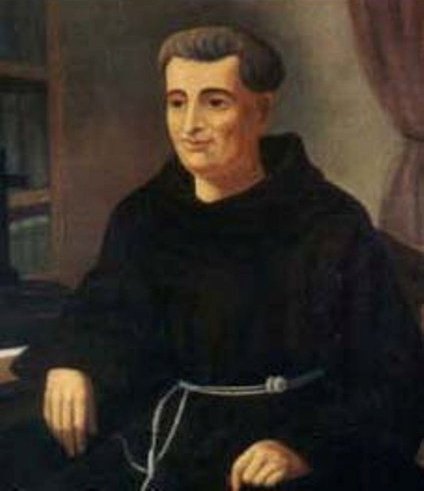
Today, 25 October, the Church in Brazil keeps the memorial of Saint Anthony of Sant’Anna Galvão — to Brazilians, simply Frei Galvão, the first saint born in Brazil. It took him twenty-eight years to build a convent and a church in São Paulo, and he lies buried before the high altar of that same church, where people still come to find him.
Guaratinguetá, 1739
Antônio Galvão de França was born in 1739 at Guaratinguetá, in the Paraíba Valley, into a devout and well-off family. His father, a Portuguese merchant, was a Franciscan tertiary; his mother, Isabel Leite de Barros, bore eleven children and died in 1755. The Holy See records that after her death none of her clothes could be found in the house: she had given them all to the poor.
At thirteen he was sent to the Jesuit seminary of Belém, in the town of Cachoeira, Bahia. As hostility to the Jesuits grew, his father advised him to follow his vocation among the Franciscans instead. On 15 April 1760 he entered the novitiate of the Friary of Saint Bonaventure at Macacu (Rio de Janeiro); he made his solemn profession on 16 April 1761, vowing to defend the Immaculate Conception of Our Lady, a doctrine still disputed at the time; and he was ordained a priest on 11 July 1762. Sent to the Friary of Saint Francis in São Paulo, in 1768 he was appointed preacher, confessor and porter — an important post, notes the Holy See.
“Son and perpetual slave” of Mary
On 9 November 1766, according to the Luz Monastery, Frei Galvão consecrated himself to the Immaculate Virgin as her “son and perpetual slave”, in a document signed with his own blood. Benedict XVI recalled the phrase at the canonisation, and also quoted the note in which he consecrated his chastity: “take my life rather than let me offend your blessed Son, my Lord”. The full text of those documents is not among the sources consulted for this page, so only the passage the Pope quoted is given here.
The Luz: the convent he built
In 1769 and 1770 Frei Galvão was confessor of the Recolhimento of Saint Teresa in São Paulo. There he met Sister Helena Maria of the Holy Spirit, who said she had visions in which Jesus asked her to found a new recolhimento. As her confessor he examined these messages and consulted others, who recognised them as genuine. On 2 February 1774 the Recolhimento of Our Lady of the Conception of Divine Providence was born, today the Luz Monastery.
Helena died on 23 February 1775 and he took charge of the young community. A new governor ordered it closed; the sisters obeyed but did not leave, and pressure from the people and the efforts of the bishop soon had it reopened. Later the friar himself was sent into exile for defending a soldier condemned to death, and the people had that order revoked too. The church was dedicated on 15 August 1802. Frei Galvão wrote the Statutes for the sisters, a guide to the interior life, and died at the Luz on 23 December 1822.
The Luz Monastery was designed and built by Frei Galvão in taipa, the rammed-clay technique that marked colonial building in São Paulo. It is listed by Iphan, Condephaat and Conpresp, and houses the convent of the Conceptionist Sisters, the church of Our Lady of the Luz and, since 1969, the Museum of Sacred Art of São Paulo.
He died before seeing it finished: the two towers of the church were still missing, as a sketch he left on the wall of a cell suggests. In 2008 the regional engineering council (Crea-SP) awarded him an honorary title of engineer and architect, and Brazil regards him as patron of builders.
The pills: an antiphon on paper
The Luz Monastery tells of a young man in great pain from kidney stones who asked Frei Galvão for a blessing. The friar wrote on a slip of paper the verse from the breviary “Post partum, Virgo, inviolata permansisti: Dei Genitrix, intercede pro nobis” and told him to swallow it, rolled up like a pill. The young man did so, trusting in Our Lady, and passed the stones without difficulty. Soon afterwards a man asked for help for his wife, in dangerous labour; Frei Galvão gave him the same paper pills, and she was delivered without trouble. This was the origin of the pills, according to the monastery’s tradition.
Today the Conceptionist Sisters prepare them with prayer, inside the monastery, and give them away free. The chaplain, Fr José Arnaldo, is plain about it: “The pills of Frei Galvão are not medicine like those from the pharmacy. They are, rather, medicine for soul and body for every Christian who has faith”. He also asks that people pray for the doctors who care for the sick. The monastery’s practice is a nine-day novena to the Most Holy Trinity, taking one pill on the first day, another on the fifth and another on the last.
Two cases linked to the pills opened the way to the altars, according to the monastery: the cure of Daniela Cristina da Silva, aged four, of fulminant hepatitis in 1990 (the miracle for beatification, recognised on 6 April 1998), and the birth of Enzo on 11 December 1999 to a mother who had been unable to carry a pregnancy to term (the miracle for canonisation, decree of 16 December 2006).
11 May 2007: the Campo de Marte
Two dates tend to get mixed up. 25 October is the day of his beatification, presided over by John Paul II in Saint Peter’s Square in 1998, and it is the day of his memorial in Brazil. The canonisation took place on Friday 11 May 2007 at the Campo de Marte airfield in São Paulo, presided over by Benedict XVI before some one million two hundred thousand faithful, according to the newspaper O São Paulo. The Pope’s journey to Brazil was for the Fifth General Conference of the Latin American Bishops at Aparecida, a town near the new saint’s birthplace; in his homily Benedict XVI even invoked Our Lady of Aparecida.
The Pope called him “the saint of Guaratinguetá” and greeted the nuns of the Luz, who radiate the spirituality of “the first Brazilian raised to the glory of the altars”.
- Slave of Mary. Devotion to the Immaculate Conception, in which he called himself “son and perpetual slave”, runs through his whole life.
- Adorer of the Eucharist. Benedict XVI described him as a “fervent adorer of the Eucharist”, in a constant attitude of adoration.
- Confessor and peacemaker. “A renowned counsellor, a peacemaker of souls and families”, greatly sought after in the confessional.
- Man of peace and charity. So the Senate Chamber of São Paulo defined him, at the end of the eighteenth century.
“Take my life rather than let me offend your blessed Son, my Lord.”— Frei Galvão, note consecrating his chastity, quoted by Benedict XVI in the homily of 11 May 2007
“Pray that God our Lord may lift sinners with his mighty arm out of the wretched abyss of guilt in which they lie.”— Frei Galvão, as testified by Sister Helena Maria, quoted by Benedict XVI in the same homily
“A man of peace and charity.”— Senate Chamber of São Paulo, late eighteenth century, quoted by Benedict XVI in the same homily
The prayers
The prayer that cannot be missing is the one on the pills: a verse from the Office of Our Lady, traditional and anonymous, which Frei Galvão wrote on the paper. It is not a magic formula but an antiphon: a song of praise to the Mother of God, prayed with the faith of one who asks for her intercession.
Post partum, Virgo, invioláta permansisti: Dei Genítrix, intercéde pro nobis.
After giving birth, O Virgin, you remained inviolate: Mother of God, intercede for us.
— verse of the Office of the Blessed Virgin, as Frei Galvão wrote it
The Luz Monastery also publishes a prayer to the Saint and a novena to the Most Holy Trinity, not reproduced here because they are of recent composition.
Sancte Antoni a Sancta Anna Galvão, ora pro nobis. Saint Anthony of Sant’Anna Galvão, pray for us — and win for us the peace and charity that the people of São Paulo recognised in you.
- Our Lady of Aparecida — the patroness of Brazil, on the 12th.
- Saint Anthony Mary Claret — the missionary of the Word, on the 24th.
- Words of the saints — a growing collection, in English and Portuguese.

Comments