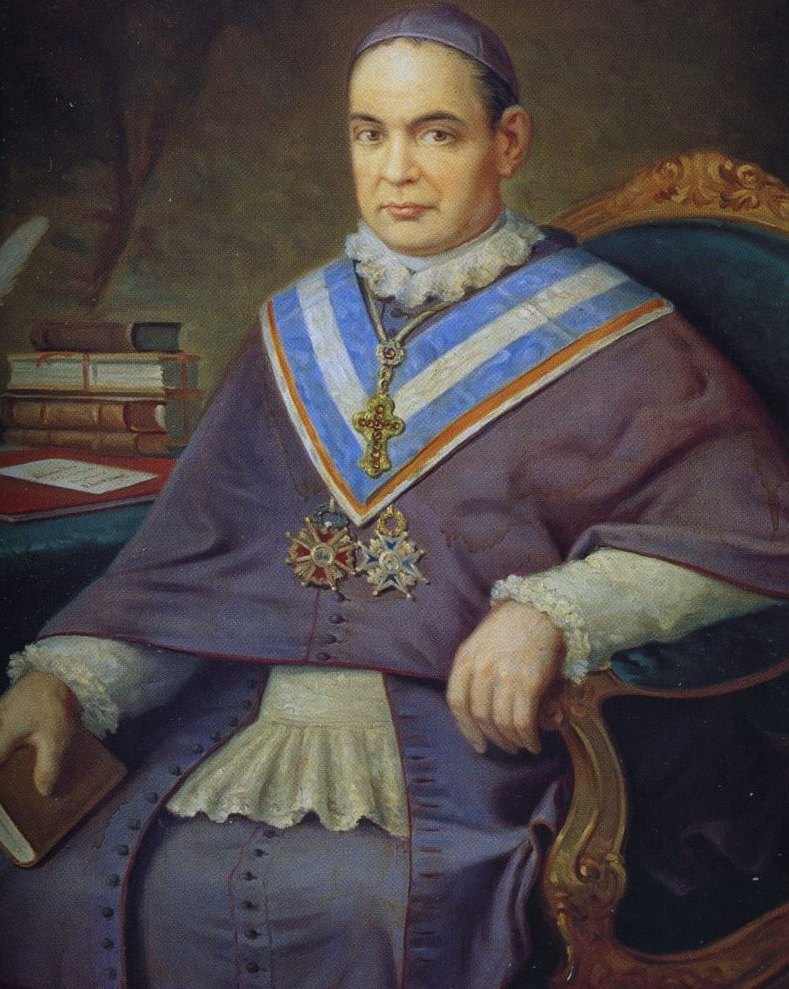
Today, 24 October, the Church keeps Saint Anthony Mary Claret (optional memorial), and his life fits into one scene. On 1 February 1856, at Holguín in Cuba, the Archbishop of Santiago had just preached for an hour and a half and was walking home at night among the crowd when a man came up as though to kiss his ring and slashed his face open with a razor. Claret wrote afterwards that he forgave the attacker “as a Christian, as a priest and as an archbishop” and begged that he be pardoned.
Among the looms
Anthony John Adjutor Claret y Clará was born on 23 December 1807 at Sallent in Catalonia and baptised two days later. His father, Juan, was a weaver and kept a small factory of yarn and cloth; the boy was put to work there, and obeyed, he says, “without saying a word or making a wry face”.
In 1825 he went to Barcelona to improve himself in the textile trade and studied drawing, grammar and French. He was offered the chance to open a factory of his own, but the Gospel shook him (the question of Mt 16:26 about what it profits a man to gain the whole world). He wanted to be a Carthusian, entered the seminary of Vic and was ordained on 13 June 1835 in the bishop’s palace at Solsona. In 1862, writing his Autobiography by order of his superior, he stopped at the factory years to pray: “O my God, how good you have been to me! […] I have been a useless servant, who did not trade as he ought with the talent you had given him. But, Lord, I give you my word that I will work.” (Aut. 35)
The missionary on foot
In 1839 he went to Rome to offer himself to Propaganda Fide. He entered the Jesuit novitiate, but a pain in his leg kept him from walking, and the Superior General, Father Roothaan, sent him back to Spain. From then on he went on foot and poor, with a Bible, a change of clothes and a map in his bundle, preaching popular missions across Catalonia; from February 1848 to May 1849, across the island of Gran Canaria.
On 16 July 1849, in a cell of the seminary of Vic, he founded with five other priests the Missionary Sons of the Immaculate Heart of Mary, the Claretians. Years later he summed up in one sentence what he expected of each of them: a man “who burns with charity and sets ablaze wherever he goes” (Aut. 494).
The archbishop of Cuba
On 11 August 1849 he learned that he had been named Archbishop of Santiago de Cuba. He resisted, and accepted out of obedience. He was consecrated at Vic on 6 October 1850 and reached Santiago on 16 February 1851. In six years he visited the huge diocese three times, fought against slavery, founded a savings bank and a farm school for poor children, and in the cholera epidemic of 1852 went about the hospitals hearing the sick.
Back to Holguín. Claret tells how the cut ran from forehead to chin, and how the doctors, seeing a prelate covered in blood, were so shaken that he had to encourage them. The attacker was sentenced to death; Claret begged for a pardon and offered to pay his passage home to the Canaries, so that the angry crowd would not lynch him.
Claret lists three “wonders” of that healing (Aut. 579–581): a fistula that closed all at once; the scar on his right arm, which took the form of a relief image of Our Lady of Sorrows, white and purple, visible for the first two years and then faded; and the idea of an association of writers, which came to him in bed and whose rules he began to write as soon as he got up.
The first two rest on his word alone. The third can be checked: the Academy of Saint Michael was founded in 1858.
The book, the Court and Fontfroide
Claret knew that not everyone goes to church. With two priest friends, José Caixal and Antonio Palau, he founded in Barcelona, at the end of the 1840s, the Religious Library, under the protection of Our Lady of Montserrat and Saint Michael. According to the Claretians, in its first eighteen years it issued more than nine million copies of books, booklets and leaflets. He himself wrote more than a hundred works, among them the popular prayer book The Straight Way (Camino recto).
In 1857 Queen Isabella II chose him as her confessor, and he went to Madrid. He lived poorly and visited prisons and hospitals. In 1868 revolution overthrew the queen and he went with her into exile; in 1869 he went to Rome for the First Vatican Council, where on 31 May 1870 he spoke in favour of the definition of papal infallibility.
Hunted, he took refuge on 6 August 1870 in the Cistercian abbey of Fontfroide, near Narbonne, and there he died on 24 October 1870, at 8:45 in the morning, aged sixty-two. On his gravestone they carved: “I loved justice and hated iniquity; therefore I die in exile.” He was beatified by Pius XI on 25 February 1934 and canonised by Pius XII on 7 May 1950; the next day Pius XII called him “small of body, but of gigantic spirit”.
- Caritas Christi urget nos. The motto of his episcopal shield is from Paul (2 Cor 5:14), and he lived it: “Charity urges me”, he wrote.
- The Word, on foot. Missions, retreats, confessions; no money for preaching.
- The book. “The book will go to his house”: that is why he founded a publishing house.
- Mary. A son of the Immaculate Heart of Mary, he said at the start of every mission the prayer given below.
“A Son of the Immaculate Heart of Mary is a man who burns with charity and sets ablaze wherever he goes; […] Nothing frightens him; he rejoices in privations; he undertakes labours; he embraces sacrifices.”— Saint Anthony Mary Claret, Autobiography, no. 494 (1862)
“Not everyone can go to church to hear the word of God, but the book will go to his house.”— Saint Anthony Mary Claret, Autobiography, no. 310 (1862)
“Charity urges me, drives me on, makes me walk, makes me run from town to town, compels me to cry out.”— Saint Anthony Mary Claret, Autobiography, no. 212 (1862)
The prayers
This is the prayer Claret said at the start of every mission, as he left it in the Autobiography. He sees himself as an arrow in Mary’s hand; the weapons are the Rosary and the word of God.
¡Oh Virgen y Madre de Dios, Madre y abogada de los pobres e infelices pecadores! Bien sabéis que soy hijo y ministro vuestro, formado por Vos misma en la fragua de vuestra misericordia y amor. Yo soy como una saeta puesta en vuestra mano poderosa; arrojadme, madre mía, con toda la fuerza de vuestro brazo contra el impío, sacrílego y cruel Acab, casado con la vil Jezabel. Quiero decir: arrojadme contra Satanás, príncipe de este mundo, quien tiene hecha alianza con la carne.
A Vos, Madre mía, sea la victoria. Vos venceréis. Sí, Vos que tenéis el poder para acabar con todas las herejías, errores y vicios. Y yo, confiado en vuestra poderosísima protección, emprendo la batalla, no sólo contra la carne y sangre, sino contra los príncipes de las tinieblas, como dice el Apóstol, embrazando el escudo del Santísimo Rosario y armado con la espada de dos filos de la divina palabra.
O Virgin and Mother of God, Mother and advocate of poor and unhappy sinners! You know well that I am your son and minister, formed by yourself in the forge of your mercy and love. I am like an arrow set in your mighty hand; hurl me, my Mother, with all the strength of your arm against the impious, sacrilegious and cruel Ahab, wedded to the vile Jezebel. I mean: hurl me against Satan, prince of this world, who has made an alliance with the flesh.
To you, my Mother, be the victory. You will conquer. Yes, you who have the power to put an end to all heresies, errors and vices. And I, trusting in your most powerful protection, begin the battle, not only against flesh and blood, but against the princes of darkness, as the Apostle says, bearing the shield of the Most Holy Rosary and armed with the two-edged sword of the divine word.
— Saint Anthony Mary Claret, Autobiography, nos. 270–271
And this is the Collect of today’s Mass:
Deus, qui in evangelizándis pópulis beátum Antónium Maríam epíscopum mira caritáte et patiéntia roborásti, eius nobis intercessióne concéde, ut, quae tua sunt quaeréntes, enixe in Christo lucrándis fratribus incumbámus.
O God, who in the evangelising of peoples strengthened Saint Anthony Mary, bishop, with wonderful charity and patience, grant us, through his intercession, that, seeking the things that are yours, we may strive earnestly to win our brothers and sisters for Christ.
Amen.
Sancte Antoni Maria Claret, ora pro nobis. Saint Anthony Mary Claret, pray for us.
- Saint John Paul II — “Be not afraid!”, on the 22nd.
- Saint Luke — the evangelist, on the 18th.
- Words of the saints — a growing collection, in English and Portuguese.

Comments