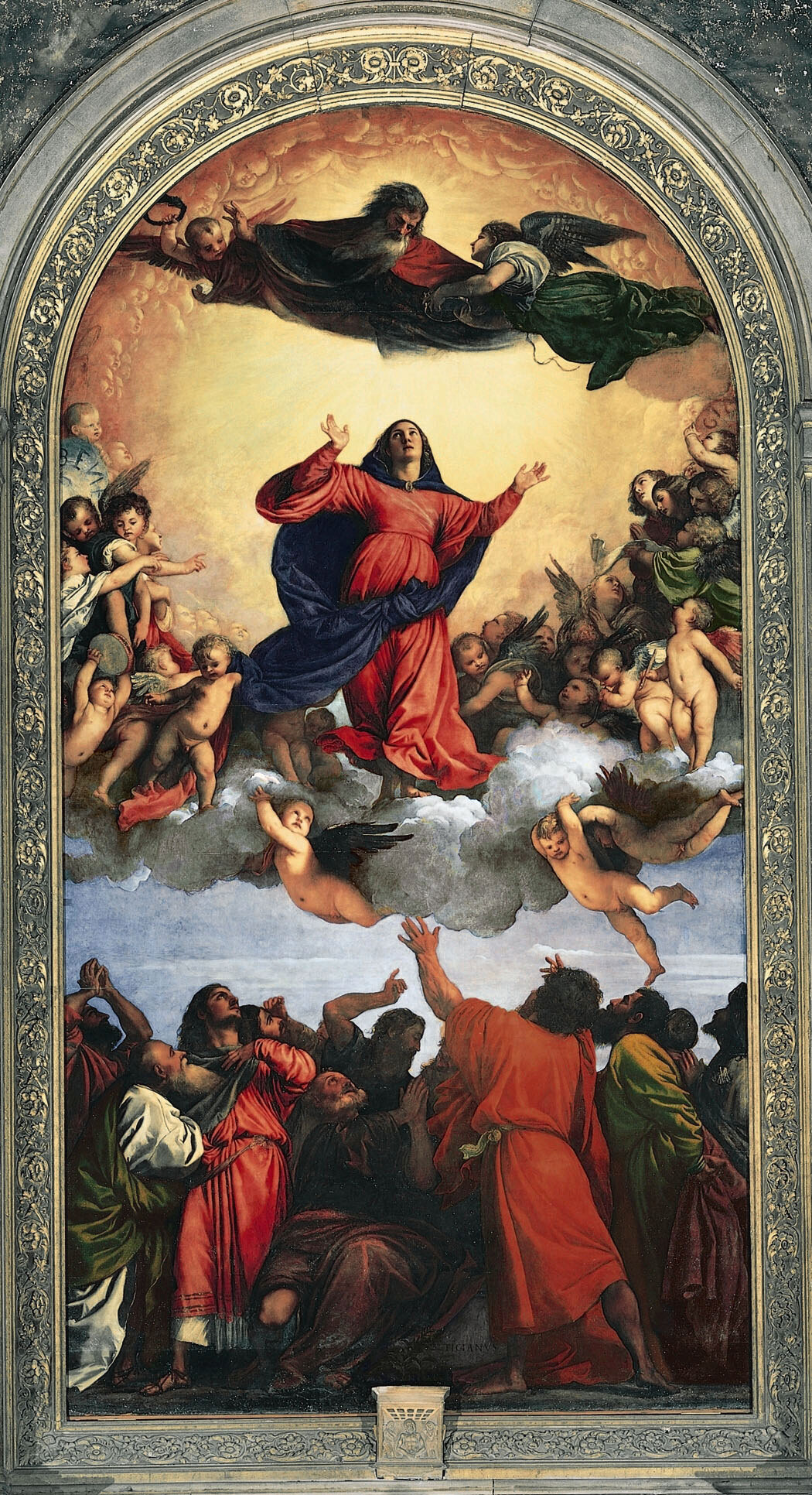
The early Church was obsessive about bones. It fought over relics, divided the remains of martyrs between rival cities, and built whole basilicas over a verified tomb. Rome had Peter and Paul; Ephesus quarrelled over John; a martyr’s finger was enough to found a pilgrimage. In that world there is a silence nobody has explained: no city, anywhere, ever claimed the body of Mary. There is no tomb. There never was.
The silence nobody broke
It is worth measuring the size of that absence. Jerusalem still shows the place where she is said to have fallen asleep, in the Kidron valley. Ephesus shows the house where she is said to have lived with John. The two cities argued about it for centuries.
But notice what neither of them argued over: the relics. In a Christendom capable of going to war over a lock of hair, nobody ever claimed to hold the body of the mother of Christ — and not for want of commercial or devotional interest, which was enormous.
There is an old scene that records exactly this embarrassment. Around the time of the Council of Chalcedon, in 451, the empress Pulcheria is said to have asked bishop Juvenal of Jerusalem to send her Mary’s relics for a church in Constantinople. The answer tradition preserves is that the sepulchre had been opened and found empty, with the cloths folded — and that this was all that could be sent.
Before any dogma, before any theological argument, the datum is this: the body left the historical record without anyone needing to explain why.
A feast far older than the dogma
Many people assume the Assumption is a recent invention because the definition is from 1950. The opposite is true: the definition arrived fifteen centuries late.
- Fifth century — a feast of the Dormition of Mary is already kept at Jerusalem.
- Around the year 600 — the emperor Maurice fixes the date at 15 August for the whole empire. The date the Church uses today is fourteen hundred years old.
- Eighth century — Saint John Damascene preaches on it at Jerusalem as something received and settled, not as news.
- East and West together — Orthodox and Catholics keep the same feast on the same day, which is rare enough to mean the thing predates the split between them.
In other words: Christian people celebrated this for a millennium and a half before anyone put it on paper in legal language.
1950: the only time
On 1 November 1950, with the apostolic constitution Munificentissimus Deus, Pius XII defined the dogma. And here is the fact almost nobody knows:
Since the First Vatican Council defined papal infallibility in 1870, a pope has used that extraordinary power exactly once in history. This was it.
Munificentissimus Deus — 1 November 1950A hundred and fifty-five years of defined infallibility, and one exercise of it. Worth remembering next time somebody says the pope “speaks infallibly” at will.
Nor was it decided in an office. In 1946 Pius XII did something without precedent: he wrote to every bishop in the world asking whether they judged the doctrine could be defined and whether their people desired it. 1,181 of 1,191 answered. A dogma preceded by a census.
The defined formula is surgical: Mary, “having completed the course of her earthly life”, was assumed body and soul into heavenly glory.
Notice what is missing. The dogma does not say whether she died. The phrase was chosen with care to leave the question open — the East speaks of the Dormition, part of the Western tradition holds a real death followed by resurrection, and Pius XII decided to shut the door on neither.
It is a rare and useful example of how the Church defines: she states what she knows and keeps quiet where she is not certain, even when keeping quiet is more trouble than stating.
Why it was fitting
The theology fits in one sentence, and Pius XII repeats it: the corruption of the tomb was not fitting for that body. The argument unfolds in three, and all three are about flesh, not privilege.
- She is the new Eve. If death and decay entered through sin, and she was preserved from sin from her conception, there was no handle by which corruption could take hold of her.
- That body gave flesh to God. Christ’s flesh was taken from hers; the body that carried, fed and buried the Son was not going to rot in a hole while the Son reigned.
- She is the first instance of what was promised to everyone. And this is the point that moves the whole subject: the Assumption is not an exception granted to one person. It is the first execution of the promise the Creed makes to you — the resurrection of the body. She got there first. The rest of the queue is ours.
The woman clothed with the sun
The liturgy of the day reads the Apocalypse: “A great sign appeared in heaven: a woman clothed with the sun, and the moon under her feet, and on her head a crown of twelve stars” (Rev 12:1).
The text has several layers — it is Israel, it is the Church, it is Mary — and the Church has never picked only one. But notice the physical detail: the woman has the moon under her feet. She stands above the thing that waxes, wanes and disappears. It is the exact image of a human body placed beyond the reach of corruption.
1950, five years after
One last thing, and it is about the date.
The dogma of the assumed body was defined in 1950 — five years after the end of a war that industrialised the destruction of human bodies. Five years after the gas chambers, the ovens, the mass graves, and two cities erased in two flashes. The century that had just finished treating the human body as disposable material on an unprecedented scale heard the Church declare, solemnly and once only, that one human body had been taken whole into God.
And there is a coincidence that is no coincidence at all. On 15 August 1945, the feast of the Assumption, the body of Maximilian Kolbe was burned in the crematorium at Auschwitz, the day after his death. Nothing of him was left to bury.
Five years later, on precisely that feast, the Church defined that human flesh has a destination. It is the most direct answer she knew how to give, and it is not a sentimental one: it is a statement about matter. What was burned, what was buried without a name, what was treated as refuse — has a future, and the first case is already settled.
A week that ends in a crown
If the 15th is the arrival, 22 August is what happens after it: the Queenship of Our Lady, placed exactly an octave later so that nobody reads them apart. First she is taken up; then she is crowned. It is one scene in two movements.
Assumpta est Maria in caelum: gaudent angeli. Mary is taken up into heaven: the angels rejoice. And we with them — because what happened to her is the sample of what was promised to us.
- The Queenship of Our Lady — the crown, an octave later.
- Saint Maximilian Kolbe — cremated on a 15th of August.
- Consecration to Our Lady — giving yourself to the one who has already arrived.
- Words of the saints — a growing collection, in English and Portuguese.

Comments